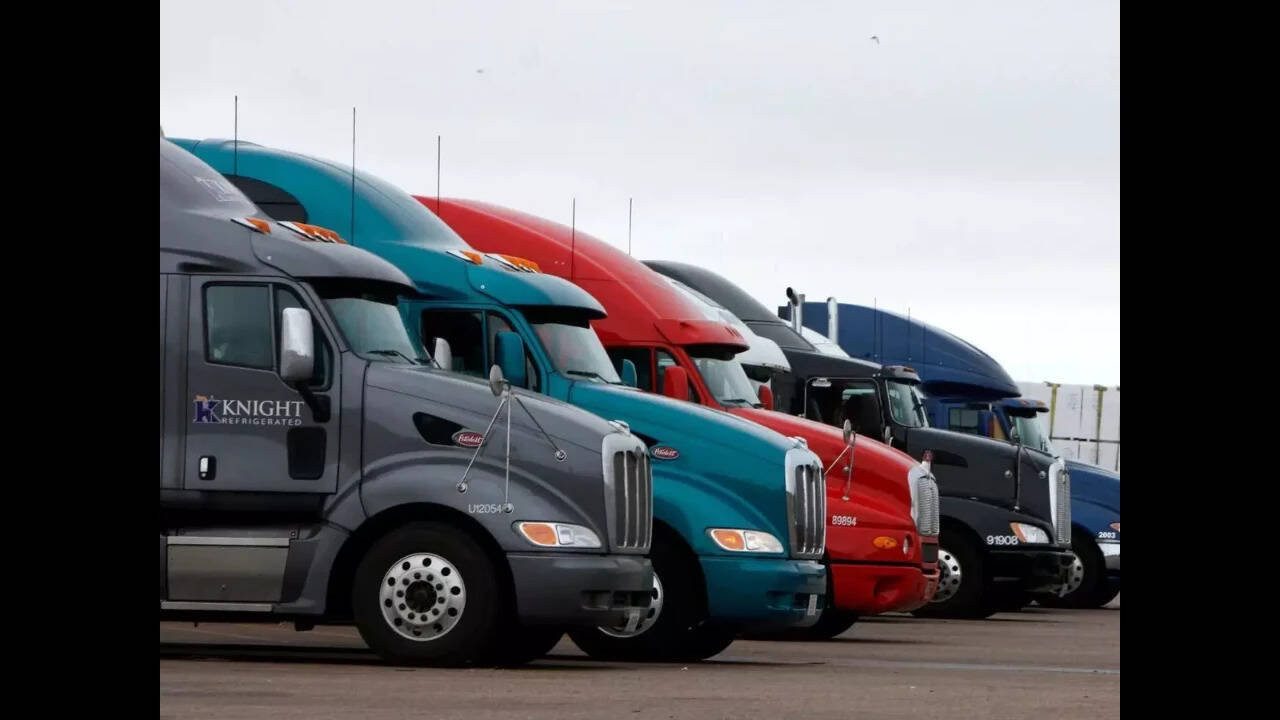
The arrest of 11 Indian nationals operating commercial motor vehicles (CMVs) in the United States without legal residency exposes a systemic failure in the intersection of Department of Transportation (DOT) compliance and federal immigration enforcement. While the arrests highlight individual criminality, the true analytical focus must remain on the Commercial Driver’s License (CDL) Procurement Loophole. This vulnerability allows individuals with non-compliant immigration status to bypass the Systematic Alien Verification for Entitlements (SAVE) program, effectively infiltrating the backbone of the North American supply chain.
The Anatomy of the Licensing Breach
To understand how 11 individuals gained the credentials to operate 80,000-pound vehicles, one must examine the friction between state-level Department of Motor Vehicles (DMV) protocols and federal oversight. A CDL is not merely a permit; it is a federalized credential governed by the Federal Motor Carrier Safety Administration (FMCSA). The breach occurs at three distinct failure points:
- Identity Shifting and Document Forgery: The primary mechanism involves the use of fraudulent social security numbers or the "recycling" of legitimate identities. In many jurisdictions, the verification of "Lawful Presence" relies on manual checks of I-94 forms or employment authorization documents (EADs), which are susceptible to high-quality counterfeiting.
- Domicile Fraud: Federal regulations require a driver to have a "Permanent Legal Presence" in the state of licensure. The suspects likely utilized "CDL Mills"—third-party training providers that provide a physical address for out-of-state or undocumented applicants to establish a false residency.
- Third-Party Testing Vulnerabilities: Many states outsource the skills test to private entities. When these entities prioritize volume over integrity, the rigorous standards intended to filter out unqualified or unauthorized drivers collapse.
The Logistics Cost Function of Illegal Labor
The presence of unauthorized drivers in the trucking sector is rarely an isolated occurrence of "identity theft." It is often a byproduct of the Logistics Arbitrage Model. Carriers facing thin margins and high insurance premiums frequently turn to "1099" contracting models to offload liability.
In this economic framework, the cost of labor ($L$) is influenced by the probability of enforcement ($P$) and the potential fine ($F$). For a predatory carrier, the equation is $L_{illegal} < L_{market} - (P \times F)$. Because the probability of a roadside ramp-check discovering immigration status is statistically low—inspectors primarily focus on Hours of Service (HOS) and mechanical safety—the perceived risk remains negligible compared to the 30% savings on payroll taxes and benefits.
The National Security and Safety Implication
The risk profile of an unauthorized driver extends beyond their legal status. In the context of the 11 arrests, the primary hazard is the Lack of Verifiable Safety History. Under the FMCSA Clearinghouse, every CDL holder’s drug and alcohol violations are tracked. However, a driver operating under a fraudulent identity exists outside this database.
- Data Blind Spots: There is no mechanism to track the prior driving history of a non-resident who has circumvented the SAVE system. This creates a "phantom driver" who may have a history of reckless operation in other jurisdictions or under different aliases.
- Insurance Indemnity Failure: In the event of a catastrophic collision, any insurance policy held by the carrier becomes void upon the discovery of unlicensed or fraudulently licensed operators. This shifts the financial burden of the accident directly onto the public and the victims, as the "fly-by-night" carrier typically declares bankruptcy to avoid civil judgments.
Technical Failures in the SAVE Program Integration
The SAVE program is designed to prevent non-citizens from accessing government benefits, including professional licenses. The failure of this system in the recent arrests suggests a Latency Gap in database synchronization.
When a DMV queries the SAVE system, the response is often dependent on the "Status Verification" level. If a driver presents a visa that was recently revoked or expired, the DMV system may still show a "Pending" or "Valid" status due to the asynchronous nature of USCIS data updates. This creates a window of opportunity—the Enforcement Lag Time—where an individual can secure a 5-year or 8-year credential based on a temporary or fraudulent status.
Structural Incentives for Carrier Complicity
The 11 drivers were likely not independent operators; they were almost certainly part of a fleet. Analysis of the carrier's role reveals a pattern of Willful Blindness. Under the Federal Motor Carrier Safety Regulations (FMCSR) Part 391, a carrier is required to maintain a Driver Qualification (DQ) file. This file must include:
- A valid medical examiner's certificate.
- An annual MVR (Motor Vehicle Record) check.
- A completed employment application detailing the last 10 years of history.
If 11 drivers in a single network were unauthorized, the carrier’s safety management system is fundamentally compromised. The carrier likely bypassed the Employment Eligibility Verification (I-9) process, utilizing "labor brokers" to distance themselves from the legal consequences of hiring unauthorized personnel. This creates a tiered liability structure where the broker takes the risk, and the carrier reaps the operational capacity.
The Failure of Roadside Enforcement
The arrest of these individuals occurred during a specific enforcement action, which highlights the inadequacy of standard inspections. Roadside inspectors are trained in the North American Standard Inspection Program. Their primary tools are the ELD (Electronic Logging Device) and the CDLIS (Commercial Driver’s License Information System).
Standard checks verify that a license is "Active," but they do not typically cross-reference the driver’s identity with federal immigration databases. This separation of powers—where local/state DOT officers lack the authority or the real-time tools to check federal residency status—ensures that thousands of unauthorized drivers remain "compliant" on paper while being illegal in status.
The Strategic Response: Biometric and Real-Time Integration
To mitigate the recurrence of this breach, the federal government must pivot from document-based verification to Biometric Credentialing. The current reliance on plastic cards and social security numbers is an antiquated defense against modern forgery.
- Mandatory Biometric CDL (B-CDL): Transitioning to a system where the CDL is linked to a fingerprint or iris scan at the point of issuance. This would prevent "identity hopping" where one driver uses multiple licenses from different states.
- Automated SAVE Triggers: Integrating the FMCSA Clearinghouse directly with USCIS databases. If a driver’s work authorization is revoked, their CDL status should automatically move to "Prohibited" in the federal system, triggering an immediate notification to the employer.
- Strict Liability for Carriers: Amending the FMCSR to hold carriers criminally liable for the "Knowing Use" of unauthorized drivers, with penalties including the permanent revocation of DOT operating authority (the "Death Penalty" for trucking companies).
The logistics industry operates on the principle of the "Last Mile," but the regulatory oversight is currently failing at the "First Mile"—the point of licensure. Until the licensing process moves toward a zero-trust architecture, the supply chain remains a porous entry point for unauthorized labor and untraceable safety risks.
Carriers must now audit their DQ files with the same rigor as an IRS investigation, or risk being dismantled by the next wave of federal enforcement actions targeting the "shadow" trucking workforce.
Would you like me to analyze the specific state-level CDL issuance policies that have the highest rates of SAVE program bypass?