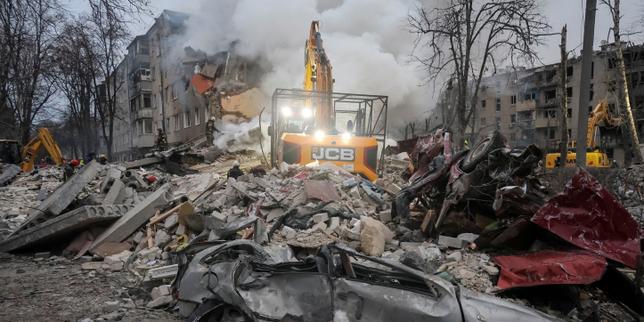
The war in Ukraine just hit another grim milestone in the Russian-occupied territories of Zaporizhzhia. A drone strike recently tore through a civilian area, leaving one person dead and more than ten others wounded. While headlines often focus on the front lines or the high-level politics in Kyiv and Moscow, this specific incident highlights the terrifying, unpredictable nature of life for those caught in the middle of occupied zones. It isn't just a statistic. It’s a reflection of how the "rear" areas of this conflict are becoming increasingly indistinguishable from the active trenches.
Local officials in the Russian-installed administration were quick to point the finger at a Ukrainian drone. According to their reports, the strike hit a high-traffic area, causing immediate casualties and significant damage to surrounding infrastructure. For the people living in Zaporizhzhia, the sound of an approaching motor isn't just noise anymore. It’s a signal to dive for cover.
Why the Zaporizhzhia Region is the War's Most Dangerous Chessboard
Zaporizhzhia sits at the heart of the conflict for several reasons, and none of them are good for the people living there. You've got the largest nuclear power plant in Europe nearby, a constant tug-of-war over logistics hubs, and a civilian population that has been living under occupation for over two years. When a drone hits a town here, it’s rarely just about the immediate target. It’s about control, disruption, and the psychological weight of the occupation itself.
Military analysts often talk about "deep strikes" as a way to soften logistics. But when those strikes happen in urban centers under Russian control, the line between military necessity and civilian tragedy gets incredibly thin. The Ukrainian military generally doesn't comment on specific tactical strikes inside occupied zones, maintaining a policy of "operational silence." However, the frequency of these incidents suggests a shift in strategy. They’re looking to make the occupation untenable, even if it means high-risk operations in populated areas.
The Human Cost of Tactical Drones
Let's talk about what happens when a drone actually hits. We aren't talking about the massive Bayraktars from the start of the war. Most of what's flying now are smaller, often FPV (First Person View) drones or modified commercial quads. They’re cheap. They’re everywhere. And they’re terrifyingly precise—until they aren't.
In this latest Zaporizhzhia attack, the reports of over ten wounded suggest the blast occurred in a space where people were simply trying to go about their day. In occupied cities like Melitopol or Enerhodar, "normal life" is a fragile facade. You go to the market, you check the news on Telegram, and you try not to look the armed soldiers in the eye. Then, out of nowhere, the sky explodes.
The medical infrastructure in these occupied zones is already under immense strain. Russian military hospitals often take priority, leaving civilian facilities understaffed and low on supplies. When ten people get sprayed with shrapnel at once, the local response capacity is pushed to its limit. It’s a chaotic, bloody mess that rarely gets fully captured in a three-sentence news brief.
Moscow's Narrative vs the Ground Reality
Russia uses these strikes to bolster its narrative that Ukraine is "terrorizing" its own people who are now under Russian protection. It's a powerful propaganda tool. They show the broken glass, the blood on the pavement, and the grieving families to justify their continued presence.
But there’s another side to this. Many residents in the occupied south see these strikes as a brutal necessity of liberation. It’s a horrific paradox. To get the occupiers out, the infrastructure they use—and the areas they inhabit—become targets. Honestly, it’s a situation where there are no "clean" hands and certainly no easy answers. The civilian death toll in Zaporizhzhia keeps climbing because the region is the literal gateway to the south. If Ukraine wants to reach the Sea of Azov, they have to go through here.
Electronic Warfare and the Failure to Protect
One thing people often ask is why these drones aren't just shot down. Russia has some of the most advanced Electronic Warfare (EW) suites in the world. They talk a big game about their "S-400" systems and "Pantsir" batteries. Yet, a relatively simple drone managed to fly into a sensitive zone and cause a dozen casualties.
This tells us two things. First, drone technology is evolving faster than the defenses meant to stop them. Small, low-flying drones are hard to pick up on traditional radar. Second, the "security" promised by an occupying force is often an illusion. If they can’t stop a single drone from hitting a street corner, they aren't as in control as they claim to be.
The Long Road Ahead for Zaporizhzhia
This strike won't be the last. As the weather shifts and both sides look for an opening, the use of unmanned systems will only increase. For the survivors of the Zaporizhzhia strike, the physical wounds might heal, but the constant anxiety of the "buzz" overhead stays.
If you're following this conflict, stop looking at it as a map with red and blue lines. Start looking at the centers of these occupied cities. That's where the real friction is. Every drone that hits a target in the occupied south shifts the political landscape in Kyiv and Moscow, but it’s the locals who pay the bill in blood.
Stay informed by cross-referencing reports from both the International Atomic Energy Agency (IAEA) regarding the nearby plant and independent monitoring groups like the Institute for the Study of War. Don't take a single Telegram post as gospel. The truth in Zaporizhzhia is usually buried under layers of rubble and state-sponsored messaging. Watch the movements around the logistics hubs in the coming weeks; that’s where the next flashpoint is likely to ignite.