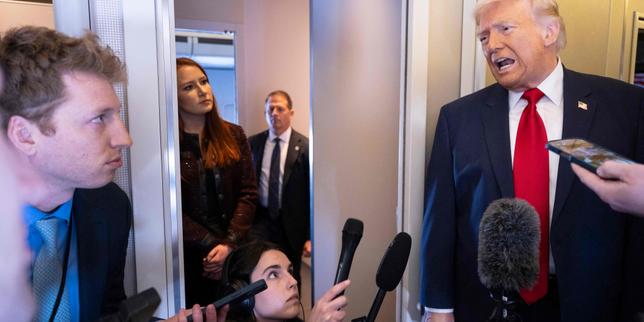
Aboard Air Force One, high above the Atlantic, President Donald Trump recently laid out the endgame for a conflict that has moved far beyond "maximum pressure." Speaking to reporters on March 7, 2026, the President confirmed that while the current strategy remains focused on air and sea dominance, the deployment of American ground troops is no longer a rhetorical impossibility. "There would have to be a very good reason," Trump remarked, before adding that any Iranian resistance would be so "decimated" by that point that a ground campaign would face little more than a hollowed-out husk of a nation. This isn't just a threat; it is the verbalization of a new military reality where the White House believes it has already broken the back of the Islamic Republic.
The core premise of the current conflict, dubbed Operation Epic Fury, is the systematic liquidation of Iran’s strategic assets. From the killing of Supreme Leader Ali Khamenei in the opening salvos on February 28 to the destruction of the Iranian Navy, the administration's goal is strategic submission. While the President’s comments on Air Force One suggested that ground troops are "something we could do later on," the logistical and political hurdles remain massive. The United States currently lacks the massive ground presence required for a full-scale occupation, focusing instead on a high-tech "decapitation" strategy that utilizes MQ-9 Reaper drones and Tomahawk missiles to dismantle the regime from 30,000 feet.
The Logic of Strategic Submission
The White House is operating on the belief that 47 years of adversarial history can be resolved through sheer kinetic force. The objective is not a traditional regime change involving boots on every street corner in Tehran. Instead, the administration is betting on a "break-glass" scenario where the degradation of the IRGC and the Ministry of Intelligence (MoIS) becomes so severe that the Iranian people, or what remains of the security forces, take the final step themselves.
This strategy relies on three pillars:
- Total Air Supremacy: US and Israeli jets are currently operating with near-total impunity over Iranian cities, having neutralized the aging S-300 and local air defense networks in the first 72 hours.
- Economic Isolation: A proposed 25% tariff on any nation trading with Tehran aims to turn the Iranian economy into a closed loop of failure.
- Encouraged Defection: Trump’s public calls for the IRGC to "lay down their arms" for total immunity is a psychological operation intended to crack the regime’s internal cohesion before a single U.S. soldier has to cross the border.
The Ground Troop Paradox
Despite the President's "decimation" rhetoric, the Pentagon’s current posture in the Middle East is heavily weighted toward air and sea power. Analysts from the Center for Strategic and International Studies (CSIS) point out that the current force level—comprising roughly 50,000 troops and 13 Navy destroyers—is optimized for punitive strikes, not a ground invasion. To secure nuclear sites like Natanz or Fordow, which are buried deep underground and likely shielded from even the heaviest "bunker busters," the U.S. would need specialized ground units and a massive logistical tail that is not yet visible on the horizon.
The President's refusal to rule out ground troops serves a dual purpose. It keeps Tehran’s interim leadership, now coalescing around Ali Larijani, in a state of constant paranoia, and it signals to domestic voters that the administration is "playing for keeps." However, the reality of "securing the uranium" is a messy, high-risk endeavor. Ground operations in the Iranian interior would mean navigating a nightmare of urban warfare and mountainous terrain against a population that, while largely disillusioned with the mullahs, may not view a foreign occupation as a "liberation."
Historical Context of the 47 Year Conflict
The administration views this as the final chapter of the 1979 Revolution. By framing the conflict as a definitive resolution to a half-century of tension, the White House is attempting to bypass the "forever war" fatigue that has plagued American foreign policy for decades. The logic is simple: if the regime is "decimated" from the air, the ground war becomes a mop-up operation rather than a slog.
The Global Cost of a Decimated Iran
While the White House celebrates the "annihilation" of the Iranian Navy, the collateral damage is radiating through the global economy. Major shipping operators are once again rerouting away from the Persian Gulf as Tehran retaliates with sporadic drone strikes on regional energy infrastructure in the UAE and Qatar. The "decimation" of Iran’s military doesn't mean the elimination of its ability to cause chaos. Even a broken regime can launch a "Plan B" that involves asymmetric attacks on water desalination plants and oil terminals across the Gulf.
The tension between the U.S. and its "once Great Ally," the United Kingdom, also underscores the isolationist streak in the Trump doctrine. The President’s recent criticism of Keir Starmer for not providing immediate support for the strikes illustrates a "with us or against us" mentality that leaves little room for traditional diplomacy. The U.S. is no longer looking for a coalition; it is looking for a victory.
The Nuclear Brinkmanship
The primary driver for the current escalation was the failure of the February 2026 talks. The U.S. demand for an immediate end to all enrichment and the dismantling of the ballistic missile program proved to be a bridge too far for Tehran. With the IAEA unable to verify the state of Iran's nuclear stockpiles, the administration chose the path of preventive war. The President's mention of "securing the uranium" suggests that if the air strikes failed to destroy the fissile material, the "very good reason" for ground troops may be closer than the public realizes.
The math is brutal. If the U.S. cannot confirm the destruction of the nuclear program via satellite imagery, the logic of "maximum pressure" dictates that someone has to go in and check. Whether that someone is a Special Operations team or a larger division of Marines depends entirely on the level of "decimation" achieved in the coming weeks.
The conflict has reached a point where "too late" is the operating phrase. Negotiations have been replaced by a war of attrition where the only acceptable outcome for Washington is the total strategic neutering of the Iranian state. As the President prepares for his "Shield of the Americas" summit, his eyes remain on the Middle East, waiting to see if the regime in Tehran will crumble under the weight of its own obsolescence or force a ground confrontation that could redefine the region for the next century.
Would you like me to analyze the specific troop movements of the U.S. 5th Fleet in the Persian Gulf to see if they align with a potential ground intervention?