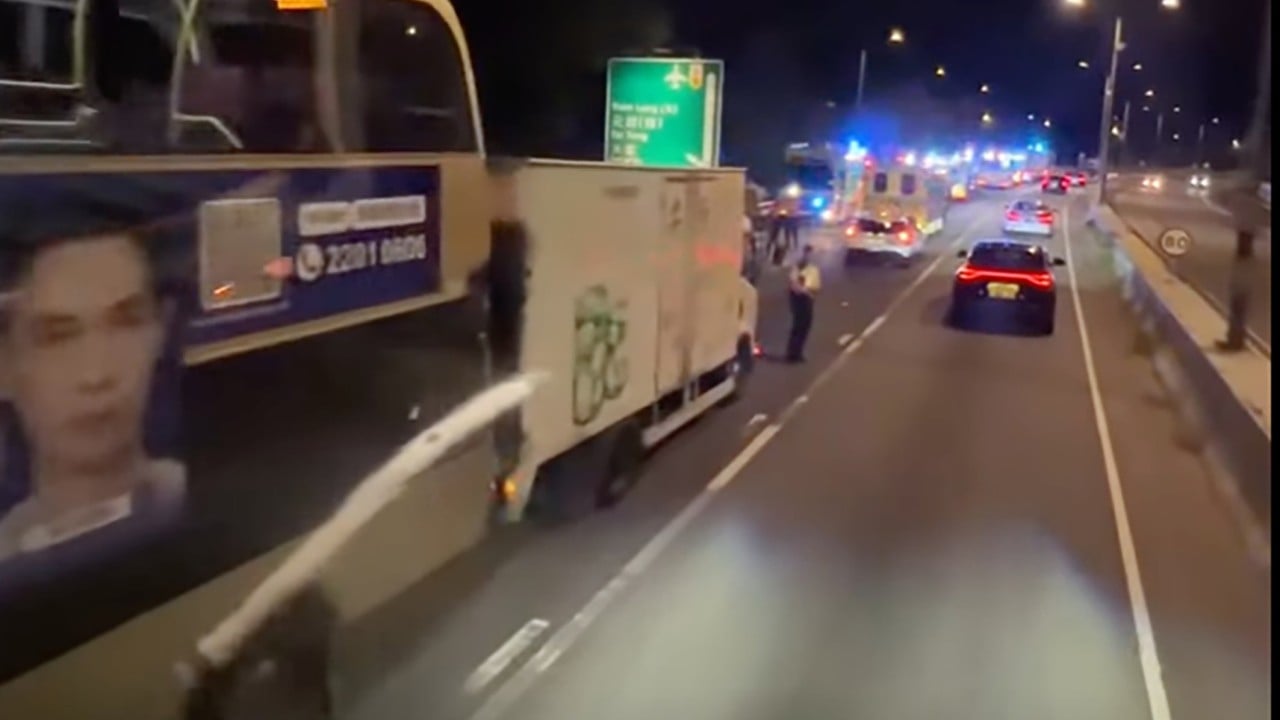
The metal crunching against metal on the Yuen Long Highway wasn't just another traffic delay. It was a massive failure of road safety that sent 21 people to the hospital. When a coach, two taxis, and a truck collide in a chain reaction, it's not just "bad luck." It's a symptom of how dangerous Hong Kong's rapid transit corridors have become during peak hours. You see these headlines and think it's a one-off. It isn't.
This specific pile-up happened near Pok Oi Interchange. That's a notorious bottleneck. If you've driven it, you know the feeling. One second you're cruising at 70km/h, and the next, the brake lights in front of you are screaming. On this particular morning, the impact was severe enough to trap passengers and leave a trail of glass and twisted frames across multiple lanes.
The chaos started around 9:00 AM. That's the heart of the morning rush when everyone is impatient. Reports indicate a medium goods vehicle slowed down, and the vehicles behind—including a coach packed with commuters—couldn't react in time. The result was a mess of 21 injured souls, ranging from minor cuts to more serious trauma that required immediate spinal immobilization on the asphalt.
The Anatomy of a Four-Vehicle Chain Reaction
Most people don't understand the physics of a multi-vehicle crash. It's a transfer of kinetic energy that doesn't stop with the first hit. In the Yuen Long Highway incident, the heavy goods vehicle acted like a wall. When the following coach slammed into the back of the smaller vehicles, the taxis were essentially the meat in a metal sandwich.
Heavy vehicles like coaches and trucks have much longer braking distances. If a driver is tailgating or even slightly distracted by a phone or a radio, they’ve already lost the chance to stop. We're talking about tons of steel moving at high speeds. In this case, the Fire Services Department had to deploy multiple ambulances and a Mobile Casualty Treatment Centre. That’s a heavy-duty response usually reserved for major disasters.
The victims weren't just drivers. Most of the 21 injured were passengers on the coach. They were just trying to get to work. Instead, they ended up on stretchers. It's a stark reminder that even if you're a perfect driver, you're at the mercy of the person behind you.
Why the Pok Oi Interchange is a Death Trap
If we're being honest, the infrastructure in New Territories West is struggling to keep up. The Yuen Long Highway serves as a primary artery connecting Tuen Mun, Yuen Long, and the rest of the city. As more housing estates pop up in Hung Shui Kiu and northern Yuen Long, the volume of traffic has exploded.
The Pok Oi Interchange is where it all goes wrong. You have merging traffic from the San Tin Highway and the Yuen Long Highway meeting local traffic. It’s a recipe for sudden stops. When you combine high-speed limits with complex merging patterns, accidents aren't a possibility—they're a mathematical certainty.
I've seen drivers cut across three lanes last minute to catch an exit. It's reckless. But the road design doesn't help. The signage is often too late, and the slip roads are too short for the current volume of heavy logistics vehicles.
The Human Cost and the Emergency Response
Watching the footage from the scene was sobering. You had elderly passengers sitting on the road divider, holding bloody tissues to their heads. The triage process in Hong Kong is efficient, but it’s still a traumatic experience for everyone involved.
The 21 injured were sent to Pok Oi Hospital, Tuen Mun Hospital, and Tin Shui Wai Hospital. This spread the load across the New Territories West cluster. It’s lucky no one died this time. But "luck" is a terrible strategy for transport policy.
Common Injuries in High-Speed Coach Crashes
- Whiplash: The sudden snapping of the neck when a 10-ton coach hits a stationary object.
- Lacerations: Flying glass from shattered windscreens is a primary cause of facial injuries.
- Lower Limb Trauma: For those in the front rows of the coach or the back seats of the taxis, leg injuries are common as the vehicle frame crumples.
- Psychological Shock: The sound of the impact stays with victims for years.
How to Protect Yourself in Hong Kong Traffic
You can't control the truck driver behind you, but you can change how you ride. If you're on a coach or a public bus that has seatbelts, wear them. It sounds basic. It is basic. Yet, I rarely see people buckling up on green minibuses or coaches in Hong Kong. In a chain-reaction crash like the one on Yuen Long Highway, a seatbelt is the difference between staying in your seat and flying into the metal handrails.
If you're driving a private car, stop tailgating. The "two-second rule" is a joke in Hong Kong because if you leave a gap, someone will dive into it. I get it. It’s frustrating. But I’d rather lose three seconds of my commute than have a medium goods vehicle parked in my trunk.
The Missing Link in Road Safety Enforcement
The police are investigating whether mechanical failure or human error caused this specific 4-vehicle pile-up. Usually, it's a bit of both. But we need to talk about professional driver fatigue. Many of these coach and truck drivers are working grueling shifts. When you're tired, your reaction time drops to the level of someone who's legally drunk.
We need more than just "slow down" signs. We need active speed enforcement and perhaps even lane restrictions for heavy vehicles on the Yuen Long Highway during peak hours. Some argue this would slow down logistics. Maybe. But 21 people in the hospital slows things down a lot more.
What You Should Do Immediately After a Highway Crash
If you ever find yourself in a pile-up like this, your first instinct is to get out. That might be a mistake. On a high-speed highway, the secondary impact is often deadlier than the first.
Check for oncoming traffic before unbuckling. If the vehicle is stable and not on fire, staying inside the "safety cage" of the car might be safer than standing on a live highway where other cars are still swerving to avoid the wreck. Once you're out, move behind the crash barrier immediately. Don't stand around taking photos for social media. Your life is worth more than a few likes on a traffic news group.
If you're a witness, don't just stop to gawk. If emergency services aren't there yet, call 999 and provide the exact lamp post number. Those little numbers on the side of the road are the fastest way for help to find you on a long stretch of highway.
The Yuen Long Highway will remain a vital, yet dangerous, part of the Hong Kong commute. Until the infrastructure catches up with the population growth in the New Territories, these multi-vehicle crashes will keep happening. Pay attention, buckle up, and for heaven's sake, keep your eyes on the road, not your phone.