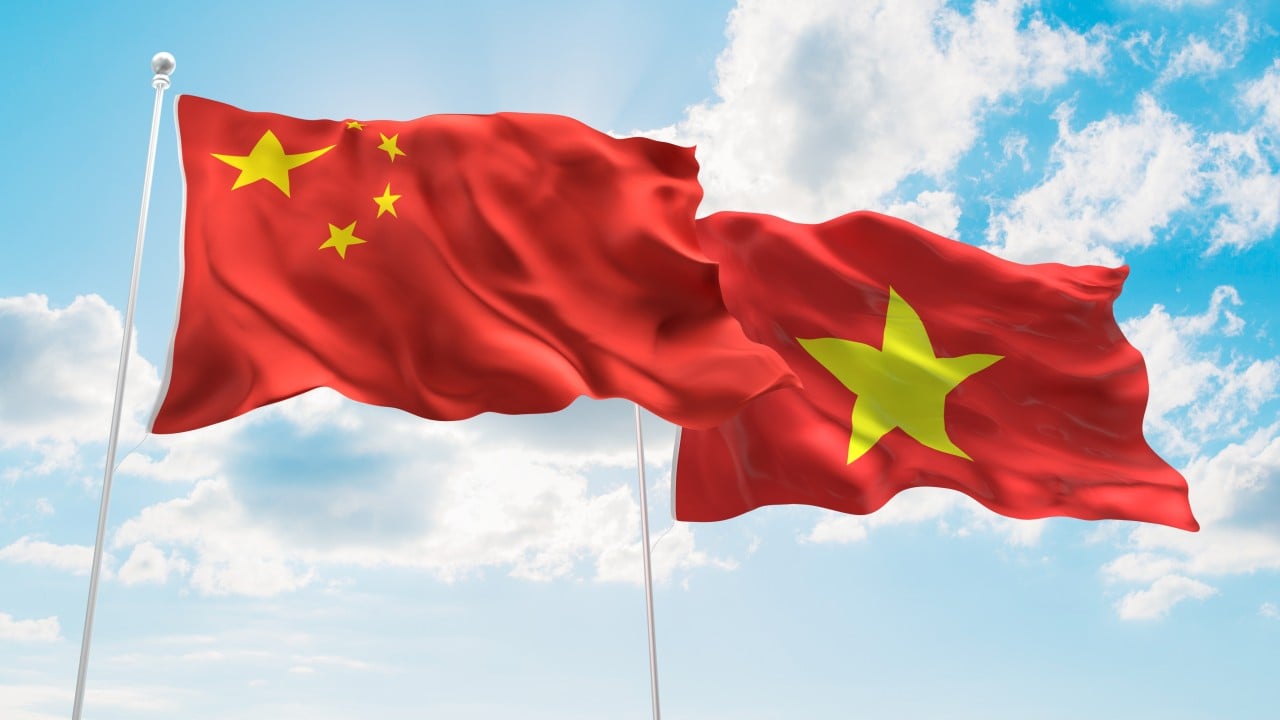
The maritime friction between China and Vietnam over the Paracel Islands (Hoàng Sa) does not exist in a vacuum of historical grievance; it is a calculated variable in a broader optimization problem. Both nations are attempting to maximize two competing values: territorial sovereignty and integrated supply chain security. While conventional analysis suggests that border disputes inevitably derail economic cooperation, the structural reality of the China-Vietnam relationship reveals a "Compensatory Alignment" model. In this framework, localized tactical friction is tolerated—and even expected—as long as the strategic utility of the Comprehensive Strategic Cooperative Partnership remains the primary driver of GDP growth and regional stability.
The Dual-Track Calculus of Hanoi and Beijing
The tension between China and Vietnam operates on a dual-track system that separates "Functional Cooperation" from "Sovereignty Deadlocks." This separation is not accidental. It is a deliberate risk-management strategy designed to prevent a single flashpoint in the South China Sea from triggering a systemic collapse of bilateral trade, which surpassed $170 billion in recent fiscal cycles. Building on this topic, you can find more in: Why the Green Party Victory in Manchester is a Disaster for Keir Starmer.
The logic of this dual-track system rests on three pillars:
- Asymmetric Dependency: Vietnam serves as a critical "Plus One" manufacturing hub for Chinese firms seeking to bypass Western trade tariffs. Conversely, Vietnam relies on Chinese intermediate goods—specifically in electronics and textiles—to fuel its export engine.
- Ideological Continuity: Both states are governed by Communist parties that prioritize regime survival through economic performance. A full-scale military escalation over the Paracels would introduce a "Volatility Tax" that neither party is willing to pay.
- The "Grey Zone" Equilibrium: By utilizing maritime militias and coast guard vessels rather than primary naval assets, both nations keep the conflict below the threshold of kinetic warfare. This allows for domestic "sovereignty signaling" without necessitating a total break in diplomatic relations.
Infrastructure as a Geopolitical Anchor
The drive for "stronger strategic ties" is anchored in physical connectivity. The expansion of high-speed rail links and the "Two Corridors, One Belt" framework represent a sunk-cost strategy. Once billions are committed to cross-border rail and energy grids, the "Exit Cost" of a maritime dispute rises exponentially. Experts at The Guardian have also weighed in on this matter.
Vietnam’s recent upgrades to its rail infrastructure to match China’s standard gauge are not merely technical improvements. They are a "Tethering Mechanism." By aligning logistics standards, Vietnam integrates itself deeper into the Southern China economic ecosystem. This creates a feedback loop: increased economic integration provides China with more non-military leverage, while providing Vietnam with a "shield of relevance" that makes a Chinese military offensive too economically damaging for Beijing to pursue.
The Cost Function of Territorial Encroachment
Every action in the Paracels carries a quantifiable diplomatic cost. We can define the "Sovereignty-Economic Trade-off" (SET) as a function where:
$$SET = \frac{V_{territory} - C_{escalation}}{U_{economic}}$$
Where:
- $V_{territory}$ is the perceived value of the island or resource.
- $C_{escalation}$ is the cost of diplomatic isolation or sanctions.
- $U_{economic}$ is the utility derived from bilateral trade.
When $C_{escalation}$ rises due to international pressure or the threat of supply chain disruption, the incentive to push the dispute toward a resolution or a "freeze" increases. Currently, Beijing perceives the $U_{economic}$ as high enough to absorb the $C_{escalation}$ of minor skirmishes. Vietnam, meanwhile, utilizes "Multilateral Hedging"—strengthening ties with the United States, Japan, and Australia—to artificially inflate $C_{escalation}$ for China.
Technological Sovereignty and the Maritime Domain
The Paracel dispute is increasingly influenced by the "Digital Silk Road" and undersea infrastructure. The contest is no longer just about fishing rights or hydrocarbon reserves; it is about the control of Subsea Cable Landing Stations (CLS) and the deployment of 5G/6G maritime networks.
China’s "Blue Hole" research and the installation of monitoring sensors in the Paracels serve a dual purpose. They provide environmental data while establishing a "Sensor Blanket" that complicates Vietnamese and ASEAN maritime surveillance. This technological encroachment creates a new type of "Fait Accompli" where physical possession of the islands is augmented by digital dominance of the surrounding waters. Vietnam’s response has been to accelerate its own domestic tech capabilities, yet the "Compute Gap" between the two nations remains a bottleneck for Hanoi’s maritime strategy.
The Role of External Variables: The US-Vietnam Factor
The deepening of the US-Vietnam Comprehensive Strategic Partnership (CSP) introduces a third-party variable that disrupts the bilateral equilibrium. For Beijing, the Paracels are a defensive rampart in the "First Island Chain." If Vietnam leans too far into the US security orbit, China’s cost-benefit analysis regarding the Paracels shifts from "Managing a Dispute" to "Preempting a Threat."
However, Vietnam’s "Four Nos" defense policy—no military alliances, no siding with one country against another, no foreign bases, and no using force in international relations—acts as a pressure valve. This policy reassures Beijing that Vietnam will not become a base for US containment, thereby keeping the Paracel dispute within the realm of "Manageable Friction."
Tactical Limitations and Strategic Deadlocks
Despite the high-level rhetoric of "shared future" and "strategic coordination," several structural bottlenecks prevent a total resolution of the maritime issue:
- Domestic Nationalism: In both nations, the Paracel Islands are symbols of national integrity. Any compromise is viewed as a systemic weakness, making a legal or territorial "Grand Bargain" politically impossible.
- The UNCLOS Divergence: While both are signatories to the United Nations Convention on the Law of the Sea, their interpretations regarding "historic rights" and "straight baselines" are fundamentally irreconcilable.
- Resource Depletion: As near-shore fisheries decline, the pressure on the Paracels as a food security asset increases, raising the stakes for local maritime law enforcement.
The Strategic Path Forward: Institutionalized De-escalation
The most probable trajectory is not a resolution, but an "Institutionalized Standoff." This involves the creation of technical working groups that discuss low-sensitivity issues—such as marine environmental protection or search and rescue—to maintain a baseline of communication while the core sovereignty dispute remains "on ice."
The real indicator of the relationship's health is not the absence of maritime incidents, but the speed of "Post-Incident Recovery." If a ramming incident in the Paracels is followed by a high-level trade forum within 30 days, the "Compensatory Alignment" model is functioning. If the diplomatic silence stretches into months, the "Volatility Tax" has become unsustainable, signaling a shift toward containment.
The optimal strategy for regional stakeholders is to monitor the "Ratio of Trade Growth to Maritime Incidents." As long as trade growth outpaces the frequency of maritime incursions, the economic gravity of the relationship will continue to anchor the political dispute. The Paracels will remain a point of friction, but they are unlikely to become a point of fracture as long as the cost of decoupling remains prohibitively high for both the Politburo in Hanoi and the leadership in Beijing.
Direct investment into cross-border logistics and the harmonization of digital trade standards will serve as the primary hedge against maritime escalation. The focus must shift from "Solving the Dispute" to "Increasing the Cost of Conflict."