The cockpit of a KC-135 Stratotanker is a cramped, utilitarian cathedral of dials and toggle switches. It smells of hydraulic fluid and stale coffee. For a pilot circling over a dark expanse of desert, the mission is rarely about the glory of the dogfight. It is about the math of survival. You are the flying gas station. You are the umbilical cord. If you fail, the sleek, multi-million dollar fighters screaming through the atmosphere become nothing more than very expensive gliders.
When an American KC-135 crashed in the mountains of Kyrgyzstan years ago, it wasn't just a localized tragedy. It was a mechanical scream that echoed through every military briefing room from Washington to New Delhi. The investigation pointed to a phenomenon called "Dutch Roll"—a violent, rhythmic oscillation that the flight control system failed to dampen. The tail literally snapped off.
In the high-stakes shadow war currently simmering between Israel and Iran, that old crash has suddenly become the most relevant ghost in the room.
We often talk about war in terms of missiles, stealth coatings, and "kill chains." We watch grainy footage of interceptors hitting targets in the night sky and marvel at the precision. But the reality of modern long-distance conflict is far more desperate and fragile. It is governed by the tyranny of distance. If Israel decides to strike targets deep within Iran, their jets have to cross over 1,000 miles of potentially hostile airspace. They cannot do that on a single tank of gas.
The Invisible Tether
Consider a pilot—let’s call him David—sitting in the seat of an F-35. He is encased in a helmet that costs more than a suburban home. He can see through the floor of his plane using augmented reality. He is a ghost on the radar. But as he crosses the border, his eyes aren't just on the target. They are on the fuel gauge.
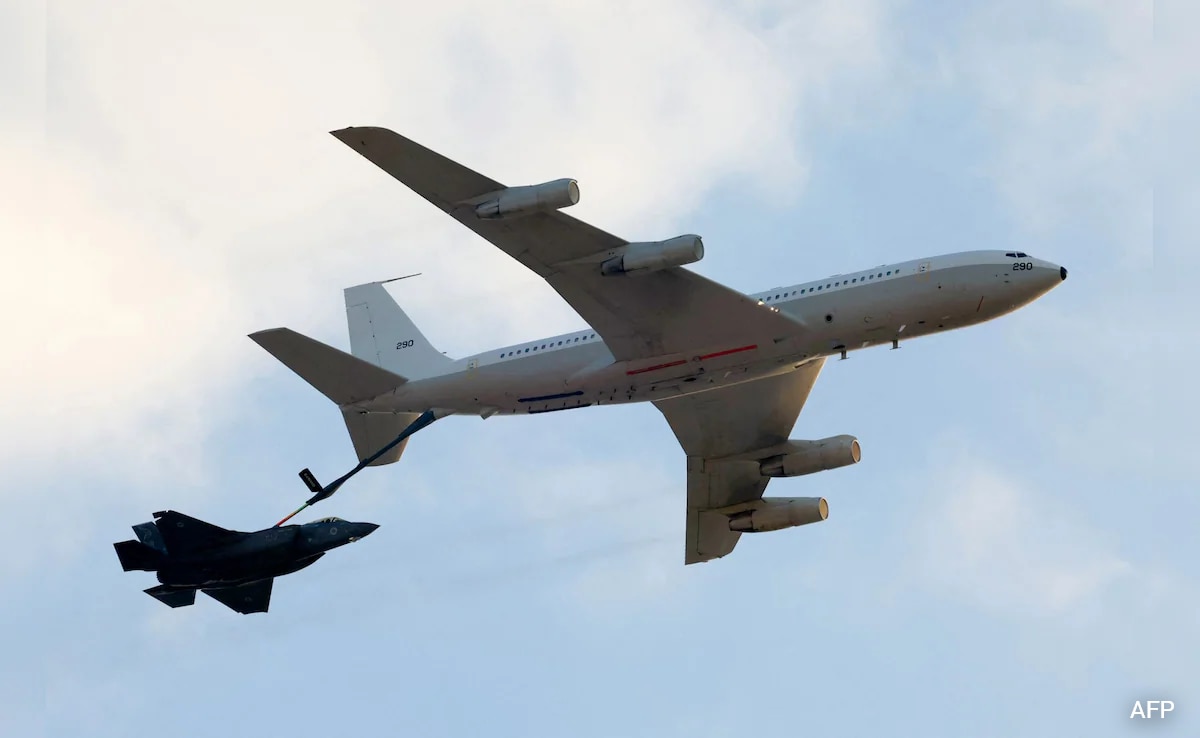
The F-35 is a marvel, but it is a thirsty one. To reach Tehran and return to base, David needs a mid-air refill. This is the moment of maximum vulnerability. A tanker is not a ghost. It is a massive, lumbering converted Boeing 707 airframe. It is a giant "kick me" sign hanging in the sky.
When Iran launched its massive drone and missile salvos toward Israel, the world saw a display of force. But military analysts saw a geography problem. Iran has the luxury of distance; Israel has the burden of it. To bridge that gap, Israel relies on a fleet of aging tankers, some of which are half a century old. They are flying on borrowed time and meticulous maintenance.
The KC-135 crash taught the world that when these support systems fail, they don't just fail a little bit. They disintegrate. For a country like India, watching this exchange from the sidelines of the Arabian Sea, the lesson is chillingly clear. You can have the fastest sword in the world, but if your arm isn't long enough to reach the enemy, the sword is useless.
The Indian Dilemma
New Delhi faces a nightmare of two fronts. To the west, a volatile border; to the north, the daunting, oxygen-thin peaks of the Himalayas. In a conflict over the mountains, jet engines struggle. They burn fuel faster. They carry less weight. The geography itself is an enemy.
For years, the Indian Air Force has been crying out for more "force multipliers"—the technical term for tankers. Currently, they rely heavily on the Russian-made IL-78. These are powerful machines, but they are plagued by maintenance issues and a lack of spare parts. They are the aging pack mules of a high-tech army.
Imagine an Indian commander looking at a satellite map of the Line of Actual Control. He has the Rafale, a world-class fighter. He has brave pilots. But he looks at the refueling orbits—the specific circles in the sky where the tankers must sit—and he sees a bottleneck. If those tankers aren't there, or if they suffer a mechanical failure like the ill-fated KC-135, the Rafales have to turn back.
The mission ends before it begins.
The Human Cost of Hardware
We treat military procurement like a grocery list, but it is actually a blood pact. When a government chooses to delay the purchase of new tankers or opts for a cheaper, less reliable maintenance contract, they are making a bet with pilots' lives.
The crew of that crashed KC-135 didn't die because they weren't skilled. They died because a complex system of sensors and steel reached a breaking point that hadn't been properly addressed. In the context of the Iran-Israel tension, the "breaking point" is the sheer stress on the airframes. Israel is currently waiting on newer American KC-46 tankers, but delivery takes years. Until then, they must patch, polish, and pray over their old fleet.
India is in a similar race against obsolescence. The country has attempted to lease tankers, to buy them secondhand, and to find domestic solutions. Each delay is a gamble.
The logic is simple: A fighter jet without a tanker is a short-range defensive tool. A fighter jet with a tanker is a strategic weapon of projection. Without the "gas station in the sky," India’s ability to protect its interests far from its shores or deep behind mountain ridges is an illusion.
The Logistics of Fire
In the movies, the hero always has just enough fuel to make it home. In reality, the margin is often less than ten minutes of flight time.
Think about the psychological pressure on a crew when the refueling boom won't connect. The metal clangs against metal. The turbulence tosses the planes like leaves. Below them, thousands of feet of empty air or hostile territory. If the tanker has a flight control glitch—if that "Dutch Roll" begins to shake the wings—it isn't just the tanker crew in danger. It is the entire strike package.
This is the "invisible stake" of the Iran-Israel theater. It isn't just about who has the better missile. It is about who has the better logistics. It is about the unglamorous, greasy work of keeping old engines running.
The KC-135 crash was a warning written in wreckage. It told us that the support system is the most critical point of failure. You can spend billions on the "tip of the spear," but if the shaft of that spear is rotten, it will snap the moment you try to throw it.
India’s neighborhood is not getting any quieter. The distances are not getting any shorter. The lesson from the desert and the mountains is that the most important plane in the air isn't the one carrying the missiles.
It's the one carrying the hope of getting home.
The sky is a vast, indifferent place. It does not care about national borders or political grievances. It only respects the laws of physics and the integrity of the machine. When the fuel runs low and the nearest runway is a thousand miles away, the only thing that matters is the shadow of a tanker waiting in the clouds. If that shadow disappears, everything else goes dark with it.