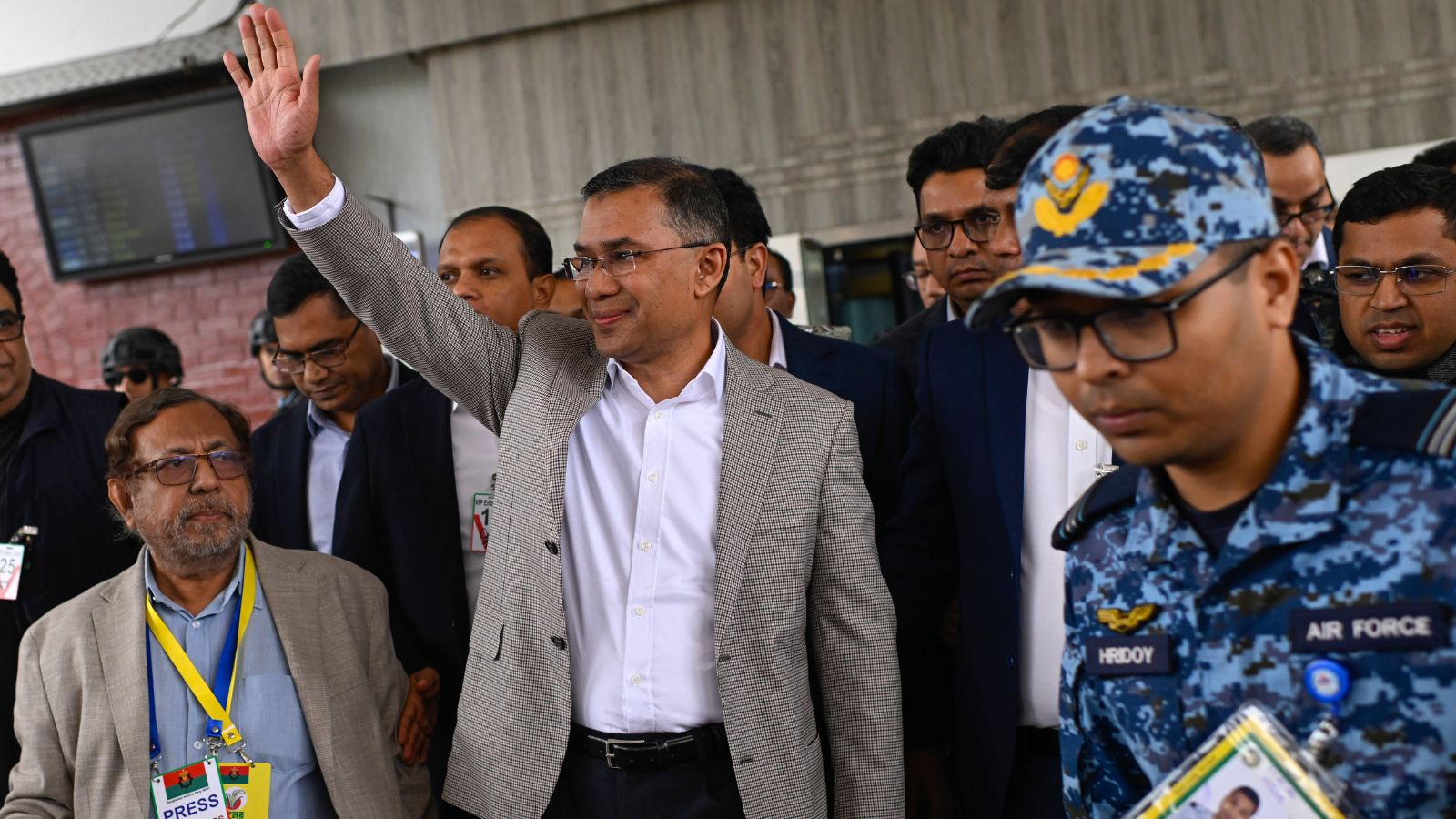
In the quiet, drafty rooms of London, far from the humid, bustling heat of Dhaka, a man sits with a map that isn't just a collection of borders. For Tarique Rahman, the acting chairman of the Bangladesh Nationalist Party (BNP), that map represents a delicate internal balance. To some, he is a distant figure of controversy; to others, he is the architect of a democratic restoration. But when he speaks of foreign policy, he isn't just talking about trade deals or diplomatic handshakes. He is talking about the dinner tables of millions of Bangladeshis who have felt the sharp sting of isolation and economic volatility.
National interest is a cold phrase. It sounds like something written in a dusty ledger by a bureaucrat who hasn't seen the sun in years. Yet, for the garment worker in Gazipur or the software engineer in Sylhet, national interest is the difference between a thriving career and a shuttered factory. Rahman’s recent assertions regarding foreign policy are a signal that the "mirage of alignment" is over. He is pitching a reality where Bangladesh stops being a pawn on a regional chessboard and starts acting like the queen.
The Weight of the Invisible Hand
Consider a hypothetical shopkeeper in a border town. Let’s call him Rahim. For years, Rahim has watched trucks roll across the frontier, carrying goods that fluctuate in price based on political whims rather than market demand. When the relationship between Dhaka and its neighbors becomes a lopsided affair of "giving without getting," it is Rahim who pays the price in inflated costs and dwindling supplies.
Rahman’s narrative shift focuses on this exact imbalance. He argues that for too long, the country’s external relations were curated to protect a specific regime rather than the 170 million souls living within the delta. He is calling for a "reciprocal dignity." This isn't a call for isolationism. It is a demand for a seat at the table where the legs are of equal length.
The invisible stakes here are massive. We are talking about the Bay of Bengal, a stretch of water that is rapidly becoming the most contested blue real estate on the planet. If Bangladesh leans too far in one direction, it risks being crushed in the gears of a "Great Power" rivalry. If it stays too neutral without a backbone, it gets ignored. Rahman is attempting to thread a needle that has broken many a tailor before him.
The Language of the New Settlement
Power speaks in many tongues, but the most effective is the language of consistency. Rahman’s message to the international community—from the corridors of Washington to the high-rises of Beijing and the historic blocks of New Delhi—is one of predictable partnership. He is moving away from the erratic pulses of the past decade.
"We will keep our interests in mind," he says. It sounds simple. It is actually a radical departure. To keep one’s interests in mind requires knowing exactly what those interests are. It isn't just about selling more shirts to Europe. It is about energy security, water rights, and the digital sovereignty of a generation that grew up with the internet but without a voice in their own governance.
The complexity of this task cannot be overstated. Bangladesh sits at a geographic crossroads. To the west lies India, a giant with whom the history is deep, tangled, and often painful. To the east, the rising influence of China offers infrastructure but brings the heavy shadow of debt. Rahman’s vision suggests a pivot toward a "Bangladesh-first" doctrine that doesn't burn bridges but insists on better tolls.
The Human Cost of Diplomacy
We often forget that foreign policy is actually a domestic policy in a tuxedo. When a government fails to negotiate fair trade terms, the middle class shrinks. When a government allows its borders to be porous to the point of insecurity, the rural poor are the first to suffer.
The genius of Rahman's recent rhetoric lies in its relatability. He isn't talking down to the people from a podium of academic jargon. He is addressing the underlying anxiety of a nation that feels it has been sold short on the global stage. He is tapping into a collective desire for respect.
Imagine a young woman in Dhaka, a university graduate with a degree in international relations. She watches the news and sees her country being discussed as a "problem to be managed" or a "market to be exploited." She wants to see her leaders stand up and articulate a vision that reflects her ambition. Rahman is targeting that specific demographic—the young, the aspirational, and the tired. He is offering them a mirror. He wants them to see a country that is a leader in the Global South, not just a follower.
The Blueprint of Reciprocity
The transition from a regime-centric foreign policy to a people-centric one requires a total overhaul of how the state functions. It means that every memorandum of understanding must be scrutinized through a single lens: Does this benefit the citizen on the street?
Rahman has been vocal about the need for transparency. This is the part of the story that often gets lost in the headlines. If the deals are made in the dark, the public loses. By advocating for a foreign policy that is open to parliamentary oversight and public debate, he is attempting to democratize the very concept of international relations.
- Economic Diversification: Reducing dependence on a few key markets to ensure that a downturn in one region doesn't collapse the national economy.
- Strategic Neutrality: Navigating the Indo-Pacific strategy without becoming a military outpost for any single bloc.
- Regional Cooperation: Strengthening SAARC and other regional bodies to ensure that South Asia grows as a unit, rather than a collection of bickering neighbors.
The math is unforgiving. $1$ plus $1$ must equal $2$ for the people of Bangladesh. For too long, the equation has felt like $1$ plus $1$ equals $0.5$ for the public and the rest for a small elite. Rahman is promising to fix the arithmetic.
The Ghost in the Room
Of course, the elephant in the room is the skepticism of the international community. They remember the past. They remember the cycles of violence and the pendulum swings of Bangladeshi politics. Rahman knows this. His current charm offensive isn't just for the voters at home; it’s a performance for the skeptical diplomats in New York and Geneva.
He is trying to prove that the BNP has evolved. He is presenting a version of himself that is more statesman than firebrand. Whether this is a genuine transformation or a tactical masterstroke is the question that keeps analysts up at night. But in the world of high-stakes politics, the intent matters less than the outcome. If he can convince the world that a stable, democratic Bangladesh is in their national interest, he has already won half the battle.
The uncertainty is palpable. It’s the same feeling you get when a storm is brewing over the Padma River. You know the landscape is about to change, but you don't know if the new silt will be fertile or if the flood will wash everything away. Rahman is betting that the people are ready for the change, even if they are afraid of the water.
The Long Game
This isn't a story about a single speech or a press release. It is a story about the soul of a nation trying to find its place in a world that is becoming increasingly cold and transactional. Tarique Rahman is positioning himself as the man with the compass.
He is telling the world that Bangladesh is no longer open for exploitation. He is telling his people that they deserve a government that treats their future as a sacred trust, not a bargaining chip. It is a bold, dangerous, and necessary play.
The sun sets over the London skyline, and across the world, it rises over the green fields of Bogra. The distance is vast, but the connection is absolute. A leader's words travel faster than the wind, and right now, those words are carrying the weight of a million hopes. The map on the table is finally starting to look like the country it's supposed to represent.
The real test won't be in the standing ovations he receives in foreign capitals. It will be in the quiet, mundane moments when a farmer can buy fertilizer at a fair price because a trade deal was actually negotiated with his hands in mind. It will be in the silence of a border that is respected rather than feared. It will be in the eyes of a nation that finally feels it is looking at itself in the mirror and liking what it sees.
A nation is not a business, but it must be managed with the precision of one. It is not a family, but it must be protected with the ferocity of one. Rahman is betting everything on the idea that Bangladesh is ready to be both.
The ink on the map is still wet. The borders are the same, but the way we look at them has changed forever.
Would you like me to analyze the specific economic implications of Rahman's proposed trade reforms for the textile sector?