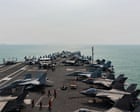
The arrival of the USS George Washington in the Arabian Sea marks the end of a grueling, unprecedented chapter for the United States Navy. After spending more than 250 consecutive days at sea without a single port visit, the USS Abraham Lincoln is finally heading home. But the quiet relief operation cannot mask the institutional fractures exposed by this record-shattering deployment. Behind the official talking points of operational necessity lies a grinding human cost that forces a hard look at modern naval readiness, chronic overstretch, and the breaking point of the all-volunteer force.
Deployments of this magnitude do not happen in a vacuum. When the Lincoln left its homeport in San Diego, it was originally slated for a standard Pacific rotation. Shifting geopolitical realities and the outbreak of hostilities involving Iran rewrote those orders mid-stride, turning a routine tour into an indefinite open-ended combat deployment. Months bled into nearly nine, stretching supply chains, mechanical systems, and the mental resilience of roughly 5,000 sailors to the absolute limit.
The Anatomy of a Breaking Point
Life on a nuclear-powered aircraft carrier is already an exercise in controlled claustrophobia. Thousands of personnel live stacked in cramped berthing compartments, breathing recycled air, working exhausting shift rotations under high-intensity flight deck operations, and breathing jet fuel exhaust. Under normal circumstances, scheduled port visits offer a critical pressure valve. Stepping onto dry land for a few days allows sailors to decompress, sleep horizontally, eat fresh produce, and disconnect from the relentless hum of the ship.
For the crew of the Lincoln, those pressure valves were welded shut.
Reports filtered back through families via restricted text messages detailing sparse meals as stores dwindled, broken plumbing systems that left heads and washrooms out of commission, and a mounting psychological toll. While top civilian and military leadership pushed back against the severity of these accounts—insisting that continuous access to clean water, functional air conditioning, and medical support remained baseline priorities—the reality on the deck plates was far more complex.
Veteran service members understand the insidious nature of operational fatigue. When equipment rusts faster than it can be chipped and painted, when mail delivery stalls for weeks, and when every tomorrow looks identical to yesterday, morale does not drop off a cliff; it erodes grain by grain.
The Strategic Fallout in the Pacific
The crisis aboard the Lincoln is not merely a welfare issue for the sailors wearing the uniform. It represents a systemic failure in global force management.
By pulling carriers away from their designated operational theaters to plug relentless gaps in the Middle East, the Pentagon creates dangerous vacuums elsewhere. The transfer of the USS George Washington from the Pacific to the Arabian Sea leaves critical regions exposed, undercutting long-term national security strategies that demand a pivot toward Asian waters. It is a shell game played with multi-billion-dollar assets and human lives, driven by a shortage of available hulls and a refusal to recalibrate commitments abroad.
Congress is beginning to ask uncomfortable questions. Oversight hearings demand accountability from naval leadership regarding how a standard six-month deployment morphed into an endurance test exceeding eight months. Yet, defensive posturing from political appointees often clashes with the grounded warnings of retired flag officers and military health experts who watch the institutional culture fray.
The Human Element Behind the Hull
Numbers on a spreadsheet cannot capture what it means to miss the birth of a child, a parent's funeral, or simply the psychological safety of a quiet room. When retention rates dip and recruitment targets become increasingly difficult to hit, Washington looks everywhere except at the daily grind of fleet life.
The George Washington has assumed the watch, and the Lincoln has turned its bow toward California. But unless the underlying calculus of deployment lengths, maintenance backlogs, and global commitments changes, the next ship in line will soon find itself facing the exact same horizon.
Concerns mount over living conditions on USS Abraham Lincoln
This broadcast segment details the growing anxieties and reports surrounding the welfare of the service members stationed aboard the carrier during its prolonged deployment.
http://googleusercontent.com/youtube_content/1