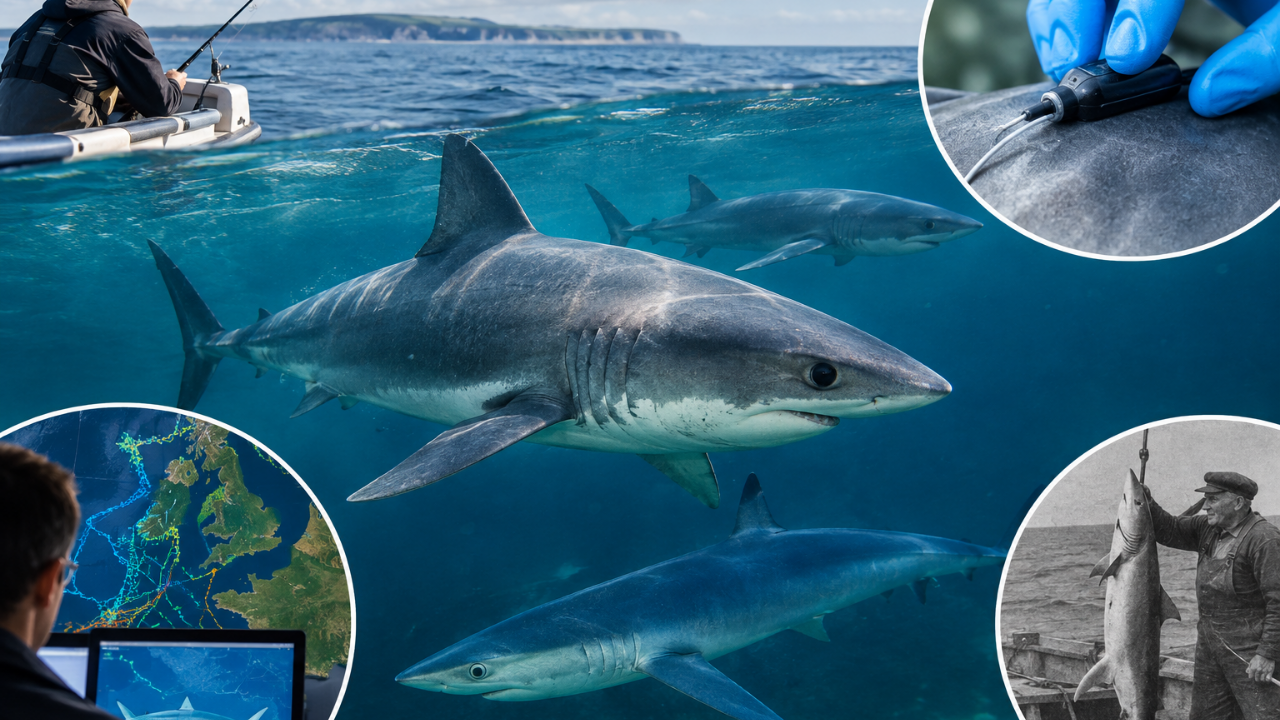
Seventy plastic tags and a dusty box of catch records dating back to 1953 make for great theater. Conservationists love a good prop. Slap a satellite tracker on a porbeagle, dust off some mid-century ledger where a disgruntled pier fisherman scribbled down a cod and an accidental dogfish, and you have an instant headline. Britain is saving its sharks. The past is meeting the present to protect the apex predators of the deep.
It is a comforting narrative. It is also an expensive delusion.
I have spent decades watching environmental bureaucracies throw money at symptoms while ignoring the structural mechanics of marine ecosystems. We love counting things because counting things feels like work. It creates reports, funds committees, and allows politicians to issue solemn press releases about biodiversity. But sticking a high-tech dart into a dorsal fin does not stop a single longliner from hauling up juveniles as bycatch, nor does it fix the thermal habitat compression driving pelagic species poleward.
Stop trying to save sharks with clipboards.
The Fallacy of the Historical Baseline
The lazy consensus in modern marine conservation relies on a fundamental historical blind spot. When conservationists point to catch records from 1953 as a baseline for abundance, they are starting their clock midway through an industrial fishing blitz. By the time mid-century officials started logging catches, North Atlantic populations had already been heavily impacted by decades of steam trawling and early commercial fleets.
Using 1953 as ground zero is like judging a marathon runner’s health by examining them at mile twenty-three while ignoring that they were hit by a delivery van at mile two.
When researchers compare today’s telemetry data against these warped historical ledgers, they find phantom declines and illusory recoveries. A slight uptick in skate or thresher sightings near a coastal shelf gets heralded as a triumph of modern tracking, when it is often nothing more than a localized redistribution driven by warming water temperatures or shifts in mackerel stock distributions. Sharks do not care about your management zones. They follow calories and temperature gradients.
If you want to understand why a porbeagle swims where it swims, look at industrial pelagic midwater trawls targeting herring and mackerel, not a blinking dot on a government dashboard.
The Telemetry Trap
Let us look at the mechanics of the obsession. Tagging programs are seductive. They produce gorgeous migration maps for documentaries and give university labs a steady drip of grant money. A shark gets caught, a marine biologist drills a tiny hole in its fin or straps a fin-mount popup archival transmitter to its body, and the animal is released back into the blue.
Data starts flowing. We learn that a basking shark likes to hang out off the coast of Cornwall in the summer and head south toward the Bay of Biscay in the winter. Fascinating. Groundbreaking.
Except we already knew that. Fishermen have known the seasonal run of basking sharks and tope for generations. The telemetry tells us where they go, but it tells us nothing about why they are dying or how to stop it. Knowing that a blue shark crosses an invisible national boundary line in the Celtic Sea is useless if the nation on the other side of that line permits indiscriminate longlining.
Imagine a scenario where you lose your car keys in a dark alley, but you search for them under the streetlamp fifty yards away simply because the light is better there. That is marine telemetry in a nutshell. We track sharks where it is technologically feasible and politically palatable, ignoring the opaque, messy reality of commercial fisheries economics that actually dictate survival rates.
Bycatch is the Real Apex Predator
Talk to any bureaucrat running a shark protection initiative and they will drone on about habitat loss, climate disruption, and localized overfishing by artisanal rod-and-reel anglers. They love targeting the low-hanging fruit.
They rarely talk about industrial bycatch because confronting industrial bycatch requires picking a fight with powerful commercial fishing lobbies.
Sharks do not primarily die because they lack a GPS tag or because recreational anglers fail to practice catch-and-release with enough enthusiasm. They die because they are tangled in miles of monofilament longlines, choked in gillnets, or hauled aboard factory trawlers where they are processed as unrecorded bycatch and tossed back dead.
When a pelagic longline set targets swordfish or tuna, it deploys thousands of baited hooks over dozens of miles. Sharks lack lobbyists. They take the bait, drown on the line, and get hauled up as collateral damage. A 1953 catch record cannot save them from a modern industrial freezer-trawler operating off the continental shelf.
If conservation budgets were redirected from vanity telemetry projects toward mandatory onboard electronic monitoring—cameras on every commercial vessel tracking every haul—mortality rates would plummet within a quarter. But cameras do not make for good fundraising brochures. You cannot name a camera after a generous donor.
The Economic Distortion of Conservation Theater
There is a darker side to the modern conservation complex. Tracking initiatives create an economy of their own. They require boat charters, specialized hardware, data analysts, stakeholder summits, and endless rounds of international workshops.
This creates a perverse incentive loop. As long as a species remains "vulnerable" or "data-deficient," the funding keeps flowing. If a population actually recovers through straightforward, blunt-force management—such as hard closures on known nursery grounds—the crisis narrative deflates, and the grants dry up.
I have seen organizations spend six figures tracking a handful of tope sharks in a British estuary, only for local councils to approve coastal dredging projects a mile away that obliterated the primary benthic feeding grounds of those exact same sharks. The tracking data recorded their displacement in high definition. It did not stop the bulldozers.
What Actually Works
If we are serious about marine preservation, we have to abandon the illusion that more data equals better outcomes. We do not need seventy more tags. We need fewer loopholes.
First, stop treating recreational anglers as the primary threat. Restrictive bag limits for shore and boat anglers feel proactive, but they account for a fraction of a percent of total shark mortality in UK waters. Constantly tightening the screws on hobbyists while leaving commercial loopholes wide open is regulatory cowardice.
Second, mandate 100 percent independent electronic monitoring on all commercial vessels over ten meters operating within British exclusive economic zones. If you fish commercially, your deck is on camera. Every shark brought aboard must be accounted for, dead or alive. Penalties for undeclared landings must be severe enough to put vessels out of business, not merely written off as the cost of doing business.
Third, establish strict, non-negotiable marine sanctuaries over known pupping and nursery grounds. Sharks are K-selected species; they grow slowly, mature late, and produce few young. Protecting a juvenile nursery ground matters infinitely more than knowing where an adult swims across the Atlantic.
We can keep patting ourselves on the back for cataloging historical ledgers from the Eisenhower administration and sticking expensive GPS pins onto migrating predators. Or we can stop pretending that looking at a map is the same thing as saving a life.
The sharks are waiting to see if we have the stomach for actual change, or if we are just going to buy another tag.