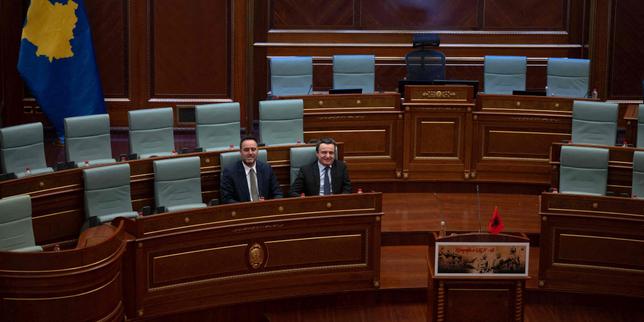
The dissolution of the Assembly of Kosovo and the subsequent call for the third general election in under eighteen months signals a systemic failure in executive-legislative alignment rather than a mere sequence of political accidents. This recurring instability is not a byproduct of voter indecision, but a structural bottleneck caused by the intersection of constitutional constraints, a fragmented party system, and the "veto player" influence of minority representation requirements. To understand the collapse of the current administration, one must analyze the cost of governance within a legal framework that prioritizes ethnic inclusivity over executive efficiency.
The Mechanism of Legislative Paralysis
The fundamental tension in Kosovo’s political architecture stems from the constitutional requirement for a "double majority" on "laws of vital interest." This mechanism, intended to protect minority rights, effectively grants a small number of representatives the power to halt the entire legislative agenda. When the executive branch fails to secure a supermajority, the government enters a state of high-maintenance survival, where every minor bill becomes a site of disproportionate horse-trading.
We can categorize the drivers of this current dissolution into three distinct pillars of institutional friction:
- The Threshold Dilemma: The 5% electoral threshold for political parties ensures a multi-party landscape, but it frequently produces "hung" parliaments where no single entity can govern without three or more coalition partners. Each additional partner introduces a new set of non-negotiable demands, increasing the complexity of the government's internal coordination.
- Executive-Judicial Friction: The Constitutional Court of Kosovo has moved from being a passive arbiter to an active participant in political outcomes. By invalidating previous elections or prime ministerial appointments based on procedural technicalities, the court has shortened the expected lifecycle of any given administration.
- The External Mandate Conflict: Kosovo’s leadership must simultaneously satisfy a domestic electorate focused on economic stagnation and an international community demanding progress on the EU-facilitated dialogue with Serbia. These two priorities are often mutually exclusive in the short term, creating a "two-level game" where the government loses domestic legitimacy if it succeeds internationally, and vice versa.
The Cost Function of Political Recurrence
Holding three elections in such rapid succession imposes significant economic and administrative costs that are rarely quantified in standard political reporting. The financial burden of the Central Election Commission (CEC) is only the surface-level expenditure. The deeper "opportunity cost" includes the complete suspension of foreign direct investment (FDI) negotiations and the freezing of capital projects.
Institutional memory is degraded when ministerial leadership rotates every six months. Civil servants, anticipating the next reshuffle, adopt a risk-averse posture, delaying the implementation of public procurement contracts. This creates a feedback loop: the government cannot deliver services because it is in a state of constant transition, and it is forced into transition because it cannot deliver services.
The math of the current crisis suggests that the "break-even point" for a stable government requires a coalition that controls at least 65 seats in the 120-seat assembly. Given the current polling data and the entrenched positions of the Vetëvendosje (VV), Democratic Party of Kosovo (PDK), and Democratic League of Kosovo (LDK), achieving this without a cross-ideological "grand coalition" is mathematically improbable.
Mapping the Strategic Failure of Coalitions
The collapse of the outgoing government can be traced back to a misalignment in "coalition payoffs." In rational choice theory, a coalition holds as long as the benefits of being in power exceed the risks of being blamed for failures. In Kosovo, the risk of "brand contamination" for junior partners—being associated with unpopular compromises on national sovereignty or economic austerity—has become too high.
- The Vetëvendosje Factor: As the primary driver of the current political shift, VV’s refusal to engage in traditional patronage politics has disrupted the historical "spoils system." While this improves transparency, it removes the "glue" that traditionally held disparate Kosovar parties together.
- The Diaspora Variable: Kosovo's elections are uniquely influenced by out-of-country voting. The diaspora tends to vote for change more aggressively than the local population, creating a mismatch between the legislative reality on the ground and the mandate granted by the ballot box.
- The Belgrade-Pristina Bottleneck: The requirement to include the Serb List (Srpska Lista) in the cabinet—as mandated by Article 96 of the Constitution—creates an internal opposition within the government itself. This is not a coalition of choice but a coalition of constitutional necessity, leading to a cabinet that is structurally incapable of reaching a consensus on national security or territorial integrity.
Strategic Forecast: The Necessity of Constitutional Reform
The upcoming elections will likely repeat the previous cycles unless there is a fundamental shift in how executive power is constituted. The current trajectory suggests three potential outcomes, each with a declining probability of long-term stability:
- Single-Party Hegemony: One party achieves a near-majority and co-opts non-Serb minority members to reach 61 seats. This provides the most "clean" governance but faces the highest risk of being checked by the Constitutional Court or international pressure.
- The Technical Caretaker: A government of experts or a broad-based "unity" cabinet designed solely to pass a budget and electoral reform before dissolving again. This is a stalemate masquerading as a solution.
- The Grand Bargain: A coalition between the ideological opposites (e.g., VV and PDK). While stable on paper, the internal friction would likely lead to legislative "ossification," where no sensitive files are moved for the duration of the term.
For Kosovo to break the cycle of "permanent transition," the strategic imperative is a shift from a parliamentary system with high-veto density to a model that either lowers the threshold for government formation or clarifies the powers of the President in deadlock scenarios. Without these structural adjustments, the fourth election is not a matter of "if," but "when."
The immediate tactical move for any party seeking to govern is the securing of a pre-election coalition agreement that explicitly defines the "exit triggers" for junior partners. Failure to define these triggers in writing before the vote will result in a repeat of the 2020-2024 instability, where governments fell not on policy failure, but on the inability to manage the internal optics of the coalition itself. The focus must shift from "winning the election" to "securing the 61st vote" for the full four-year term.
Would you like me to analyze the specific economic impact of these election cycles on Kosovo's GDP growth and IMF loan conditions?