The global economy just hit a wall of water and steel. For the first time in modern history, the United States military has confirmed that not a single commercial vessel successfully transited the Strait of Hormuz during a continuous twenty-four-hour window. This isn't a temporary traffic jam or a cautious slowdown; it is a full-scale operational paralysis of the world’s most critical energy artery. While official reports focus on the immediate tactical blockade, the deeper reality involves a catastrophic breakdown in the "freedom of navigation" doctrine that has underpinned global trade since the end of the Second World War.
The numbers are staggering. Usually, about 21 million barrels of oil pass through this narrow choke point every day, representing roughly 20% of global liquid petroleum consumption. When that flow stops, the shockwaves don't just hit gas stations; they rattle the foundation of industrial manufacturing, plastics, and international credit markets. For another view, see: this related article.
The Mechanics of a Modern Choke Point
Closing the Strait of Hormuz does not require a massive conventional navy. This is the first hard lesson of the current crisis. In previous decades, a blockade meant a line of battleships or a dense field of contact mines. Today, the math has changed. The proliferation of low-cost, long-range "suicide" drones and anti-ship cruise missiles has turned the 21-mile-wide passage into a kill zone where the cost of defense far outweighs the cost of the attack.
Insurance companies were the first to blink. Long before the physical blockade was finalized, Lloyd’s of London underwriters began hiking "war risk" premiums to levels that made transit economically impossible for independent tankers. When the first reports of kinetic interceptions surfaced, the industry simply stayed home. Further reporting on the subject has been provided by Financial Times.
The U.S. Fifth Fleet, based in nearby Bahrain, finds itself in an impossible tactical bind. While American destroyers are equipped with the most advanced Aegis combat systems on the planet, they are facing a saturation problem. If an adversary launches fifty drones costing $20,000 each, and the Navy responds with interceptor missiles costing $2 million per shot, the math of attrition favors the blocker. This economic imbalance is the silent engine behind the current zero-ship count.
The Ghost Fleet and the Risk of Miscalculation
While the official count remains at zero for recognized commercial vessels, there is a murky underside to this story. Our sources in maritime intelligence suggest that several "dark fleet" tankers—vessels with disabled transponders and obscured ownership—tried to hug the Omani coastline during the dead of night. They didn't make it.
The sophistication of coastal surveillance now includes synthetic aperture radar (SAR) satellites that can see through cloud cover and darkness. There is nowhere to hide in a strip of water this narrow. The fact that even these seasoned smugglers, who typically operate in the shadows to bypass sanctions, have been frightened into anchoring tells us everything we need to know about the lethality of the current blockade.
Why Conventional Deterrence Failed
For years, the prevailing wisdom in Washington and Brussels was that no actor would dare close the Strait because the resulting economic blowback would hurt the blocker as much as the victim. This was a projection of Western rationalism onto a theater that operates on a different set of incentives.
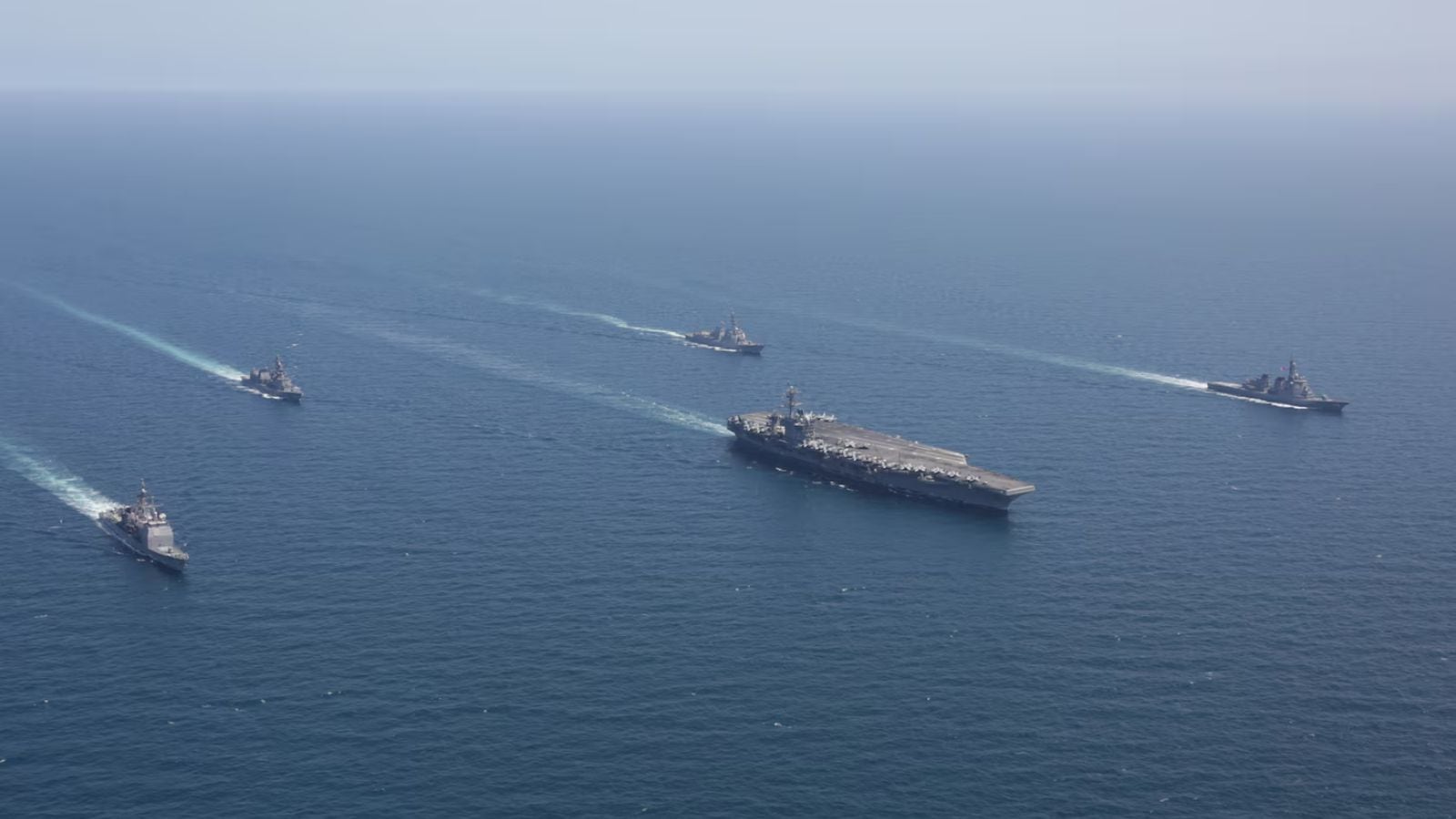
Deterrence fails when the "unthinkable" becomes a viable survival strategy for a cornered power. We are seeing a shift from maritime skirmishes to total denial of access. The U.S. Navy’s traditional "carrier strike group" model is designed for blue-water dominance—deep oceans where there is room to maneuver and react. In the cramped, littoral environment of the Persian Gulf, a carrier is a massive, $13 billion target.
The strategy has shifted from "protecting the ships" to "neutralizing the source," but the source is now a decentralized network of mobile launchers hidden in rugged coastal terrain. You cannot "sink" a truck hidden in a mountain cave with a carrier-based fighter jet without risking a much wider, more uncontrolled escalation.
The Energy Domino Effect
The immediate impact is a massive spike in Brent Crude, but that is only the surface. The real danger lies in the liquefied natural gas (LNG) markets. Qatar, one of the world's largest LNG exporters, is effectively locked in. Unlike oil, which can be stored in massive underground salt caverns or redirected via pipelines to some extent, LNG is a "just-in-time" commodity.
If the cooling facilities in Ras Laffan cannot offload their product onto ships, the entire production chain must be throttled back. You cannot simply turn off a gas field like a kitchen faucet. The technical damage to the reservoirs from an emergency shut-in could take years to repair.
Critical Vulnerabilities in the Supply Chain
- Refinery Starvation: Asian refineries, particularly in Japan and South Korea, are configured for the specific "sour" grades of crude that come out of the Gulf. Switching to American "sweet" light crude isn't a simple dial turn; it requires hardware reconfiguration that takes months.
- The Insurance Void: Even if the U.S. military begins a "tanker war" style escort mission—reminiscent of Operation Earnest Will in the 1980s—commercial crews may refuse to sail. The psychological impact of modern precision weaponry is far higher than the unguided mines of the past.
- The Pipeline Myth: While Saudi Arabia and the UAE have pipelines that bypass the Strait to the Red Sea or the Gulf of Oman, these systems lack the capacity to handle even half of the usual volume. Furthermore, those pipelines are themselves static targets for drone strikes.
The Silicon and Steel Defense
The U.S. response is currently pivoting toward an uncrewed approach. Task Force 59, the Navy’s robotic integration unit, has been scrambling to deploy "mesh networks" of underwater and surface drones to provide a persistent "digital carpet" across the Strait. The goal is to create a transparent battlefield where no missile can be launched without an immediate, automated counter-strike.
However, technology is a double-edged sword. The same GPS-jamming techniques that have plagued Eastern Europe are being deployed here. Ships that rely on digital charts and satellite positioning are finding their systems "spoofed," showing their location as miles inland when they are actually in the center of the shipping lane. In a waterway where the deep-water channel is only two miles wide, a five-degree navigation error results in a grounded mega-tanker. A grounded ship is a permanent blockade in itself.
The Strategic Silence of the East
Perhaps the most telling aspect of the last twenty-four hours is the reaction—or lack thereof—from Beijing. China is the primary consumer of the oil passing through Hormuz. Usually, one would expect a forceful demand for the restoration of order. Instead, there is a calculated stillness.
This suggests that the blockade isn't just a regional conflict; it's a test of the American-led security architecture. If the U.S. cannot guarantee the safety of the Strait, the entire value proposition of the U.S. Dollar as the global reserve currency—which is intrinsically tied to the "petrodollar" system—comes into question. If you can't get the oil, you don't need the dollars to buy it.
The Hard Truth of Maritime Power
We have entered an era where "sea control" is no longer a permanent state. It is a temporary condition that must be fought for every hour. The fact that the first twenty-four hours of this blockade were 100% successful proves that the old methods of showing the flag and hoping for the best are dead.
The blockade is a symptom of a larger shift in the physics of war. When a $50,000 drone can reliably threaten a $500 million cargo ship, the traditional rules of the ocean are rewritten. The U.S. and its allies are not just fighting a tactical enemy; they are fighting an economic reality that says defending the Strait might soon cost more than the oil inside it is worth.
The ships are sitting at anchor, their engines idling, waiting for a signal that may not come for weeks. Every hour they wait, the global supply chain loses a piece of its integrity that it may never fully recover. The "free" in freedom of navigation has just been replaced by a price tag that no one is currently willing to pay.
The next move won't be a diplomatic cable; it will be a test of whether the U.S. is willing to risk a carrier to prove the Strait is still open. Until that happens, the zero stays on the scoreboard.