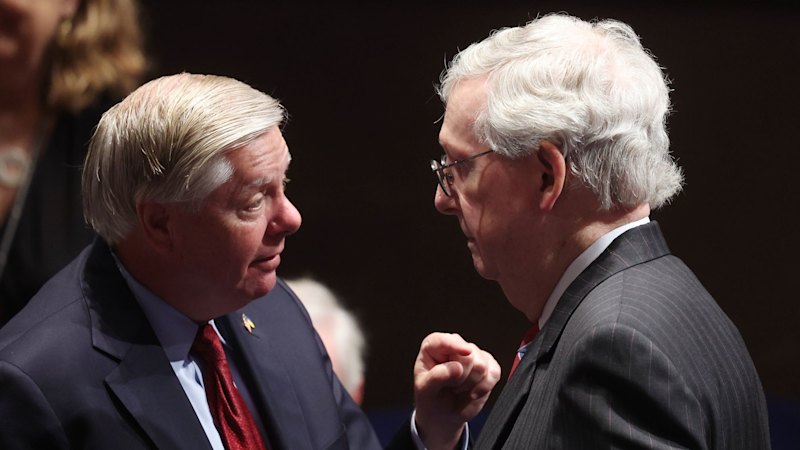
The media eulogies for Lindsey Graham are following a predictable, lazy script. Commentators are weeping over the definitive end of the "Three Amigos"—that legendary Senate trio of Graham, John McCain, and Joe Lieberman—portraying them as the last vanguard of a principled, bipartisan American foreign policy. The conventional narrative is neat, comforting, and utterly wrong. It tells a story of a bygone era of honorable hawkishness that supposedly dissolved into the transactional, protectionist chaos of the modern political climate.
This romanticized history completely misreads how Washington operates.
The Three Amigos were not tragic idealists outpaced by history. They were the ultimate transactional chameleons. Lindsey Graham’s political trajectory did not represent the death of old-school neoconservatism under the wheels of the America First movement. It represented its ultimate victory. By shedding the skin of McCain’s brand of maverick idealism and adapting to the raw transactionalism of the current era, Graham did not lose his soul. He successfully hijacked the populist right to ensure that the American war machine kept running exactly as he wanted it to.
The Myth of the Ideological Sellout
The standard critique of Graham is that he was a principled institutionalist who surrendered his values for access to power. Critics point to 2015, when he called Donald Trump a "kook" and a "race-baiting xenophobic religious bigot," and contrast it with his later status as a trusted confidant and frequent golfing partner. They view this as a pathetic capitulation.
That is an incredibly naive reading of political leverage.
In Washington, access is the currency that buys policy. Graham understood what high-minded purists failed to grasp: standing on principle from the sidelines gets you nothing but applause from journalists who will never vote for you. By swallowing his pride and offering his unvarnished loyalty, Graham secured a seat in the room where the most consequential decisions of the decade were made.
Consider the strategic dividend of that compliance. While isolationist factions thought they were reshaping the political right into a non-interventionist fortress, Graham was quietly whispering in the executive ear. The results speak for themselves. The United States did not retreat from the world stage. Instead, it engaged in an aggressive confrontational stance against Iran, continued massive funding pipelines to Ukraine, and maintained an unshakeable, unconditional alliance with Israel.
Imagine a scenario where Graham had followed the path of Never-Trump Republicans, issuing sternly worded press releases from think-tank exile. The hawkish center of gravity in American foreign policy would have collapsed. Instead, Graham played the sycophant to remain the puppet master. He proved that the DC establishment does not need to win the ideological debate if it can simply co-opt the winner.
The Illusion of Shifting Israel Politics
Mainstream analysis insists that the domestic politics surrounding Israel have fundamentally fractured, pointing to rising polarization and bitter congressional debates. They use Graham’s career as a case study in how bipartisan consensus has eroded into weaponized partisanship.
This completely confuses internet noise for legislative reality.
When you strip away the performative floor speeches and the viral social media clips, the structural mechanics of American support for Israel remain remarkably stable. The defense appropriations bills still pass. The intelligence-sharing agreements remain ironclad. The core geopolitical alignment persists regardless of who holds the gavel.
Graham’s genius was recognizing that the rhetoric needed to change even if the policy remained identical. In the era of the Three Amigos, support for foreign interventions was framed in the lofty vocabulary of democratic promotion, human rights, and the international order. Today, that language is dead. Graham simply swapped it out for the vocabulary of raw national interest, civilizational defense, and winning.
When challenged on the civilian toll of global conflicts, Graham didn't retreat to the defensive crouch of traditional diplomats. He leaned into the aggression, bluntly stating that certain conflicts were existential fights that allies could not afford to lose. It was jarring, it was controversial, but it was effective. It stripped away the hypocritical veneer of humanitarian intervention and exposed the hard truth of empire: power cares about outcomes, not aesthetics.
The Transactional Blueprint
The legacy of the Three Amigos isn't a lost golden age of bipartisan camaraderie. It is a masterclass in how a dedicated minority can dictate the foreign policy of a superpower by being entirely indifferent to party purity.
Lieberman did it from the center-left before moving independent. McCain did it by weaponizing his personal moral authority. Graham did it through shameless, calculated flattery. The methodology shifted, but the objective never changed: keeping American military might actively deployed across the globe.
I have watched political operations spend tens of millions of dollars trying to build ideological movements from the ground up, believing that if you change the hearts and minds of the voters, the policy will follow. It is an expensive delusion. Graham demonstrated the shortcut. You do not need to convert the base if you can manage the leader.
This approach comes with a brutal downside that absolute purists cannot tolerate: you must be willing to endure public humiliation and look like a hypocrite on a daily basis. You have to defend positions you once ridiculed and praise individuals you despise. For Graham, that was a bargain price to pay for the chairmanship of the Senate Judiciary and Budget committees, and the ear of the presidency.
The foreign policy establishment is currently mourning a man they claim was the last of his kind. They are missing the forest for the trees. Graham didn't take the secrets of the old guard to the grave. He left behind a definitive blueprint for how to survive, adapt, and rule in an era of absolute polarization. The Amigos are gone, but the machine they built and maintained is running exactly as intended. Stop looking for principles in the ruins of Washington foreign policy; look at the scoreboard.


