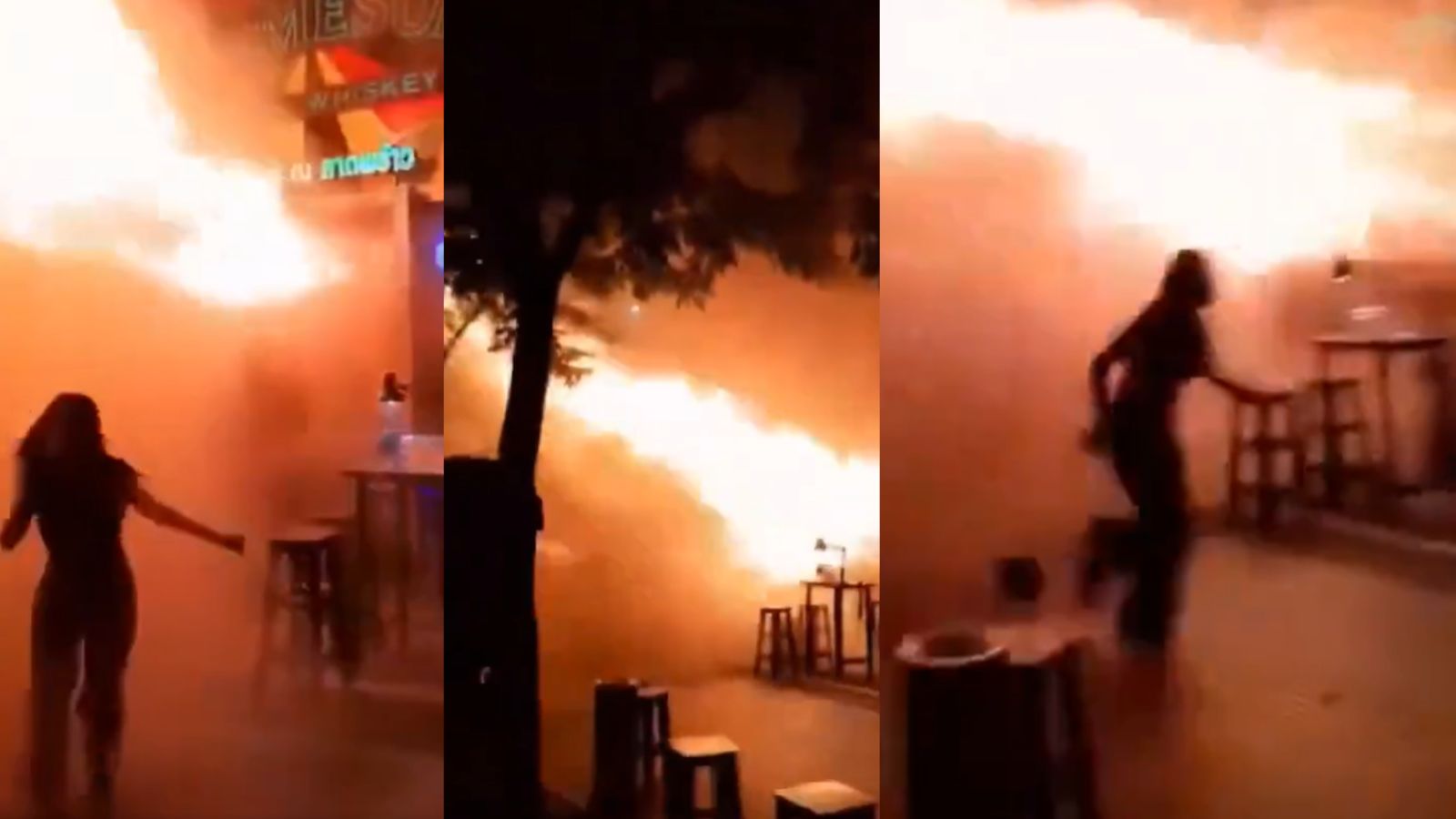
Mass casualty incidents in commercial nightlife venues are rarely the result of a single isolated failure; instead, they represent a predictable convergence of architectural bottlenecks, flammable interior finishes, and rapid-onset environmental toxicity. The fire at the Rong Beer Na Lat Phrao pub in Bangkok’s Chatuchak district, which resulted in 27 fatalities and 63 injuries, serves as a stark case study in how mechanical failures transform into human entrapment zones within minutes.
To evaluate how a localized electrical ignition can escalate into a high-fatality event in under thirty minutes, the incident must be broken down into its core operational mechanics: structural fuel load, pathfinding degradation under total blackout conditions, and directional egress occlusion.
The Thermal and Toxic Velocity Function
The rapid escalation of the fire from a localized point of origin to a structural flashover is a function of the materials used in the venue's interior design. Eyewitness and forensic accounts indicate the fire originated near a ceiling-mounted air conditioning unit or stage circuit breaker, immediately engaging the ceiling assembly.
Commercial entertainment venues frequently utilize open-cell polyurethane foam for acoustic dampening and thin plastic composite panels for aesthetic finishes. These materials possess high heat release rates and low structural resistance to ignition. When these polymers combust, they undergo thermal degradation, shifting from a solid state to highly flammable liquid droplets that accelerate downward fire spread.
This creates a dual-threat environment:
- Vertical Radiation: The ignition of ceiling materials generates a downward radiant heat flux. This rapidly brings furniture, tables, and flooring to their autoignition temperatures without requiring direct flame contact.
- Toxic Volatilization: The combustion of polyurethane and synthetic plastics generates dense concentrations of carbon monoxide (CO) and hydrogen cyanide (HCN). HCN is an uncoupling agent of oxidative phosphorylation, capable of rendering an individual incapacitated within seconds of inhalation.
The primary cause of mortality in this architecture is not thermal tissue damage, but acute hypoxia driven by these atmospheric toxins. The rapid migration of smoke from the stage area toward the primary egress points effectively severed the safest evacuation pathways before structural evacuation could be initiated by the occupants.
Pathfinding Degradation and Architectural Symmetry Blinding
The immediate consequence of the initial electrical failure was a total power outage. In high-density architectural spaces, a sudden loss of illumination introduces severe pathfinding degradation, particularly when emergency lighting systems fail to operate or are obscured by dense smoke layers.
Human exit selection during an emergency follows the familiarity heuristic. Occupants instinctively attempt to exit through the identical path they utilized to enter the venue. At the Rong Beer Na Lat Phrao pub, the main entrance also served as the primary vector for fire and smoke migration, as the blaze originated near the front stage area. This localized positioning created a physical and psychological barrier, forcing the estimated 300 occupants to abandon their primary route and seek secondary alternatives.
In total blackout conditions, mixed with rapidly descending toxic smoke, the human brain loses spatial orientation. Individuals must rely on tactile navigation—feeling along walls and structural elements to locate exits. This structural reality creates a severe trap: when architectural layouts direct fleeing crowds toward localized dead ends, such as restrooms or utility corridors, these spaces become secondary accumulation zones.
Official reports confirmed that a significant concentration of the 27 deceased victims were discovered in the venue’s restrooms located at the rear of the property. When pathfinding fails, occupants mistake restroom alcoves for exit corridors, entering enclosed spaces with zero external egress. Once inside, these rooms act as low-lying reservoirs for toxic gas accumulation, neutralizing survival margins.
The Mechanics of Egress Occlusion
The survival rate of an enclosed crowd during a fire is directly proportional to the clear width of its exit paths and the structural integrity of its discharge points. The failure of the secondary evacuation route at the venue can be attributed to two main factors: structural occlusion and spatial configuration bottlenecks.
[Ignition Source (Stage/Ceiling)] ---> [Rapid Smoke/Toxic Gas Generation]
                                                |
                                                v
                                    [Main Entrance Blocked]
                                                |
                                                v
[Internal Layout Obstructions (Tables/Chairs)] ---> [Restroom Dead-End Accumulation]
                                                |
                                                v
                                    [Obstructed Fire Exits]
Preliminary findings from the Bangkok Metropolitan Administration's Department of Disaster Prevention and Mitigation identified severe internal layout obstructions. High-density seating arrangements—specifically tightly packed tables and heavy wooden bar stools—acted as physical dissipators of kinetic energy. As a panicked crowd of approximately 300 individuals shifted toward the rear of the single-story concrete building, people tripped over unanchored furniture, creating a cascading crowd crush effect.
The second limitation involves the geometric design of the emergency exits. While the venue possessed secondary doors, an exit route that routes directly through a commercial kitchen introduces immediate secondary hazards. Kitchen spaces contain narrow aisles, heavy stainless-steel infrastructure, and potential grease fuel loads.
Furthermore, first responders noted that access to these rear exits was actively blocked by stored inventory and interior fixtures. When an emergency exit door is narrow or obstructed, the flow rate of the crowd drops exponentially. The mathematical relationship governing crowd flow through a bottleneck dictates that as density exceeds four people per square meter, the physical pressure exerted by the crowd can cause structural collapse of the individuals at the front, completely halting all forward progress.
Regulatory and Enforcement Arbitrage
The occurrence of the Chatuchak fire highlights an ongoing vulnerability within urban safety infrastructure: the divergence between static code compliance and active operational reality. The venue had reportedly passed a safety inspection in April, demonstrating that the facility met the baseline legal requirements on paper.
This reveals a systemic gap in municipal oversight. Static inspections verify the existence of hardware—such as the physical presence of an emergency door or a fire extinguisher—but fail to account for operational habits that accumulate over time. The post-inspection introduction of unrated acoustic materials, the blocking of exit pathways with service carts, and the modification of electrical loads for live performances represent real-time risk escalations that static regulatory frameworks cannot intercept.
Addressing this deficit requires a transition toward dynamic enforcement metrics. Municipalities must implement unannounced operational audits during peak capacity hours to ensure that exit pathways remain completely unobstructed, emergency backup power grids actuate instantaneously upon primary grid failure, and maximum occupancy thresholds are strictly maintained through active door counts. Until enforcement mechanisms account for the fluid nature of commercial space utilization, the structural preconditions for catastrophic crowd entrapment will persist.


