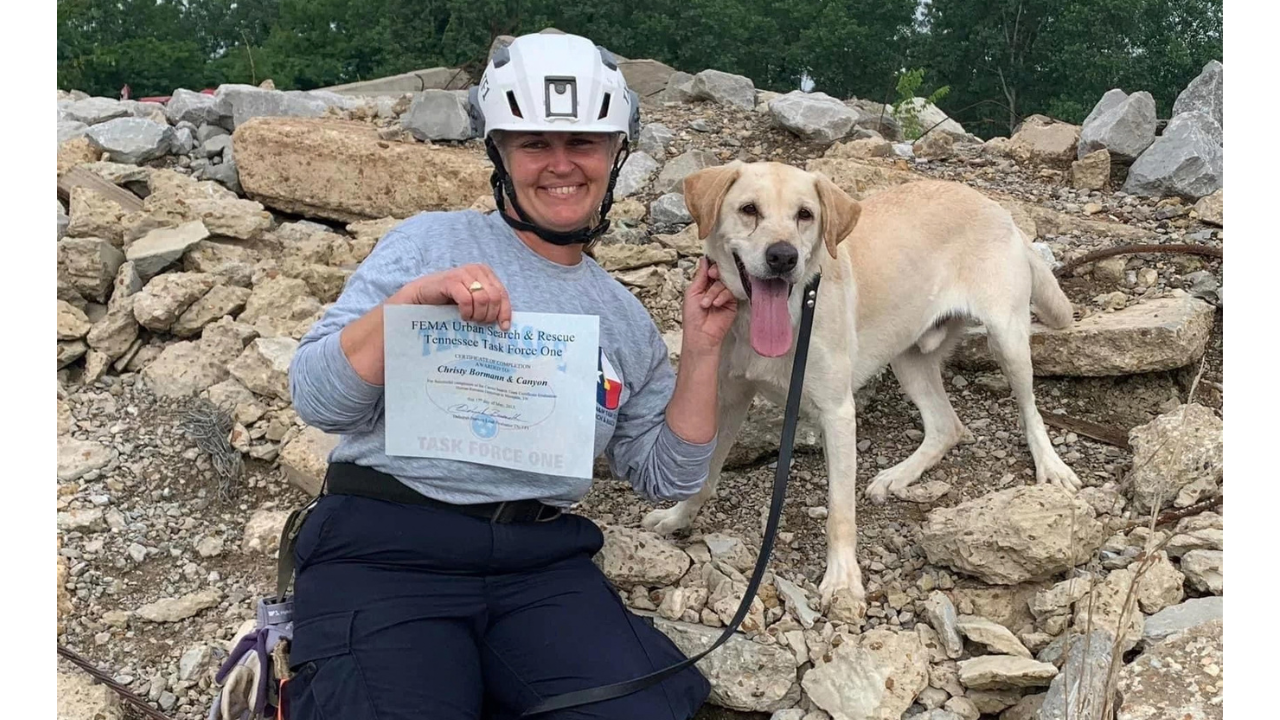
Disaster response operations require a high-throughput information-gathering mechanism capable of operating in unstructured, high-entropy environments where traditional sensors fail. While mechanical search platforms face mobility constraints in collapsed structural rubble, biological search agents—specifically canine units—provide an integrated sensory apparatus combining high-resolution olfaction, localized propulsion, and autonomous decision-making. The lifecycle efficiency of a disaster response canine is determined by three variables: genetic baseline selection, conditioning throughput, and deployment operational uptime. Analyzing an anomalous high-performer, such as a rescue dog transitioning from severe environmental deprivation to elite deployment status, exposes the operational bottlenecks and selection criteria governing effective search-and-rescue systems.
The Selection Matrix and Environmental Plasticity
Standard deployment protocols rely on pre-screened puppies sourced from controlled breeding lines with documented lineage, stable nervous systems, and high prey drive. The alternative pathway—sourcing from municipal animal shelters or rescue intake facilities—introduces a high-variance input stream. Learn more on a similar topic: this related article.
[Intake Source] ---> [Behavioral Stress Test] ---> [Drive Quantification] ---> [Operational Pipeline]
When an intake candidate originates from a background of severe malnutrition and neglect, the physiological adaptation mechanisms differ significantly from control-group subjects. The primary metric for non-traditional selection is not immediate behavioral compliance, but environmental plasticity—the speed at which an animal recovers cognitive baseline following acute stress exposure.
- Cortisol Baseline Regulation: Evaluating how rapidly an animal’s endocrine system normalizes after encountering novel stimuli or high-stress structural geometry.
- Resource-Driven Drive Persistence: Measuring focus retention when food or toy rewards are introduced under variable reinforcement schedules.
- Proprioceptive Confidence: Assessing physical movement across unstable, elevated, or claustrophobic surfaces without freezing or avoidance behaviors.
Malnutrition during the developmental window typically introduces structural growth constraints or joint vulnerabilities. However, subjects that clear veterinary clearance thresholds often demonstrate disproportionate resilience. This psychological durability—forged through early environmental pressure—frequently correlates with sustained stamina during multi-day deployment rotations in disaster zones. Additional analysis by USA Today highlights related perspectives on the subject.
The Training Throughput Function
Transforming a raw candidate into a certified Federal Emergency Management Agency urban search-and-rescue canine requires an intensive conditioning pipeline. This process operates as a deterministic function where repetition, reward timing, and olfactory discrimination training build a specialized neural network for scent tracking and source localization.
The training architecture relies on operant conditioning, transitioning from primary reinforcement (food, toy) to secondary conditioned reinforcement (marker cues), and finally to intrinsic reward driven by search completion. The primary training phases divide into distinct competency vectors:
- Olfactory Discrimination: Isolating human scent profiles (perishable organic compounds emitted via skin rafts and breath) from background contamination, including decomposing materials, accelerants, and industrial chemicals.
- Alert Mechanics: Training the dog to execute a distinct passive response (sitting, barking, or staying) upon scent source identification to prevent structural disturbance of unstable debris fields.
- Directional Control: Developing off-leash command compliance at extended distances, allowing handlers to vector the canine through grid patterns across rubble fields using whistles and hand signals.
The conversion efficiency of this pipeline is constrained by handler skill and institutional standardization. National standards mandate rigorous certification tests that evaluate off-lead obedience, ladder climbing, rubble navigation, and blind-find speed. A rescue subject that achieves certification demonstrates that early-stage environmental deficits can be entirely overwritten by high-frequency, structured behavioral shaping.
Operational Deployment Economics and System Reliability
Deploying a search canine unit into an active disaster zone—such as structural collapse sites, landslide aftermaths, or severe weather zones—presents a high-stakes resource allocation challenge. The economic and operational value of the unit lies in its time-to-detection metric compared to mechanical ground-penetrating radar, acoustic listening devices, or thermal imaging cameras.
| Detection Technology | Mobility in Debris | Scent Discrimination | Power Source / Uptime | False Positive Vector |
|---|---|---|---|---|
| Acoustic Sensors | Low (Stationary placement) | None (Sound only) | Battery-limited | Environmental noise |
| Thermal Imaging | Moderate (Line of sight) | None (Heat signature) | Battery-limited | Ambient temperature |
| Canine Units | High (Autonomous traversal) | High (Human specific) | Biological / 20-30 min bursts | Handler cueing / distraction |
The primary operational bottleneck is fatigue management. A canine conducting active air-scenting operates at peak metabolic expenditure. Optimal work-rest ratios dictate 20 to 30 minutes of active search followed by mandatory cooling and hydration intervals. Scaling a disaster response protocol requires redundant canine teams to maintain continuous search coverage without degradation in olfactory acuity.
Furthermore, public recognition metrics—such as annual operational awards—tend to focus on individual anomalies rather than systemic capacity. While an exceptional transition from an unconditioned rescue intake to an elite deployment asset provides a compelling narrative, scaling search-and-rescue infrastructure requires standardizing the intake screening protocols that identify hidden plasticity in marginalized populations, rather than relying on stochastic exceptions.
Deploy redundant handler-canine pairings to maintain uninterrupted operational coverage during prolonged disaster response cycles, and formalize early-stage behavioral stress-testing parameters to capture high-plasticity candidates from non-traditional intake streams.