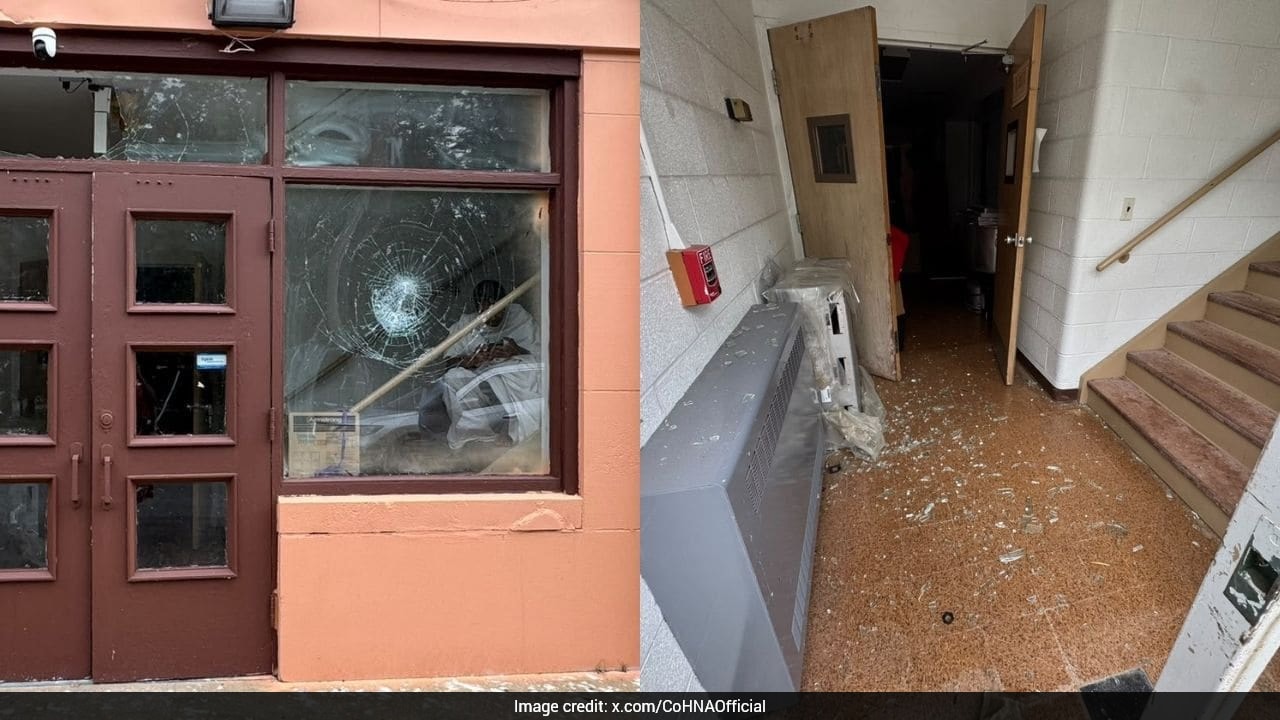
Security failures at localized houses of worship rarely stem from spontaneous anomalies. They emerge from predictable structural gaps in perimeter defense, delayed intelligence loops, and the unique friction points of open community spaces operating within polarized sociopolitical climates. When the Shree Swaminarayan Vadtal Dham Hindu Mandir in Richmond Heights, Ohio, was targeted with bricks thrown directly at the structure while priests and devotees occupied the interior
Structural Analysis of Hate Incidents and Cultural Security Architecture
news
Security failures at minority religious infrastructure are rarely isolated aberrations; instead, they function as systemic stress tests of public safety networks and community vulnerability management. When a Hindu temple in the United States experiences a direct act of physical vandalism while congregants are actively present inside, the incident demands an analytical decomposition beyond standard media reactive reporting. Evaluating such events requires moving past emotive headlines to examine the underlying risk vectors, the operational mechanics of community defense, and the broader institutional response frameworks necessary to mitigate escalation.
The Threat Vector Matrix
Physical attacks against faith-based sanctuaries rely on predictable vulnerabilities that security architects categorize into three distinct structural vectors.
The first vector is spatial accessibility. Unlike commercial properties or heavily guarded state installations, houses of worship are historically designed for open civic engagement, welcoming strangers and community members alike. This architectural openness inherently creates a low-friction entry point for actors seeking maximum psychological impact with minimal tactical resistance.
The second vector is symbolic visibility. Houses of worship serve as concentrated nodes of cultural identity. When an external actor seeks to target a specific demographic, these locations provide a stationary, universally recognized focal point. The presence of devotees inside during an attack elevates the event from property damage to a direct assault on personal safety, maximizing psychological resonance within the diaspora community.
The third vector is systemic deterrence deficits. Municipal law enforcement agencies operate under resource constraints that preclude static, 24-hour protection for every religious institution within a jurisdiction. Consequently, perpetrators calculate a high probability of temporal gaps between law enforcement response times and the execution of the offense.
The Economics of Institutional Hardening
Mitigating these vulnerabilities involves a rigorous cost-function analysis. Communities face a continuous trade-off between open spiritual access and baseline physical security. Implementing robust defense mechanisms requires shifting from reactive post-incident policing to proactive target hardening.
Physical infrastructure improvements represent the baseline investment. This includes upgrading perimeter fencing, installing impact-resistant ballistic glass, deploying high-definition closed-circuit television networks with automated night-vision capabilities, and establishing controlled-access entry points. However, physical barriers alone are insufficient without a synchronized human security protocol.
Operational security demands the establishment of trained community watch committees, standardized emergency communication protocols with local law enforcement, and clear evacuation hierarchies. The financial burden of these measures often creates a resource disparity, leaving smaller congregations structurally exposed compared to heavily endowed institutions. Addressing this disparity requires public-private security grant mechanisms that subsidize hardening initiatives without compromising civil liberties.
Systemic Failure Points in Public Safety Integration
When an incident occurs, the aftermath typically reveals friction within the information-sharing pipeline between minority community organizations and municipal intelligence apparatuses. Effective threat mitigation relies on early indicator detection, yet local law enforcement agencies frequently lack specialized cultural literacy regarding minority religious symbols, text-based grievances, or transnational hate groups operating locally.
This disconnect creates a systemic lag. Without specialized intelligence units tracking bias-motivated threats against specific religious minorities, law enforcement agencies remain in a perpetually reactive posture. Elevating institutional response requires formalizing liaison networks between community leadership and regional intelligence centers, ensuring that low-level harassment and online threats are systematically logged and analyzed before escalating into physical violence.
Strategic Frameworks for Resilience
Long-term risk reduction depends on institutionalizing three operational shifts.
First, civil rights frameworks must recognize targeted attacks on cultural infrastructure not merely as misdemeanor vandalism, but as strategic efforts to intimidate protected classes, thereby warranting elevated federal investigative priorities and resource allocation.
Second, community organizations must transition from informal volunteer security to certified, professionalized risk management models that incorporate standardized threat assessments and continuous crisis simulation training.
Third, municipal policy must integrate cultural security metrics into broader urban planning strategies, ensuring that local zoning and safety ordinances account for the specific vulnerability profiles of minority institutions.
Sustainable security is not achieved through temporary outrage cycles, but through the systematic execution of defensive architecture, intelligence sharing, and resource distribution designed to eliminate the operational window for politically or racially motivated aggression.