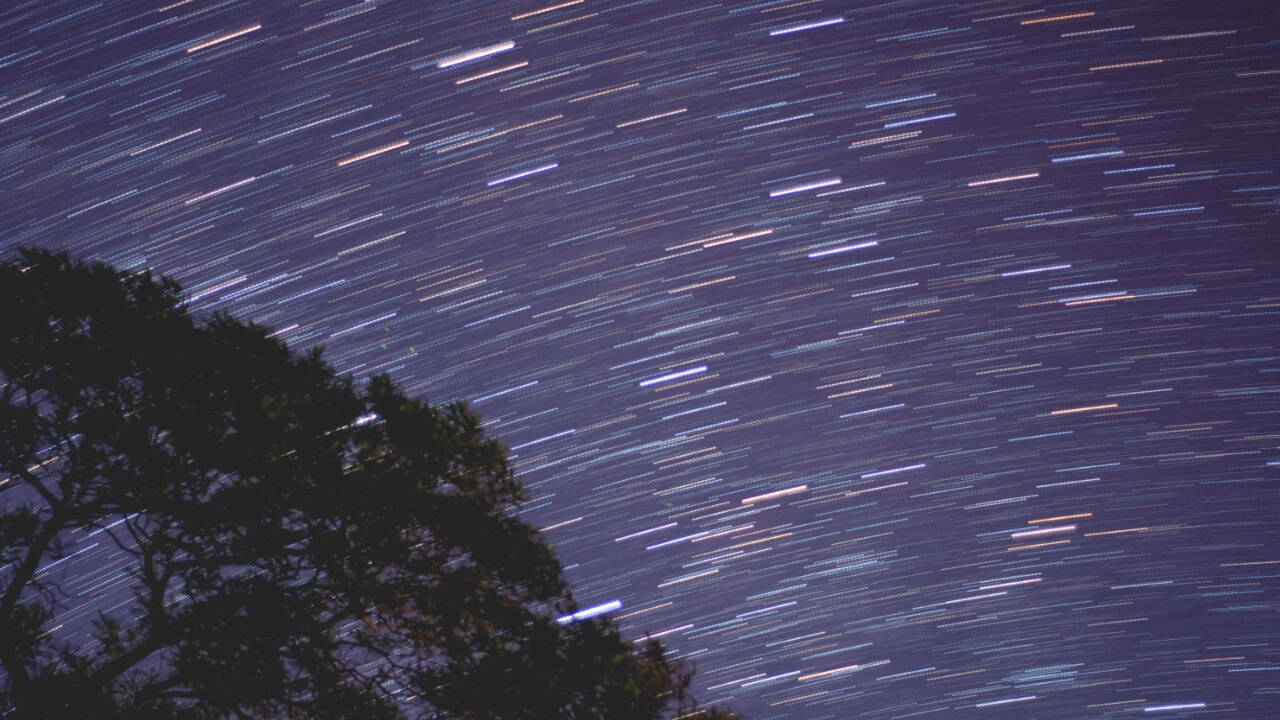
Observational astronomy in November suffers from a persistent operational failure—viewers treat celestial mechanics as passive entertainment rather than a signal-to-noise optimization problem. Standard skywatching guides list dates for meteor showers and lunar phases without accounting for the physical variables that govern visibility: atmospheric extinction, lunar albedo interference, and radiant altitude. When Earth intersects the debris streams of Comet 55P/Tempel-Tuttle (the Leonids) and Comet 2P/Encke (the Taurids) while simultaneously navigating lunar perigee, success requires calculating the exact temporal windows where solar depression angle and lunar phase create usable contrast.
The Physics of November Debris Intersections
Meteor showers are not atmospheric weather events; they are high-velocity kinetic intersections between Earth’s orbital path and cometary ablation trails. The November calendar features two distinct debris architectures that behave according to entirely different physical rules.
The Taurid Complex and Resonant Swarm Mechanics
The Northern and Southern Taurids originate from Comet 2P/Encke, an ancient, fragmented body whose debris stream has dispersed over millennia due to planetary perturbations, primarily from Jupiter. Unlike narrow, dense cometary trails that produce brief, intense outbursts, the Taurid stream exhibits a broad cross-section. Earth spends weeks traversing this dust cloud, resulting in low Zenithal Hourly Rates (ZHR)—typically five to ten meteors per hour under ideal dark-sky conditions.
The operational value of the Taurids lies not in volume, but in mass distribution. Gravitational resonance with Jupiter occasionally shepherds larger millimeter-to-centimeter-sized fragments into concentrated filaments known as the Taurid Resonant Swarm. Because these particles enter Earth's atmosphere at a relatively low geocentric velocity of approximately 27 to 29 kilometers per second, they experience prolonged ablation. This slower deceleration allows larger meteoroids to penetrate deeper into the stratosphere before disintegrating, producing high-magnitude bolides and fireballs. Observational strategy here requires prioritizing wide-field sky coverage over high-frequency counting, as a single Taurid event can exceed the apparent brightness of Venus (magnitude -4).
The Leonid Velocity Vector
The Leonid meteor shower operates on the opposite end of the kinetic spectrum. Sourced from Comet 55P/Tempel-Tuttle, the Leonid stream orbits the Sun in a retrograde direction—opposite to Earth’s prograde motion. This geometric alignment produces a head-on collision with Earth’s atmosphere at approximately 71 kilometers per second, near the theoretical maximum for solar system bound objects.
Kinetic energy scales with the square of velocity ($E_k = \frac{1}{2}mv^2$). A Leonid particle possesses roughly six times the kinetic energy of a Taurid particle of identical mass. When a Leonid meteoroid strikes the upper atmosphere at 100 to 120 kilometers altitude, the extreme ram pressure ionizes surrounding air molecules instantaneously. This creates persistent trains—glowing columns of ionized gas and excited sodium atoms that remain visible for minutes after the solid particle has vaporized. However, the shower's radiant, located in the sickle of the constellation Leo, does not rise above the eastern horizon until local midnight. Attempting to observe the Leonids during evening hours yields zero valid data, as the Earth itself physically blocks the incoming debris stream.
The Lunar Albedo Bottleneck and Perigee Dynamics
The primary failure mode for November meteor observation is stray light pollution from the Moon. Most casual guides celebrate the occurrence of a November supermoon—a full moon coinciding with lunar perigee—without explaining how this event degrades deep-sky and meteor visibility across a ten-day operational window.
Orbital Eccentricity and Angular Diameter
The Moon’s orbit around Earth is an ellipse with an eccentricity of approximately 0.0549. Consequently, the Earth-Moon distance fluctuates between roughly 356,500 kilometers at perigee and 406,700 kilometers at apogee. When the full phase aligns within 90 percent of perigee, the lunar disk presents an apparent angular diameter up to 14 percent larger and an illuminance roughly 30 percent brighter than an apogee full moon.
This increase in illuminance directly elevates sky background brightness. Through Rayleigh scattering and Mie scattering—where sunlight reflected off the lunar regolith interacts with atmospheric nitrogen, oxygen, and aerosols—the sky takes on a uniform luminescent veil. In astronomical photometry, this raises the limiting magnitude of the sky. Under moonless Bortle Class 2 conditions, the human eye detects stars and meteors down to magnitude +6.5. A perigee full moon drops that threshold to magnitude +3.0 or +4.0, effectively erasing 80 to 90 percent of faint Leonid and Taurid meteors from visual detection.
The Lunar Illusion and Atmospheric Refraction
Observers frequently misattribute the visual scale of a rising perigee moon to optical magnification. In reality, a camera lens with a fixed focal length records the rising Moon at the exact same pixel diameter as the Moon at zenith—in fact, it is marginally smaller at the horizon because the observer is farther from the Moon by one Earth radius (approximately 6,371 kilometers).
Two distinct mechanisms govern the horizon observation:
- Atmospheric Extinction and Rayleigh Scattering: When the Moon sits at low altitude, its light traverses up to 40 air masses compared to a single air mass at zenith. Shorter blue wavelengths scatter out of the line of sight, leaving longer red and orange wavelengths to reach the observer. This reduces total surface brightness, allowing the human retina to resolve lunar maria (basaltic plains) and ray craters without saturation.
- Cognitive Scaling: The Ponzo illusion and relative size contrast against terrestrial foreground objects force the human visual cortex to process the lunar disk as substantially larger than when suspended in an empty zenith sky.
Planetary Opposition and Elongation Mechanics
November routinely places outer planets into prime observational geometry, governed by synodic periods and orbital mechanics rather than arbitrary calendar dates.
Superior Planets at Opposition
When an outer planet—such as Jupiter, Saturn, or Uranus—reaches opposition, Earth passes directly between the Sun and the target planet. This configuration optimizes three observational variables simultaneously:
- Minimum Distance: The planet is at its closest point to Earth for the current synodic cycle, maximizing its apparent angular diameter in telescope eyepieces.
- Maximum Illumination: The planet presents a 100 percent illuminated disk, eliminating phase shadows and maximizing total reflected flux.
- All-Night Visibility: The planet rises in the east precisely at sunset, transits the local meridian at local midnight, and sets in the west at sunrise.
Observing a superior planet at transit (midnight) is critical for high-resolution planetary imaging. At transit, the target reaches its maximum altitude above the horizon, minimizing the column of turbulent Earth atmosphere (astronomical seeing) through which light must pass. Observing the same planet two hours after sunset introduces severe chromatic dispersion and thermal turbulence, blurring fine cloud bands on Jupiter or the Cassini Division in Saturn’s rings.
Inferior Planet Elongation Constraints
Mercury and Venus, orbiting closer to the Sun than Earth, never reach opposition. Their observational windows are strictly bounded by maximum eastern or western elongation—the greatest angular separation between the planet and the Sun as viewed from Earth. In November, northern hemisphere observers face specific ecliptic geometry challenges. During autumn evenings, the ecliptic—the apparent path of the Sun and planets across the sky—intersects the western horizon at a shallow angle. Even when Mercury reaches maximum eastern elongation, its low altitude above the horizon places it deep within the twilight glare and thick atmospheric extinction layer. Conversely, pre-dawn western elongations in autumn benefit from a steep morning ecliptic angle, lifting Venus or Mercury rapidly out of the solar glare into dark skies.
Atmospheric Transmission and Seeing Variables
Possessing exact ephemeris data for November events guarantees nothing if local atmospheric physics are ignored. Observational astronomy operates entirely at the mercy of the Earth’s troposphere.
Transparency vs. Seeing
Analysts must separate two distinct atmospheric metrics that are routinely conflated:
- Transparency: A measure of atmospheric clarity, dictated by water vapor content, smoke, dust, and aerosol concentration. High transparency is mandatory for observing faint, diffuse targets like meteor trails, nebulae, and galaxies. Cold, dry Canadian high-pressure systems moving south in November often deliver exceptional transparency.
- Seeing: A measure of atmospheric stability, governed by laminar versus turbulent airflow across thermal boundaries. The polar jet stream frequently dips southward in November, introducing high-velocity wind shear at the tropopause (around 10 kilometers altitude). This turbulence creates rapid refractive index fluctuations, causing point sources like stars and planetary disks to scintillate and smear. A crisp, transparent November night often produces terrible astronomical seeing, rendering high-magnification planetary observation impossible while remaining ideal for wide-field meteor watching.
The Thermal Equilibrium Bottleneck
Telescopes and optical instruments stored indoors at 20°C and deployed into 2°C November night air experience severe internal tube currents. Warm air rising off the primary mirror or objective lens creates localized refractive distortion identical to atmospheric turbulence. Large-aperture reflectors require 45 to 60 minutes of active ventilation or passive cooling to reach ambient thermal equilibrium before high-resolution observation can begin.
Limitations of Predictive Models
Meteor forecasting relies on numerical integrations of cometary dust trails ejected during past perihelion passages. While models for the Leonids can predict filament encounters down to the exact minute, inherent uncertainties remain. Cometary outgassing is non-uniform; solar heating creates localized jets on the comet nucleus that impart unpredictable non-gravitational accelerations to ejected particles. Furthermore, the Taurid complex is so heavily diffused by centuries of planetary perturbations that predicting exact fireball rates on a given night remains probabilistic rather than deterministic. Local microclimates—such as valley radiation fog or lake-effect cloud formation triggered by cold air moving over warm autumn waters—can invalidate regional clear-sky forecasts within minutes.
Tactical Execution Protocol for November Observation
To extract maximum observational yield from November’s celestial schedule, execute the following operational sequence rather than relying on general calendar alerts:
- Audit Lunar Interference First: Cross-reference peak meteor dates against the lunar phase calendar. Discard any observing window where the Moon is greater than 40 percent illuminated and above the horizon during the target radiant's peak altitude. Shift meteor observation sessions to the dark-sky window between moonset and astronomical twilight (when the Sun is 18 degrees below the horizon).
- Align Observation with Radiant Transit: For the Leonids, deploy no earlier than 01:00 local time, when Leo clears 30 degrees altitude in the east. Direct your field of view 45 degrees away from the radiant point and 50 degrees above the horizon; meteors seen directly at the radiant appear foreshortened, whereas off-axis viewing captures longer, easily detectable ionization trails.
- Prioritize Naked-Eye Wide-Field Geometry for Meteors: Abandon binoculars and telescopes for meteor showers. A telescope’s narrow field of view (often less than 1 degree) restricts sky coverage to less than 0.005 percent of the visible hemisphere. Utilize dark-adapted human vision (requiring 30 minutes of zero exposure to white or blue light) to monitor the maximum possible solid angle of the sky.
- Time Planetary Sessions to Meridian Transit: Schedule telescopic observation of superior planets within 60 minutes of their local meridian transit time, when altitude is highest and atmospheric air mass is minimized. Deploy optical equipment outdoors at least 45 minutes prior to transit to eliminate thermal tube currents.
- Filter Forecast Data by Jet Stream Velocity: Consult upper-atmosphere wind speed maps at the 300-millibar level before setting up high-magnification optics. If overhead jet stream velocities exceed 35 meters per second, abandon high-resolution planetary targets and pivot immediately to low-magnification deep-sky clusters or naked-eye meteor tracking where atmospheric seeing is irrelevant.