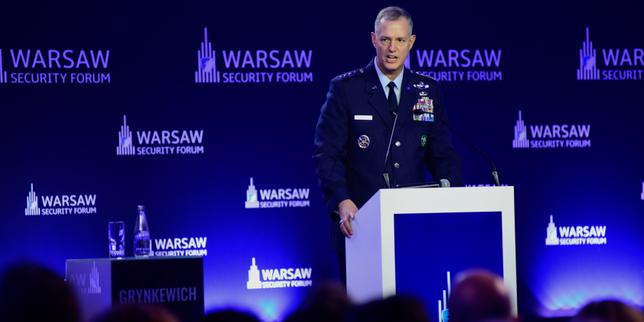
Surprise attacks sound like Hollywood movie plots, but in modern military strategy, nations spend billions trying to ensure they never actually happen in the real world. When top allied military leaders step up to microphones and claim that a sudden, unannounced strategic strike against the Atlantic alliance is practically off the table, skeptics roll their eyes. History is filled with unexpected offensives, from Pearl Harbor to the opening days of the 2022 invasion of Ukraine.
Yet the architecture of global defense has shifted dramatically. Today's battlefield isn't just about trenches and tanks. It's an omnipresent grid of high-altitude reconnaissance satellites, electronic signals intelligence, cyber monitoring, and persistent aerial patrols. If a major power starts moving heavy armor, fuel supplies, or logistics columns toward a frontier, space-based optics catch it before the engines even warm up.
The Anatomy of Modern Warning Systems
You can't hide a modern military buildup. That's the core argument behind the alliance's confidence. Decades ago, commanders could mass divisions under the cover of bad weather or nightfall. Today, synthetic aperture radar can see straight through cloud cover, rain, and darkness. Infrared sensors track heat signatures from hidden encampments. Signals intelligence intercepts encrypted tactical chatter months before an operation kicks off.
Think about what happened in early 2022. Western intelligence agencies watched Russian forces gather on Ukraine's borders for months, publishing maps, troop counts, and projected timelines in real-time. While the political leadership struggled to deter the conflict, the military intelligence failure of a hidden surprise attack was entirely absent. Everyone knew it was coming. The warning time wasn't minutes or hours; it was weeks and months.
NATO's posture relies on this transparency. The idea is simple: if an adversary knows you can see their every move, the perceived tactical benefit of a surprise strike evaporates. Deterrence works best when the element of surprise is stripped away entirely.
Where Traditional Intelligence Falls Short
Of course, knowing something is happening and knowing what to do about it are two entirely different challenges. This is where military analysts often point out the dangerous gap in high-level optimism. Intelligence agencies suffer from confirmation bias, political interference, and analytical fatigue.
During the Yom Kippur War in 1973, Israeli intelligence had massive amounts of data indicating an impending attack. Analysts simply misinterpreted the intentions behind the troop movements, assuming Arab nations were merely conducting routine exercises. The data was there. The human judgment failed.
That vulnerability still exists. Satellites can photograph every tank on a highway, but they cannot take a snapshot of a political leader's mind. They cannot measure the exact threshold where saber-rattling turns into a genuine order to fire.
Cyber warfare and hybrid tactics further complicate the picture. A physical invasion requires massive logistics trains that are impossible to conceal. A cyber assault against power grids, financial networks, or satellite command chains takes a fraction of a second and leaves very few footprints until the lights go out. When leaders talk about avoiding surprise attacks, they are usually talking about conventional military invasions. The gray zone of hybrid warfare remains remarkably murky.
The Cost of Absolute Preparedness
Maintaining a posture where surprise is impossible comes with a staggering financial and operational price tag. Allied commands must maintain 24-hour watch rotations, keep vast intelligence-gathering networks funded, and share sensitive information across dozens of member states with differing political priorities.
Information sharing is notoriously difficult. NATO operates on a consensus model. If one member state doubts the intelligence provided by another, friction builds immediately. Bridging those political gaps requires constant diplomatic upkeep. You can have the best radar systems in the world, but if political leaders hesitate to act on the warnings because of economic ties or diplomatic fatigue, the technology is useless.
Commanders must also deal with the phenomenon of false alarm fatigue. When intelligence agencies constantly warn of impending threats that fail to materialize, public and political support starts to wane. Leaders get tired of bracing for crises that stall out. Striking the right balance between vigilance and alarmism is an ongoing tightrope walk for defense chiefs.
Redefining Defense in a Multipolar World
The nature of strategic surprise is changing because the global security landscape is shifting away from traditional state-on-state conflicts. We live in an era of proxy battles, economic coercion, information manipulation, and sub-conventional skirmishes.
An adversary doesn't need to launch a blitzkrieg across a European plain to achieve their strategic goals anymore. They can undermine democratic institutions from the inside, disrupt undersea communication cables, or manipulate energy supplies. These actions don't trigger traditional military alarms, yet they can be just as devastating as an armed incursion.
When alliance leaders claim that a surprise military attack is impossible, they are speaking strictly about large-scale conventional warfare. They understand that satellites, drones, and SIGINT stations have effectively closed the window on undetected invasions. But defending against modern threats requires looking far beyond traditional borders and military bases.
Keeping nations secure means building resilience into critical infrastructure, hardening digital networks against sabotage, and teaching the public to spot sophisticated disinformation campaigns. The next major shock to global security probably won't arrive with rolling tanks. It will likely slip through a digital backdoor or exploit an economic dependency while everyone is busy watching the horizon for a conventional army that never comes.