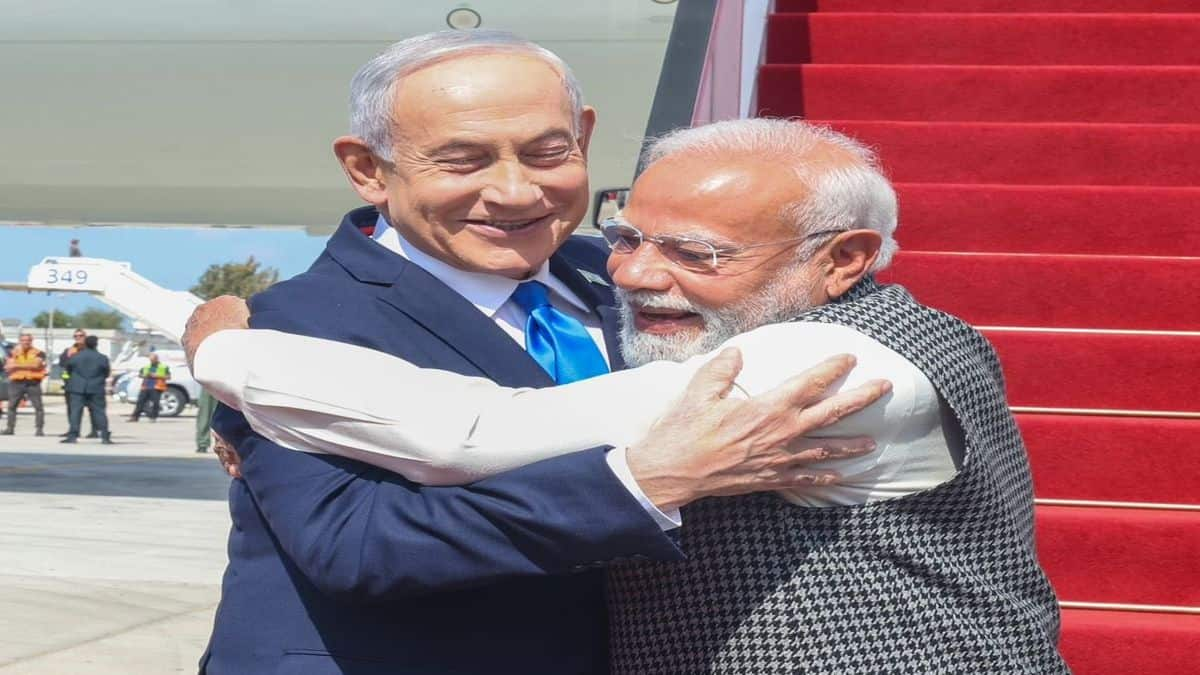
The diplomatic architecture between India and Israel has transitioned from a historical period of "hesitant engagement" to a high-velocity strategic partnership defined by transactional necessity and ideological congruence. While media narratives focus on the personal chemistry between Narendra Modi and Benjamin Netanyahu, a structural analysis reveals that this alignment is driven by three measurable pillars: defense-industrial interdependence, shared asymmetric threat profiles, and the pursuit of technological sovereignty. The "hugs and praise" observed in bilateral summits are not the drivers of policy; they are the symbolic lubricants for a deep-seated convergence of national interests that persists regardless of domestic political shifts in either Jerusalem or New Delhi.
The Defense Procurement Cycle and Localized Co-Production
The Indo-Israeli relationship is anchored by a massive defense-industrial complex. India is Israel’s largest buyer of military hardware, accounting for approximately 37% of Israeli arms exports between 2018 and 2022. However, the nature of this trade has shifted from a buyer-seller model to a co-development framework necessitated by India’s "Make in India" initiative.
This shift is governed by a specific Transfer of Technology (ToT) utility function. Israel, unlike many Western suppliers, provides high-end military technology with fewer "end-use" monitoring constraints. This allows India to integrate Israeli subsystems into indigenous platforms. Key examples include:
- Barak-8 Surface-to-Air Missiles: A joint venture between DRDO and Israel Aerospace Industries (IAI) that secures India’s naval assets.
- Phalcon AWACS: Integrating Israeli radar systems onto Russian Il-76 airframes, creating a hybrid intelligence capability.
- Small Arms and Loitering Munitions: Establishing production lines for Tavor rifles and Harop drones within Indian borders through ventures like Astra-Rafael.
The bottleneck in this relationship is not political will but the absorption capacity of India's defense public sector undertakings (PSUs). Israel’s role is to bridge the "innovation-to-mass-production" gap that often plagues Indian domestic defense manufacturing.
The Asymmetric Warfare Convergence
Both nations operate within volatile regional subsystems where non-state actors and state-sponsored proxies define the security threat. This creates a shared requirement for Intelligence, Surveillance, Target Acquisition, and Reconnaissance (ISTAR) capabilities.
The logic of their cooperation is rooted in the "Zero-Sum Security" principle. For Israel, India represents a massive market and a reliable partner that does not condition security cooperation on the Palestinian issue. For India, Israel provides the technical means to monitor borders with Pakistan and China without the political baggage often attached to American or European systems.
The integration of Israeli Pegasus-style digital forensic tools and Heron drones provides India with a persistent surveillance capability over difficult terrain. The efficacy of this cooperation is measured by the reduction in response time during border incursions. By sharing tactical doctrines on counter-terrorism and urban warfare, both states optimize their internal security spending through shared "best practices" derived from active combat experience.
De-hyphenation as a Diplomatic Framework
The most significant shift in the Modi-Netanyahu era is the formalization of "de-hyphenation." Historically, India's relations with Israel were constrained by its commitment to the Palestinian cause and its energy dependence on the Arab world. The current strategy decouples these two tracks.
This decoupling functions through a Multi-Vector Alignment Strategy:
- The Abraham Accords Variable: The normalization of relations between Israel and several Arab states (UAE, Bahrain, Morocco) removed the "reputational cost" for India to engage openly with Israel.
- I2U2 (India, Israel, UAE, USA): This "West Asian Quad" focuses on joint investments in water, energy, transportation, and space. It transforms the bilateral relationship into a regional economic bloc.
- Energy Security Balance: While India remains dependent on Gulf oil, it views Israel as a partner for the "Green Transition," focusing on solar storage and green hydrogen.
The risk to this framework is the volatility of the Middle East. India’s pursuit of the IMEC (India-Middle East-Europe Economic Corridor) relies on a stable Israel. Any prolonged regional conflict forces India to revert to a more cautious, "neutrality-seeking" posture to protect its eight million citizens working in the Gulf.
Technological Sovereignty and Agricultural Resilience
Beyond the theater of war, the India-Israel partnership addresses fundamental resource scarcities. India’s agricultural sector, which employs nearly half its population, faces an existential threat from groundwater depletion. Israel’s mastery of Micro-Irrigation and Desalination provides a scalable solution.
The establishment of "Centers of Excellence" across India is not a philanthropic gesture but a strategic market expansion for Israeli ag-tech firms like Netafim. The logic is simple: by increasing Indian crop yields through Israeli drip irrigation, Israel secures a dominant position in the world’s largest emerging agricultural market.
In the technology sector, the focus has moved to Semiconductors and Cyber-Security. As India attempts to build a domestic chip ecosystem, Israeli design expertise becomes a critical input. The "Innovation Bridge" between Bengaluru and Tel Aviv facilitates a flow of venture capital and intellectual property that bypasses traditional hubs in Silicon Valley.
The Friction Points and Structural Limits
A rigorous analysis must acknowledge the "tapering effect" of this partnership. There are three primary constraints:
- The Russia-China Vector: India maintains a deep, path-dependent relationship with Russia for hardware and energy. Israel is a critical ally of the United States. If US-China or US-Russia tensions force a "binary choice" on global players, the India-Israel axis will face immense stress as they are pulled toward different poles.
- Trade Imbalance: Outside of defense and diamonds, bilateral trade remains relatively low ($10 billion range). The failure to finalize a Free Trade Agreement (FTA) indicates lingering protectionist impulses in the Indian bureaucracy and niche market concerns in Israel.
- Domestic Political Volatility: While the personal bond between Modi and Netanyahu is strong, it creates a "concentration risk." If the leadership in either country shifts toward parties with different ideological foundations, the pace of high-profile cooperation may slow, even if the underlying military-industrial ties remain intact.
Strategic Forecast: From Bilateralism to Integrated Systems
The future of the India-Israel relationship will be defined by the integration of their respective digital and physical infrastructures. We are moving toward a phase of Deep Interoperability.
Strategic stakeholders should anticipate the following:
- Expansion of the IMEC Corridor: If the geopolitical heat in Gaza and Lebanon subsides, expect India to double down on using Israeli ports (like Haifa, owned by the Adani Group) as the gateway for Indian goods into Europe. This is a direct hedge against the Chinese Belt and Road Initiative.
- Cyber-Kinetic Defense Units: Expect the formalization of joint cyber-command exercises as state-backed hacking becomes a standard tool of regional rivalry.
- Space-Based Collaboration: Leveraging India’s low-cost launch capabilities (ISRO) with Israel’s miniaturized satellite technology for global commercial applications.
The relationship is no longer a "friendship" in the sentimental sense. It is an optimized, high-yield asset in the portfolios of both nations. The "hugs" are merely the public-facing evidence of a cold, calculated alignment of two middle powers seeking to maximize their autonomy in a multipolar world.
India must prioritize the acceleration of the FTA to move the relationship beyond the defense silo. Without a diversified economic base, the partnership remains vulnerable to shifts in global arms market dynamics. Israel, conversely, must ensure its tech transfers translate into genuine "co-creation" to remain India's preferred partner over increasingly aggressive competitors from France and the United States.
The next logical step for the Indian Ministry of External Affairs is the institutionalization of the I2U2 framework into a permanent secretariat to insulate these projects from the cyclical volatility of West Asian politics.