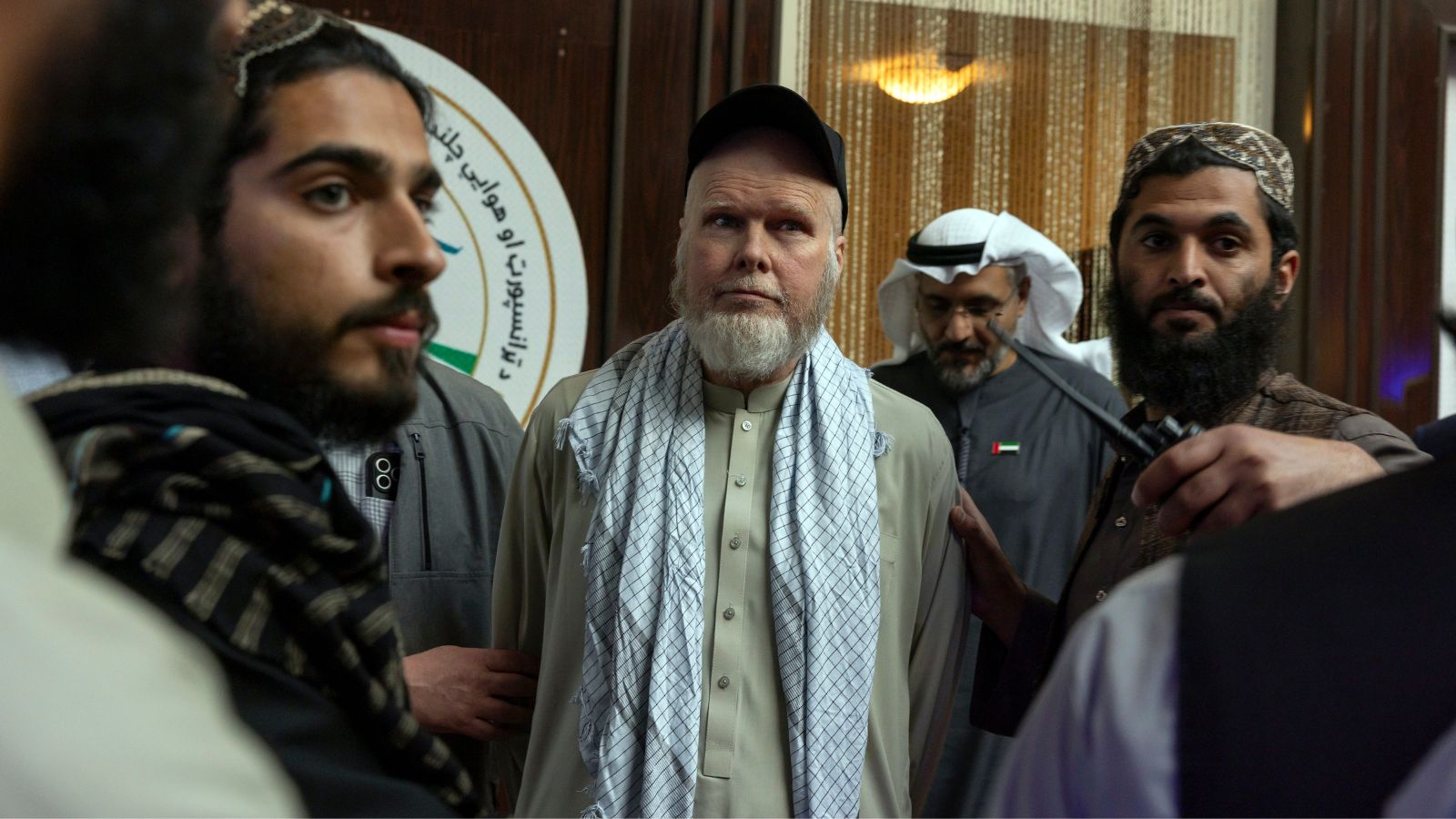
The silence of a cell is never truly silent. It is a thick, heavy thing, composed of the hum of distant generators, the rhythmic scuff of a guard’s boot, and the sound of a man’s own heartbeat thudding against his ribs like a trapped bird. For Dennis Coyle, that silence lasted five hundred days. It was a span of time measured not in calendars, but in the slow migration of sunlight across a patch of cracked concrete.
When the news broke that the Taliban had agreed to release the American legal consultant, the headlines were predictably sterile. They spoke of "diplomatic breakthroughs" and "negotiated frameworks." They treated Coyle like a piece on a chessboard, a transactional asset moved from one square to another to satisfy the geopolitical appetites of Washington and Kabul. But a man is not a footnote. To understand why this release matters, we have to look past the press releases and into the shadow of the Hindu Kush.
Coyle wasn't a soldier. He wasn't a spy. He was a man who went to Afghanistan to work on commercial law, a task that seems almost absurdly mundane in a land defined by decades of fire. He was detained in August 2022, shortly after the one-year anniversary of the chaotic U.S. withdrawal. He vanished into the machinery of a nascent government that the rest of the world refused to recognize.
The Geography of a Disappearance
Imagine standing in a marketplace in Khost. The air tastes of diesel and toasted saffron. You are there to do a job, to bridge the gap between international legal standards and a reality that is shifting beneath your feet. Then, the tap on the shoulder. The polite, firm insistence. The world shrinks.
The detention of Dennis Coyle was never just about Coyle. It was a symptom of a much larger, more jagged problem: how do two entities communicate when they don't even agree on each other’s right to exist? The Taliban wanted legitimacy, frozen assets, and a seat at the table. The United States wanted its citizens back and a guarantee that the country wouldn't revert to a global launchpad for terror.
Caught in the middle was a private citizen who likely spent his afternoons wondering if his family remembered the specific pitch of his laugh.
Negotiations for detainees like Coyle are rarely a straight line. They are a jagged series of "if-then" statements whispered in the backrooms of Doha. For months, the Biden administration signaled that the release of Coyle and fellow American Ryan Corbett—who remains held—was a non-negotiable prerequisite for any thawing of relations. The Taliban, meanwhile, played a game of strategic patience. They knew that in the American political cycle, a captive is a ticking clock.
The Human Cost of High Stakes
We often talk about "geopolitical leverage" as if it’s an abstract concept, like gravity or inflation. It isn't. Leverage is the weight of a daughter’s tears when she realizes her father is missing another birthday. Leverage is the gray hair that sprouts on a spouse’s head during the long nights of wondering if a loved one is eating, sleeping, or breathing.
The mechanics of Coyle's release involved a complex dance. It required the mediation of third-party countries, likely Qatar or the United Arab Emirates, acting as the nervous system for a body that refused to let its left hand talk to its right. The Taliban's decision to let him go suggests a calculated shift. They are realizing that holding Americans indefinitely provides diminishing returns. You can only squeeze a stone for so long before you realize you're just getting tired, not thirsty.
Consider the reality of the captors themselves. For the Taliban, a prisoner like Coyle is a burden as much as a prize. He requires guards, food, and medical attention. More importantly, he represents a permanent barrier to the international banking systems they desperately need to revive a collapsing economy.
But for the American public, the story is simpler. It’s about a seat at the dinner table that has been empty for nearly two years. It’s about the terrifying realization that in the modern world, being an American abroad can suddenly make you a high-value currency in a market you never chose to enter.
The Invisible Framework
The release wasn't an act of charity. It was a cold, hard trade, even if the "currency" hasn't been fully disclosed. Historically, these exchanges involve the release of Afghan prisoners held in third countries or the easing of specific, targeted sanctions that allow humanitarian aid to flow more freely.
Wait. The logic here is brutal. If the U.S. gives too much, they incentivize the taking of more hostages. If they give too little, the captive rots.
This is the tightrope walked by the Special Presidential Envoy for Hostage Affairs. Every word is weighed. Every concession is measured against the precedent it sets. While the public sees a sudden "agreement," the reality is a grueling marathon of incremental trust-building. You start by asking if the prisoner can have a letter. You move to a phone call. You eventually get to a plane idling on a tarmac in the middle of the night.
The release of Dennis Coyle provides a flicker of hope for those still held in the dark. It proves that the channels, however clogged with dust and animosity, still function. It proves that there is a price for human life that both sides are willing to pay, however grudgingly.
The Weight of the Return
Coming home isn't like the movies. There are no slow-motion runs across a tarmac. Instead, there is the overwhelming sensory assault of a world that didn't stop while you were gone. The colors are too bright. The noises are too sharp. The people are too many.
Coyle returns to a country that has moved on to new crises, new elections, and new wars. He returns to a legal landscape that he once tried to navigate, now fundamentally altered by his own ordeal. He is free, but the five hundred days he left behind in that cell are a debt he can never truly recover.
The dust of Khost stays in the lungs long after the plane touches down in Washington.
As we look at the grainy photos of Coyle eventually reuniting with his family, it’s easy to feel a sense of closure. We shouldn't. This isn't the end of a story; it's a chapter in a much longer, much darker book about the cost of engagement in a fractured world. There are others still waiting in those silent cells. There are other families looking at the moon and wondering if their fathers are looking at it, too.
The release of one man is a victory, yes. But it is also a reminder of the fragility of the individual when caught in the gears of history. Dennis Coyle is coming home because, for a brief moment, his life was worth more to his captors as a gesture than as a guest.
The plane will land. The doors will open. The air of freedom will rush in—sweet, cold, and heavy with the ghosts of the time he will never get back. He will step out, a ghost returning to the land of the living, carrying the weight of a silence that most of us will never have to hear.