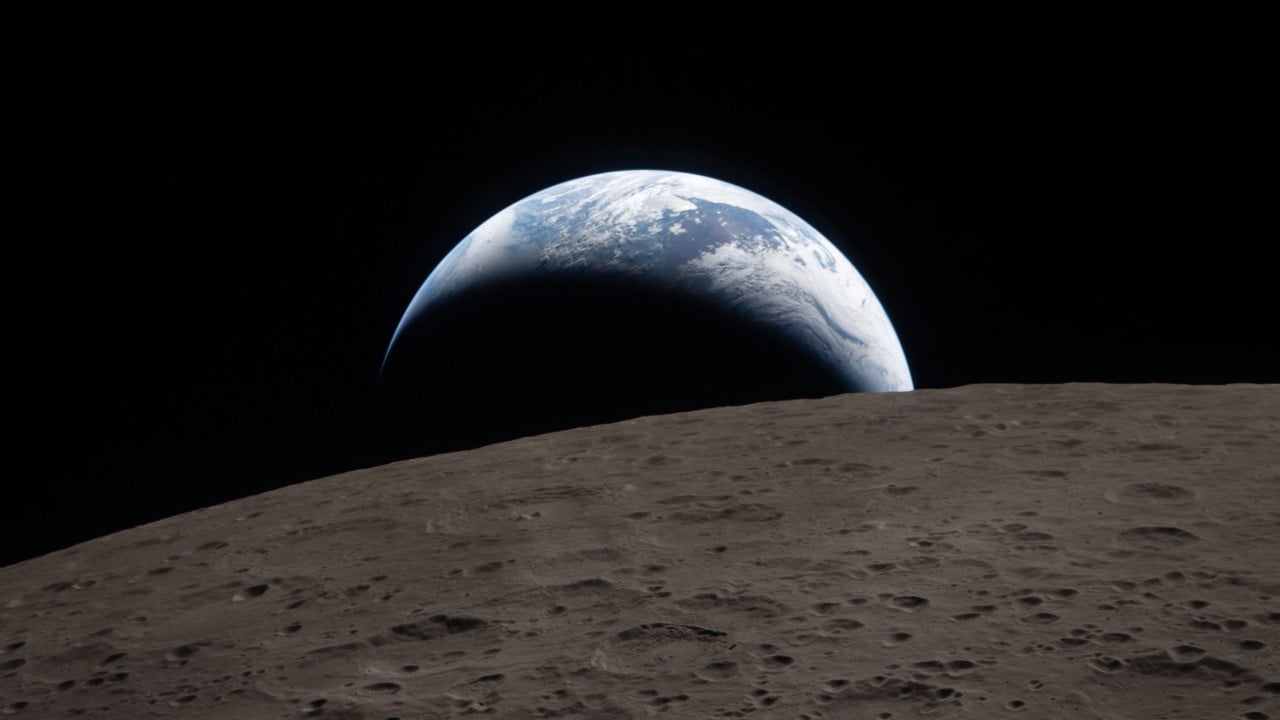
The successful completion of the Artemis II mission represents more than a victory for NASA; it functions as the definitive proof of concept for the Orion spacecraft’s life support systems and the Space Launch System’s (SLS) deep-space lift capacity. For India, this success serves as the external catalyst required to transition the Indian Space Research Organisation (ISRO) from a provider of cost-effective satellite launches to a primary stakeholder in the lunar economy. The acceleration of India’s space program is now tethered to a specific logistical framework: the ability to integrate into the Artemis Accords while maintaining the domestic autonomy established by the Chandrayaan series.
The Structural Mechanics of Indian Lunar Integration
India’s ascent in the lunar sector is governed by three specific operational pillars. These pillars dictate how ISRO allocates its limited budget ($1.6 billion USD equivalent for FY 2024-25) compared to the expansive capital of its peers.
1. Data-Driven Mission Validation
The success of Artemis II provides the telemetry and operational data necessary to validate the Lunar Gateway concept. India’s strategic interest lies in the LUPEX (Lunar Polar Exploration) mission, a joint venture with Japan’s JAXA. While Artemis II proved the feasibility of human transit, LUPEX focuses on the quantitative analysis of lunar volatiles at the South Pole. The relationship is symbiotic: Artemis II provides the transport infrastructure, while India’s expertise in low-cost sensor suites provides the ground-level resource mapping required for permanent habitation.
2. High-Thrust Propulsion Transition
A persistent bottleneck for Indian deep-space ambitions has been the mass-to-orbit ratio of the Geosynchronous Satellite Launch Vehicle (GSLV) Mk III, also known as LVM3. The LVM3 can deliver approximately 4,000 kg to Geostationary Transfer Orbit (GTO). In contrast, the SLS utilized in Artemis II delivers over 27,000 kg to Trans-Lunar Injection (TLI). This disparity creates a "lift gap." India is addressing this through the development of the NGLV (Next Generation Launch Vehicle), which utilizes semi-cryogenic propulsion. The goal is to triple the current payload capacity while introducing reusability, effectively lowering the cost-per-kilogram to a level that undercuts current SpaceX Falcon 9 rates for lunar-adjacent orbits.
3. Human Spaceflight Capability (Gaganyaan)
The Artemis II success validates the safety protocols for human lunar flybys. India’s Gaganyaan mission is the prerequisite for any participation in the Artemis program. By proving the ability to maintain life support for a crew of three in Low Earth Orbit (LEO) for up to seven days, India moves from a technical observer to a potential contributor of crew members for future Lunar Gateway rotations.
The Cost Function of Sovereign Lunar Access
The economics of the new space race differ fundamentally from the Cold War era. Success is no longer measured purely by "firsts" but by the sustainability of the orbital supply chain. India’s competitive advantage is rooted in a unique cost function:
$$C = (L_{c} + O_{c}) / S_{r}$$
Where:
- $C$ is the total mission cost efficiency.
- $L_{c}$ represents the localized manufacturing cost (leveraging India's lower labor and engineering overhead).
- $O_{c}$ represents the orbital operational overhead.
- $S_{r}$ represents the success reliability rate.
By maintaining high $S_{r}$ with drastically lower $L_{c}$, India creates a fiscal buffer that allows for iterative failure in high-risk domains like cryogenics. The "frugal engineering" often cited in media is actually a rigorous optimization of supply chain logistics, where 80% of components are sourced from domestic MSMEs (Micro, Small, and Medium Enterprises). This reduces the currency exchange risk and dependency on international ITAR-restricted components.
Strategic Bottlenecks and Risk Mitigation
Despite the optimism surrounding the Artemis II milestone, India faces significant technical and geopolitical friction points. These are not merely obstacles but systemic constraints that define the pace of development.
The Cryogenic Efficiency Barrier
While India has mastered domestic cryogenic engines, the ISP (Specific Impulse) of these engines must increase to support the heavy-lift requirements of a lunar base. The current CE-20 engine is a workhorse, but a multi-engine cluster configuration for the NGLV requires a level of vibration management and thermal shielding that ISRO is currently stress-testing. Failure to achieve this efficiency will result in a continued reliance on "gravity assist" maneuvers, which extend mission durations from days to weeks, increasing the risk of radiation exposure for crewed flights.
The Artemis Accord Diplomacy
The Artemis Accords are as much a legal framework as a technical one. By signing, India has aligned with a US-led norms-based approach to space exploration. However, this creates a potential friction point with the ILRS (International Lunar Research Station) project led by China and Russia. India's strategy is to maintain "strategic autonomy" in space. This involves contributing unique modular hardware—specifically in the fields of robotics and deep-space communication—that are interoperable with various international systems, thereby preventing vendor lock-in with a single superpower's space architecture.
Quantification of the Lunar Resource Economy
The long-term objective post-Artemis II is the extraction of Helium-3 and water ice. The South Pole of the moon is the primary theater for this activity. India's Chandrayaan-3 mission provided the first direct thermal measurement of the lunar surface near the pole. The findings—a sharp temperature gradient just below the surface—suggest that sub-surface ice is more accessible than previously modeled.
- Regolith Processing: The energy required to extract 1 liter of water from 1 cubic meter of lunar regolith is estimated at 1,500 kJ. India is currently researching solar-thermal concentrators that can provide this energy without the need for heavy nuclear batteries.
- Oxygen Generation: Through molten salt electrolysis, oxygen can be extracted from lunar soil. ISRO’s laboratory-scale tests must now be scaled to a payload-ready prototype for the Chandrayaan-4 sample return mission.
The Architecture of Chandrayaan-4 and 5
The roadmap following Artemis II involves a transition from surface landing to sample return. Chandrayaan-4 is designed as a multi-module mission:
- Transfer Module: Handles the trajectory from Earth to lunar orbit.
- Lander Module: Executes the precision descent.
- Ascender Module: Launches from the lunar surface to rendezvous with the transfer module.
- Re-entry Module: Brings the samples through Earth's atmosphere.
This complexity mimics the Apollo and Artemis mission profiles. The mastery of autonomous docking in lunar orbit is the final technical hurdle. Once ISRO demonstrates that the Ascender can dock with the Transfer module without ground-station intervention, India will have the full technical stack required for human lunar landings.
Operational Realignment
To capitalize on the post-Artemis II environment, ISRO is decoupling its commercial and scientific wings. NewSpace India Limited (NSIL) is now the primary interface for satellite launches, freeing ISRO’s core scientists to focus on the R&D of the "Moon-to-Mars" pipeline. This organizational shift mirrors the NASA/SpaceX relationship but keeps the intellectual property within the state framework.
The immediate requirement for India is the expansion of its Deep Space Network (DSN). The current 32-meter antenna at Bylalu is insufficient for the projected data density of high-definition video feeds from crewed lunar missions. Investment in a secondary DSN site, potentially in the Southern Hemisphere or via partnership with ESA, is a non-negotiable prerequisite for 2028-2030 mission windows.
The Strategic Play
The Artemis II success has effectively shortened the timeline for the global lunar economy. For India to avoid being relegated to a secondary tier, the following sequence of maneuvers is required:
- NGLV Finalization: Prioritize the semi-cryogenic engine flight tests above all other orbital projects. Without the NGLV, India remains a passenger in the lunar race.
- Polar Mapping Dominance: Utilize the LUPEX mission to create the definitive high-resolution map of water-ice distribution. Data is the currency of the Artemis Accords; the nation that knows where the water is controls the location of the future bases.
- Private Sector Integration: Shift from a "government-designed, private-built" model to a "private-designed, government-bought" model for non-critical components. This mimics the successful COTS (Commercial Orbital Transportation Services) program in the US, allowing ISRO to offload the risk of minor hardware development.
India's trajectory is no longer defined by the ability to reach the moon, but by the ability to stay there. The success of Artemis II provides the highway; India must now provide the industrial-scale vehicles to traverse it.