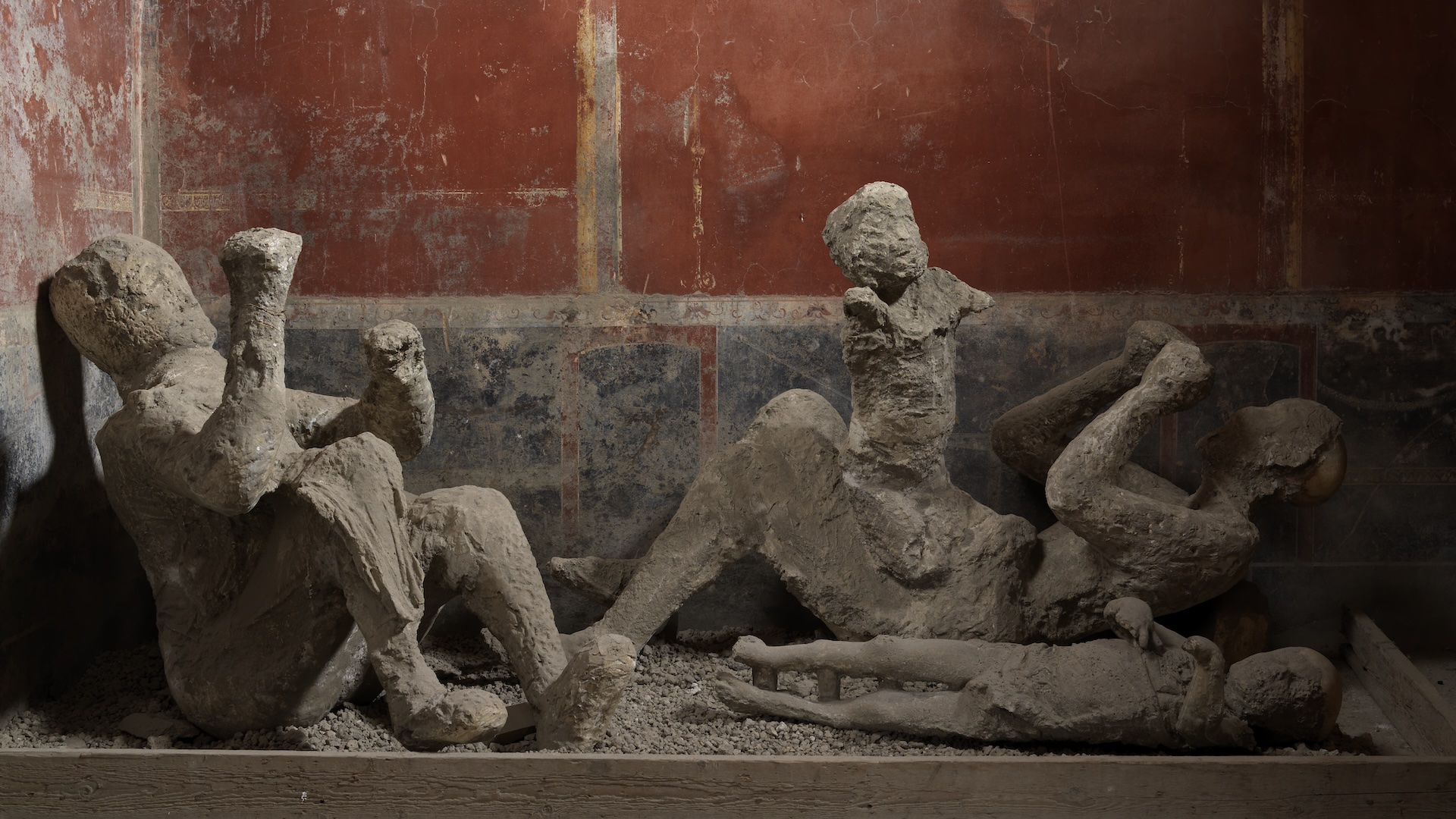
The recent push to reconstruct the faces of Pompeii’s victims using generative artificial intelligence has ignited a fierce debate between technological evangelists and traditional historians. While sensational headlines suggest we are finally "seeing" the people of 79 AD, the reality is far more complicated. These images are not photographs from the past. They are statistical averages dressed in digital skin. By feeding skull measurements and bone density data into neural networks, researchers are attempting to bridge a two-millennium gap. However, the process creates a fundamental tension between historical accuracy and the human desire for a relatable face.
The core of this movement lies in the application of Generative Adversarial Networks (GANs) to bio-archaeology. Instead of relying on a forensic artist’s subjective interpretation, software analyzes the structural markers of a skull—the depth of the eye sockets, the bridge of the nose, the alignment of the jaw—and compares them against vast datasets of modern human faces. The result is a high-definition portrait that looks startlingly alive. But beneath the high-resolution texture lies a web of assumptions about genetics, soft tissue depth, and even the lifestyle of the Roman underclass.
The Algorithmic Approximation of History
Archaeology has always been an exercise in educated guesswork. When a researcher unearths a fragmented skull from the ash of Mount Vesuvius, they aren't just looking at bone; they are looking at a map of a life. Traditionally, forensic reconstruction involved physical clay modeling, a painstaking process where every muscle was laid down by hand based on established biological markers. It was slow. It was expensive.
Enter the current wave of machine learning. By utilizing software capable of processing thousands of anatomical variables in seconds, researchers can now produce "portraits" of the deceased at a scale previously unimaginable. This isn't just about making a pretty picture for a museum exhibit. The goal is to use these visualizations to better understand the demographics of Pompeii—to put a face on the diverse population of merchants, slaves, and aristocrats who lived in the shadow of the volcano.
The problem starts with the training data. Most generative models are trained on contemporary faces, which often reflect modern nutritional standards, dental care, and skincare routines. A Roman citizen in 79 AD lived a radically different life. Their teeth were worn down by stone-ground bread. Their skin was weathered by constant exposure to the Mediterranean sun without the benefit of modern protection. When an AI "fills in the blanks" of a Pompeian skull, it often defaults to the smooth, symmetrical features found in its modern training set. We risk turning the ancient dead into modern influencers.
The Ethics of Digital Resurrection
There is a visceral power in looking into the eyes of a person who died two thousand years ago. It creates an immediate, emotional bridge to the past. This power, however, comes with a heavy ethical burden. There is no consent from the dead. While we often treat the residents of Pompeii as historical artifacts, they were human beings who suffered an agonizing end. Transforming their remains into digital puppets for public consumption raises questions about the commodification of tragedy.
Museums and research institutions are increasingly using these AI-generated faces to drive engagement. It works. A tweet featuring a reconstructed "Pompeian girl" will receive ten times the engagement of a paper on volcanic tephra layers. But we must ask what is being lost in the pursuit of the "likes." When we prioritize a lifelike image over a scientifically accurate representation of uncertainty, we are moving away from history and toward entertainment.
The technical community often argues that these reconstructions are "probabilistic truths." They represent the most likely appearance of an individual based on their skeletal structure. This is a thin defense. A probability is not a person. By presenting these images without a clear explanation of the margins of error, institutions are effectively rewriting the visual history of the Roman world.
The Hidden Bias in the Code
Every AI model carries the fingerprints of its creators. In the context of Pompeii, this manifests in the way skin tone, hair texture, and eye color are assigned. Because DNA preservation in the intense heat of a volcanic eruption is hit-or-miss, researchers often have to make subjective calls on these features.
If the model is skewed toward a certain ethnic profile, the entire population of "reconstructed" Pompeii will start to look suspiciously uniform. Historical records tell us Pompeii was a cosmopolitan hub, a port city where people from across North Africa, the Middle East, and Europe mingled. If the AI defaults to a generic "Mediterranean" look based on modern Italian demographics, it erases the true diversity of the Roman Empire.
- Skeletal Data: The foundation of the reconstruction, often incomplete due to heat damage.
- Soft Tissue Depth: Estimates based on modern populations, which may not account for ancient diets.
- Dataset Bias: The tendency of AI to gravitate toward "average" beauty standards.
- Historical Context: The missing link that AI cannot "know"—clothing, jewelry, and scars.
We are currently seeing a gold rush in "AI archaeology," where the speed of production outpaces the development of academic standards. Some researchers are using open-source tools intended for hobbyists to generate images that are then presented as scientific breakthroughs. This lack of rigor threatens to undermine the credibility of the entire field.
Beyond the Surface
The true potential of this technology isn't in making faces for Instagram. It’s in the ability to run thousands of simulations on skeletal remains to identify patterns of disease, trauma, and migration. If we move past the obsession with the "face," we can use these neural networks to analyze bone density across the entire population of the city, revealing how social class dictated health outcomes.
For example, an AI could analyze the wear patterns on the teeth of hundreds of victims and correlate that with their estimated age and the location of their homes. This would provide a far more "definitive" look at the lives of Pompeians than any high-def render of a brown-eyed boy. The face is a distraction. The data is the story.
The pushback from traditionalists is not just about a fear of new technology. It is a defense of the "unknowable." In history, admitting we don't know something is an act of integrity. When an AI provides a definitive image, it closes the door on that uncertainty. It provides an answer where there should be a question. This digital certainty is a form of historical fiction that we are currently masquerading as hard science.
The Mechanics of the Reconstruction
To understand why these images can be misleading, one has to look at the "denoising" process in generative models. When a model takes a rough 3D scan of a skull and begins to build a face, it is essentially trying to reduce the "noise" or the gaps in the data. It does this by predicting what should be there based on its previous training.
If the skull has a shattered nasal bone—a common occurrence in the collapsing buildings of Pompeii—the AI doesn't just leave it broken. It repairs it. It looks at the surrounding bone structure and "guesses" the most likely shape of the nose. While this creates a complete image, it erases the trauma that might have defined that person's life. It sanitizes the past.
We are entering an era where the boundary between a historical record and a digital fabrication is becoming invisible. This isn't just about Pompeii. This is about how we will view all of human history moving forward. If every pharaoh, every medieval peasant, and every ancient soldier is given a "face" by an algorithm, we will eventually lose the ability to distinguish between the evidence and the imagination.
A New Standard for Visual History
The solution isn't to ban AI from the trenches. That would be a regression. Instead, we need a new framework for "algorithmic transparency" in archaeology. Every AI-generated face should be accompanied by a "confidence map"—a visual overlay that shows which parts of the face are based on solid skeletal data and which parts are purely speculative.
If the jawline is 90% bone-supported but the ears and eyelids are 100% AI-hallucinated, the public needs to see that. This wouldn't diminish the impact of the image; it would enhance its educational value. It would teach the viewer that history is a puzzle with missing pieces, rather than a finished photograph.
The tech industry's obsession with "seamless" results is the enemy of honest archaeology. We don't need seamless. We need the seams. We need to see where the bone ends and the math begins. Only by acknowledging the limitations of our tools can we hope to use them responsibly.
The Cost of the Quick Fix
There is a financial incentive to use AI for these reconstructions. Physical forensic reconstruction can cost thousands of dollars per head and take months. A digital model can be generated for pennies in a matter of minutes. In an era of shrinking academic budgets, the lure of "good enough" is strong.
But "good enough" is a dangerous standard for the keepers of our collective memory. When we settle for an algorithmic average, we are choosing convenience over truth. We are effectively saying that the specific, individual reality of a person's life is less important than our desire for a quick visual payoff.
The residents of Pompeii were preserved in ash, providing us with a unique, haunting window into a specific moment in time. They deserve better than to be turned into generic avatars. If we are going to bring them back to life digitally, we must do so with the precision of a surgeon and the skepticism of a detective. Anything less is a betrayal of the very history we claim to be preserving.
The next time you see a lifelike face of a Roman victim scrolling through your feed, look past the eyes. Look at the symmetry, the perfect skin, and the modern hairstyle. Ask yourself whose face you are actually looking at—the victim’s, or the programmer’s. The truth of Pompeii isn't found in a rendered image; it's found in the gaps, the breaks, and the silence of the stones. Stop looking for yourself in the past and start looking for the people who were actually there.