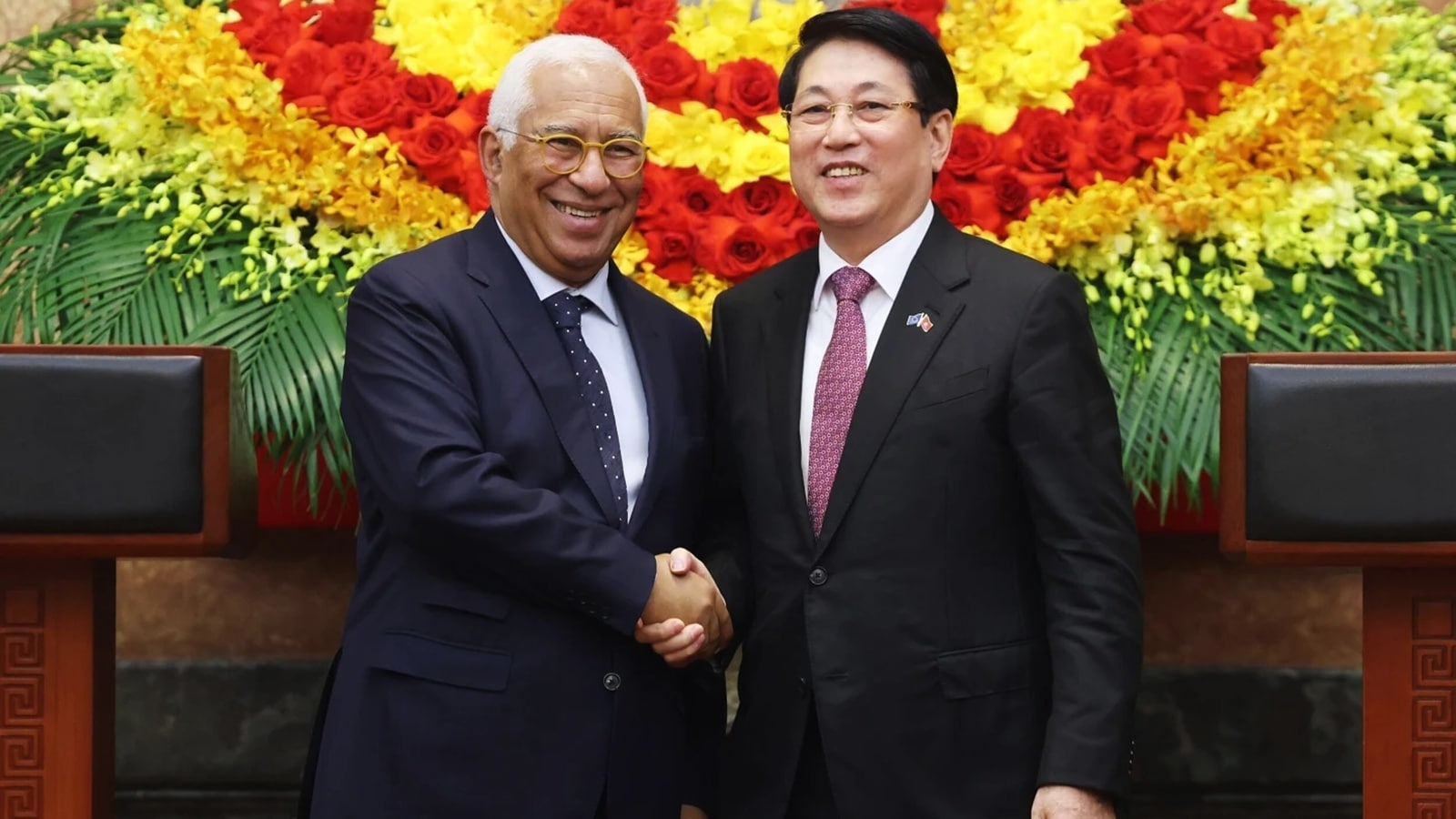
Vietnam is currently executing a sophisticated "multi-vector" foreign policy designed to transition from a manufacturing hub to a high-value technology and green energy partner. This shift is not merely a diplomatic gesture but a calculated response to the China Plus One strategy and the volatility of US-China trade relations. By elevating its relationship with the European Union (EU) to a Comprehensive Strategic Partnership, Hanoi is attempting to create a triad of influence, balancing its historical proximity to China and its security ties with the US against the economic and technological standards of the European market.
The mechanism of this upgrade relies on three distinct structural levers: regulatory alignment via the EU-Vietnam Free Trade Agreement (EVFTA), the acceleration of the Just Energy Transition Partnership (JETP), and the diversification of foreign direct investment (DI) into the semiconductor and digital infrastructure sectors.
The Economic Logic of Regulatory Convergence
The EVFTA serves as the primary engine for this partnership, providing a roadmap for Vietnam to integrate into the EU's high-standard regulatory environment. Unlike the broad, often vague agreements signed with regional neighbors, the EVFTA mandates specific changes in Vietnamese labor laws, intellectual property protections, and environmental standards.
The cost of non-compliance with these standards is the loss of "GSP+" status and the imposition of tariffs that would render Vietnamese exports uncompetitive against emerging manufacturing rivals like India or Indonesia. Vietnam’s strategy is to treat these regulations as a forced modernization of its domestic industrial base. This creates a feedback loop: as Vietnam adopts EU-aligned standards, it becomes a more attractive destination for European firms looking to de-risk their supply chains from China.
The Trade Imbalance and Value Chain Migration
Historically, Vietnam's trade with the EU has been dominated by low-margin goods: textiles, footwear, and agricultural products. The current strategic pivot aims to invert this model. The objective is to move from assembly-level participation to component-level manufacturing.
- Electronics and Telecommunications: Shifting from basic PCB assembly to integrated circuit design and high-end consumer electronics.
- Specialized Machinery: Leveraging German and Italian expertise to upgrade the capital equipment used in Vietnamese factories.
- Green Hydrogen and Renewables: Utilizing the EU's Global Gateway initiative to fund offshore wind projects, which reduces the carbon intensity of Vietnam’s industrial zones—a prerequisite for avoiding the EU’s Carbon Border Adjustment Mechanism (CBAM) taxes.
The Just Energy Transition Partnership (JETP) as a Security Asset
Energy security is the bottleneck for Vietnam's industrial ambitions. The country’s power grid, currently reliant on coal and hydropower, is struggling to meet the surge in demand from energy-intensive sectors like semiconductor fabrication. The JETP, backed by the EU and G7 partners, provides a financial framework of $15.5 billion to catalyze the transition to renewable energy.
This is more than an environmental initiative; it is a strategic maneuver to decouple Vietnam’s energy future from Chinese coal technology and financing. By anchoring its energy grid to European technology and multilateral financing, Hanoi mitigates the risk of "debt-trap" scenarios while ensuring its exports remain "green" enough to enter the European market under future environmental regulations.
Grid Infrastructure Constraints
The primary limitation of the JETP is the physical capacity of Vietnam’s transmission lines. Power generated by wind farms in the south cannot currently be efficiently transported to the industrial clusters in the north. European investment is therefore being channeled into "smart grid" technologies. This creates a technical dependency on EU-standard systems, which effectively locks in a multi-decadal partnership through technical interoperability.
The Semiconductor Calculus: Moving Beyond the US
While the US-Vietnam partnership focuses heavily on the "Strategic Partnership" for security and regional stability, the EU partnership provides the technical and educational infrastructure. The EU’s "European Chips Act" and Vietnam’s own National Semiconductor Strategy are being synchronized to create a talent pipeline.
Vietnam faces a talent deficit of approximately 50,000 engineers in the semiconductor sector. The EU’s role involves:
- Vocational Training: Establishing European-style dual-education systems in Hanoi and Ho Chi Minh City.
- Research & Development: Joint ventures between European firms (like ASML or STMicroelectronics) and Vietnamese tech giants like FPT or Viettel.
- Quality Assurance: Adopting ISO and European standards for semiconductor testing and packaging.
This diversification reduces Vietnam's exposure to US export controls. If Washington tightens restrictions on technology transfers to the region, Vietnam’s alignment with EU standards provides a secondary channel for technological growth that is less susceptible to the binary "US vs. China" geopolitical conflict.
Strategic Hedging and the China Factor
Vietnam cannot afford to alienate China, its largest trading partner and primary source of industrial inputs. The "Comprehensive Strategic Partnership" with the EU is a balancing act, not a replacement. Vietnam imports roughly 30% of its intermediate goods from China; any sudden rupture would paralyze its export-led economy.
The logic of the EU upgrade is to gain bargaining leverage. By strengthening ties with Brussels, Hanoi signals to Beijing that it has alternative sources of capital and technology. This reduces the risk of economic coercion. Simultaneously, it signals to Washington that Vietnam is not a "client state," but a sovereign actor with a diversified portfolio of powerful allies.
The Limits of Soft Power
A critical friction point in the EU-Vietnam relationship remains the issue of human rights and labor standards. The EU's "Everything But Arms" (EBA) and FTA frameworks include clauses related to political freedoms and independent labor unions. Hanoi’s challenge is to implement the economic and labor reforms required by the EU without undermining the internal stability of its one-party system.
The current solution is the creation of "Internal Advisory Groups" (IAGs), which allow for a degree of civil society participation in trade monitoring without shifting the underlying political structure. This is a fragile equilibrium. If the EU perceives a significant regression in these areas, the economic benefits of the partnership could be suspended, as was seen with Cambodia.
The Strategic Playbook for Market Entry
For investors and analysts, the upgrade in EU-Vietnam ties suggests a specific trajectory for the next decade. The focus is shifting from "Cheap Vietnam" to "Technical Vietnam."
- Infrastructure Arbitrage: Firms that specialize in logistics and energy infrastructure will find high demand as Vietnam attempts to meet EU-standard ESG (Environmental, Social, and Governance) requirements.
- Legal and Compliance Services: There is a growing market for firms that can navigate the intersection of Vietnamese domestic law and EVFTA mandates.
- Component Manufacturing: The highest growth will be seen in mid-stream manufacturing—producing the parts that go into European machinery or cars, rather than just the final assembly.
The definitive forecast for Vietnam’s position in the global economy depends on its ability to absorb European capital while maintaining its manufacturing links to China and its security links to the US. This "triple-link" strategy is high-risk but offers the highest potential reward: transforming Vietnam into the indispensable node of the Indo-Pacific trade architecture.
Hanoi must now prioritize the immediate deregulation of its energy market and the rapid scaling of its technical education system. Failure to do so will result in "stranded assets"—factories that are ready to produce for the EU market but lack the clean power and skilled labor to meet European mandates. The strategic move is to treat the EU partnership not as a trade deal, but as an industrial operating system upgrade.