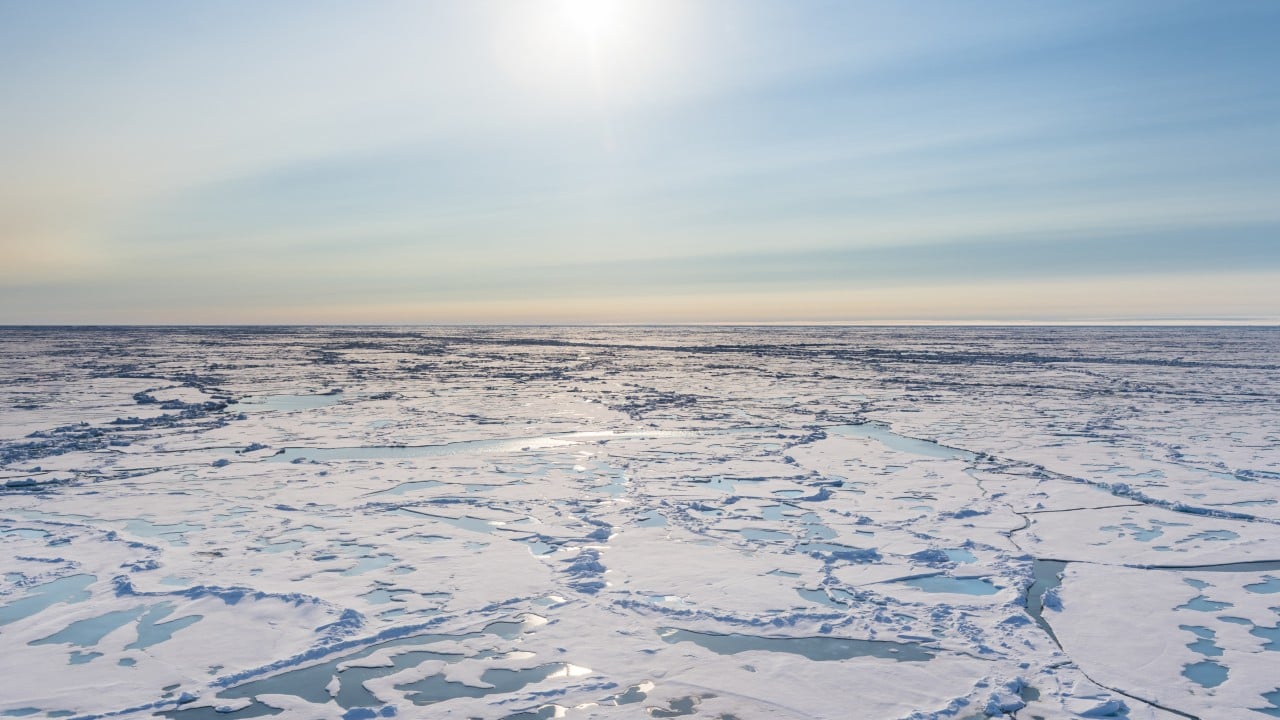
The map on the wall of a high-latitude government office doesn't look like the one in your school atlas. From the top down, the world is a shrinking circle of white, ringed by hungry eyes. For decades, the Arctic was a frozen vault, its contents locked away by physics and sheer, brutal cold. But the vault is cracking. As the ice retreats, it leaves behind a vacuum, and nature loathes a vacuum almost as much as a superpower does.
Imagine a sailor named Elias. He is a hypothetical composite of the merchant mariners now eyeing the Northern Sea Route. To Elias, the Arctic isn't a geopolitical chessboard; it is a shortcut. It is a way to shave eleven days off a trip from Busan to Rotterdam. But as his ship cuts through waters that were solid ice a generation ago, he is sailing through a trigger point. To his left, the muscular reach of a resurgent Russia, fortified by Chinese capital. To his right, the watchful, sometimes distracted gaze of the United States.
In the middle are the "linchpins." Canada and South Korea.
These two nations are currently performing a high-wire act over the North Pole. They are not superpowers, but they are not bystanders either. They are the essential middle powers, the ones who possess the specialized tech and the geographic legitimacy that the titans lack. They are trying to build a bridge before the ice disappears entirely, hoping to ensure that the High North remains a zone of cooperation rather than a theater of war.
The Icebreaker Gap
South Korea does not have a single inch of Arctic coastline. Geographically, it has no business claiming a seat at the table. Yet, if you want to traverse the frozen north, you eventually have to talk to Seoul.
Consider the sheer technical audacity of an LNG carrier capable of crushing through two meters of ice. You cannot simply "leverage" existing designs for this. It requires a specific kind of industrial soul. South Korean shipyards, like those in Geoje, are the only places on Earth currently capable of churning out the high-end, ice-strengthened vessels that make Arctic commerce viable.
While the U.S. has famously struggled to maintain its aging icebreaker fleet—often down to just one heavy breaker, the Polar Star, which is effectively a museum piece held together by hope and welding wire—the South Koreans are building the future. They have the Araon, and they are commissioning more. They have turned their lack of geography into a monopoly on utility.
Russia knows this. China knows this. They have spent the last decade courting South Korean engineering to facilitate their "Polar Silk Road." It is a seductive offer: "You build the ships, we provide the escort, and we both get rich while the West watches from the sidelines."
The Canadian Dilemma
Six thousand miles away, Canada faces the opposite problem. It has the geography—thousands of miles of jagged, sensitive, sovereign coastline—but it lacks the teeth to guard it. For a long time, Ottawa could rely on the "frozen shield." If the ice is impassable, you don't need a navy.
That shield is melting.
The Northwest Passage is becoming a real, navigable waterway. For Canada, this is an existential headache. If they claim it as internal waters, they have to be able to police it. If they can’t police it, the U.S. and others will call it an international strait, stripping Canada of its control.
This is where the human element becomes visceral. For the Inuit communities in the Canadian North, the "opening" of the Arctic isn't a trade opportunity. It’s an invasion. It’s the sound of massive engines disrupting whale migrations. It’s the risk of an oil spill in a place where there is zero infrastructure to clean it up.
Canada is caught. It needs the U.S. for security, but it fears American encroachment on its sovereignty. It sees the Russia-China partnership growing in the East and realizes it cannot stand alone.
The Silent Partnership
In the last year, something shifted. Ottawa and Seoul started talking.
It was a quiet alignment, born of a shared realization: if the middle powers don't stick together, the superpowers will carve up the Arctic like a Sunday roast. This isn't just about trade; it's about the "2+2" ministerial meetings and the security pacts that don't make the front pages.
Canada has the critical minerals—lithium, cobalt, nickel—that South Korea needs for its green tech revolution. South Korea has the maritime technology Canada needs to monitor its own backyard. It is a marriage of necessity. By linking their fates, they create a "middle path." They provide an alternative to the binary choice of "Team USA" or "Team Russia-China."
This matters because the Arctic is the world’s heat sink. What happens there dictates the sea levels in Florida and the monsoon patterns in South Asia. If the development of the Arctic becomes a wild-west gold rush fueled by a Moscow-Beijing alliance, environmental protections will be the first thing tossed overboard.
The Invisible Stakes
Why should a person living in a temperate suburb care about a scrap of ice three thousand miles away?
Because the Arctic is the final frontier of globalization. It is the last place on Earth where the rules are still being written. If Canada and South Korea fail to establish a framework based on international law and environmental stewardship, we are looking at a future where the shortest trade route on Earth is controlled by a de facto monopoly.
Think of the "Elias" on that ship again. In the South Korean-Canadian vision, Elias sails through waters where his safety is guaranteed by international agreements, where his ship’s emissions are regulated, and where the local Indigenous populations have a say in the traffic. In the alternative vision—the one being pushed by the "Polar Silk Road"—Elias is a guest in a private lake, subject to the whims of a singular, authoritarian power.
The friction is already visible. Russia has moved to restrict foreign warships in the Northern Sea Route. China has declared itself a "Near-Arctic State," a term that makes geographers wince but makes generals take notice.
The Pivot
The strategy being deployed by these middle powers is one of "functional cooperation." They aren't trying to start a war; they are trying to make themselves too useful to ignore.
South Korea is positioning itself as the Arctic’s indispensable laboratory. They are researching everything from permafrost microbes to satellite-based ice tracking. Canada is slowly, painfully, beginning to reinvest in its Northern presence, not just with soldiers, but with infrastructure that serves both the military and the local populace.
But the clock is ticking. The ice doesn't care about diplomatic schedules. It melts at its own pace, a physical countdown to a new geopolitical reality.
We often think of history as something decided by the loudest voices in the room. We think of the U.S. and China as the only players that matter. But watch the quiet ones. Watch the nations that build the ships and hold the coastline. They are the ones currently deciding whether the top of the world becomes a bridge or a battleground.
The quiet man in the room is often the one holding the keys. Canada and South Korea have realized that if they don't use those keys to lock the door against chaos, no one else will.
High above the Arctic Circle, the wind is screaming across a landscape that is turning from white to blue. It is a beautiful, terrifying transition. Down in the deep water, the pressure is building. Not just the pressure of the tides, but the pressure of a world that has finally realized the North is no longer out of reach.
The ice is gone. The game is on.