Urban infrastructure development operates under severe mechanical and operational stress gradients where single-point structural failures propagate catastrophic failure cascades into adjacent public thoroughfares. When a tower crane experiences a catastrophic collapse over a moving vehicle artery, the resulting disaster is rarely the product of a single isolated anomaly. Instead, it represents the terminal point of a compounding sequence of latent vulnerabilities across engineering design, operational execution, and municipal safety oversight. Understanding this event requires stripping away anecdotal panic to examine the precise physical, economic, and logistical vectors that transform a static construction zone into a kinetic hazard zone.
The Mechanical Failure Vector Matrix
Tower cranes are engineered tension-and-compression systems designed to withstand extreme load vectors under varying meteorological conditions. Their stability relies on three interdependent structural domains: the foundation anchorage, the mast assembly, and the jib-counterjib balance. When a collapse initiates, it points directly to a breach in one of these domains under load conditions that exceeded the safety margin threshold.
The primary mechanical vulnerability stems from foundation stress distribution. Fixed-base cranes anchored to concrete pours rely on precise load calculations accounting for dead weight, dynamic hoisting loads, and wind overturning moments. If the sub-grade stabilization or anchor bolt torque specifications deviate from engineering tolerances during high-utilization phases, micro-fractures propagate unseen beneath the surface. As dynamic loads shift during heavy lifting cycles, these micro-fractures coalesce into a macro-structural shear plane.
The second mechanical domain involves the climbing frame and telescoping process. Cranes frequently alter their height as buildings ascend. This phase introduces transient structural configurations where standard lateral bracing is temporarily uncoupled or reconfigured. If wind shear encounters the mast during an uncoupled or transitional state, the bending moment experienced by the lower tower sections surpasses the yield strength of the steel alloys. The resulting buckling sends the upper jib downward in an uncontrolled arc rather than a vertical drop.
The third vector relates to operational load management and mechanical fatigue. Hoist winches, slewing gears, and brake mechanisms undergo relentless cyclic loading. Metal fatigue in slewing ring bolts or wire rope strands degrades tensile strength over time. Without rigorous non-destructive testing regimes utilizing ultrasonic or magnetic particle inspection, internal flaws remain undetected until catastrophic failure occurs under load.
The Economic Cost Function of Construction Velocity
Safety margins in urban construction exist in direct tension with financial optimization models. Real estate development operates on compressed timelines where capital carrying costs, loan interest accrual, and leasing deadlines impose severe penalties for delays. This economic pressure creates a structural incentive to compress safety verification cycles, defer non-urgent maintenance windows, and push equipment utilization rates past recommended operational limits.
The cost function governing site operations balances the marginal cost of safety precautions against the expected cost of failure multiplied by its probability. Because catastrophic crane collapses possess a low statistical probability of occurrence in any single operational hour, project managers systematically underestimate the expected loss value. This manifests as compromised weather monitoring protocols, inadequate exclusion zones over active streets, and insufficient crane operator rest cycles.
Furthermore, subcontracting hierarchies fragment accountability. When primary developers delegate site logistics, crane erection, and daily operation to multi-tiered subcontractors, communication channels fracture. The entity making financial decisions regarding equipment rental duration or maintenance expenditure is often insulated from the operational ground truth experienced by the rigging crew. This misalignment between capital control and risk management creates an environment where warning signs reported by technicians are filtered through administrative layers focused entirely on schedule adherence.
Kinetic Energy Transfer and Urban Impact Dynamics
When a multi-ton steel structure detaches from its elevation and intersects with street-level traffic, the physics of kinetic energy transfer dictate the severity of the outcome. A tower crane mast and jib possess immense mass. Dropping from a height of several hundred feet, gravitational acceleration converts potential energy into kinetic energy that far exceeds the structural energy absorption capacity of standard passenger vehicles.
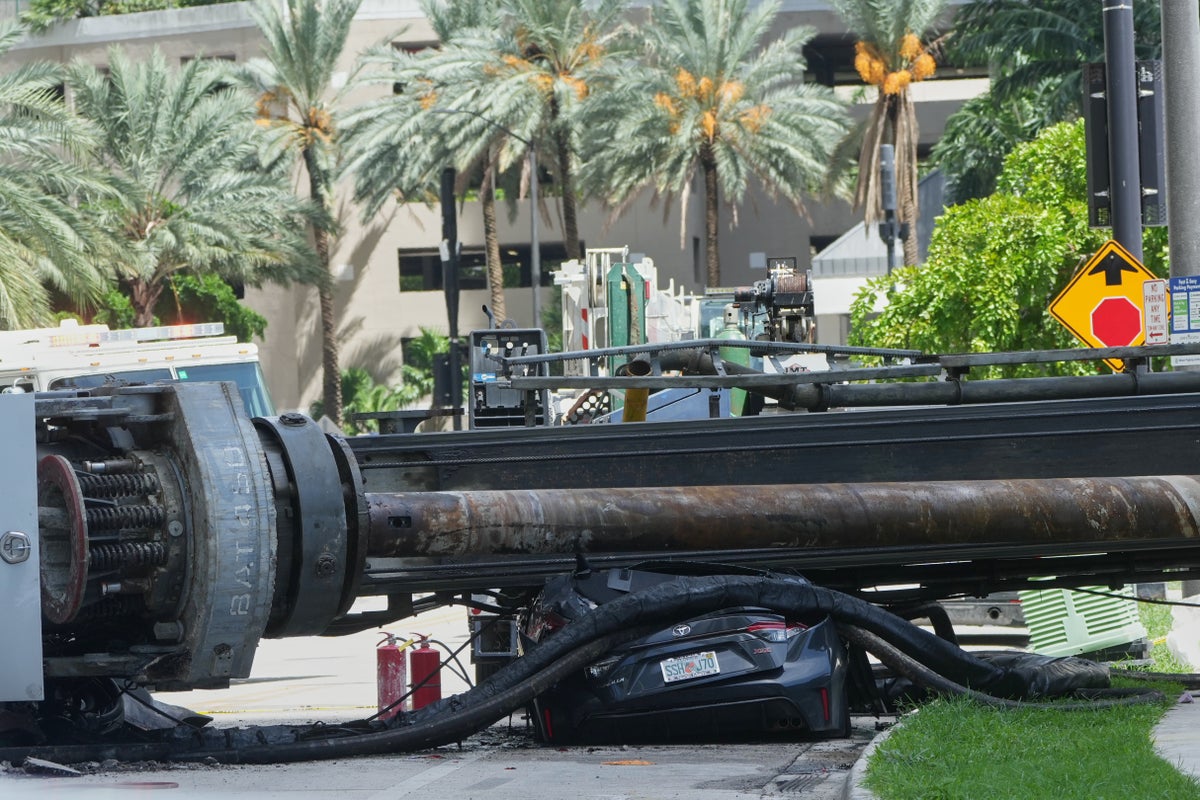
The impact mechanics involve two distinct phases: primary kinetic impact and secondary thermal ignition. The initial impact transfers raw mechanical force directly into the passenger cabin of the moving car. The vehicle structure is crushed along predetermined crumple zones designed for horizontal collision vectors, not vertical compressive loads of this magnitude. Consequently, the passenger compartment experiences catastrophic intrusion, overwhelming occupant protection systems.
The secondary phase involves the rupture of vehicle fuel systems or high-voltage battery packs in electric and hybrid vehicles. High-pressure hydraulic lines from the crane machinery, combined with gasoline or lithium-ion energy sources, create an immediate ignition environment. The friction of shearing metal sparks combustible fluids, transforming the impact site into an active fire zone. This fire complicates emergency response logistics, trapping occupants and delaying extraction until hazardous material and suppression units neutralize the thermal threat.
The Municipal Logistics and Public Interface Deficit
Urban construction sites do not exist in a vacuum; they interface directly with dense pedestrian and vehicular ecosystems. Managing this boundary requires strict traffic diversion protocols, overhead protective scaffolding, and temporary street closures during high-risk maneuvers such as crane climbing, jumping, or heavy lifts over public rights-of-way.
The breakdown in municipal oversight typically occurs at the intersection of private development ambition and public right-of-way protection. Municipal building departments are frequently under-resourced, relying on self-certification or sporadic third-party inspections rather than continuous, independent engineering audits of active crane operations. When permits are granted for street-adjacent construction, the conditions stipulated for public protection often prioritize traffic flow continuity over absolute safety isolation.
Allowing moving traffic beneath an active crane swing radius represents a fundamental failure of risk allocation. In high-density urban environments, the economic imperative to keep commercial corridors open supersedes the conservative requirement for total exclusion zones. Municipalities balance tax revenue and traffic congestion metrics against safety risks, inadvertently accepting a baseline probability of catastrophic failure in exchange for urban mobility.
Strategic Operational Reconfiguration
Mitigating the risk of catastrophic crane collapses requires a fundamental overhaul of how structural safety, municipal regulation, and site logistics intersect. Incremental adjustments to existing protocols will fail to address the systemic pressures driving these incidents.
First, real-time structural health monitoring must become a mandatory baseline requirement for all tower cranes operating within municipal limits. Strain gauges, tilt sensors, and IoT-enabled vibration monitors installed at critical stress points—such as anchor bases and slewing rings—provide continuous data streams to both site engineers and municipal regulatory bodies. Automated shutdown triggers should engage when structural stress parameters approach critical safety margins, removing human judgment and schedule pressure from the equation.
Second, the regulatory enforcement model must shift from reactive post-incident investigation to proactive, independent oversight. Municipalities must institute unannounced engineering audits conducted by state-certified crane inspectors independent of the developer's payroll. These inspections must verify anchor torque, wire rope integrity, and operator certification records under penalty of immediate site shutdown.
Third, urban planning regulations must enforce absolute exclusion zones over active traffic lanes during high-risk crane operations. The practice of maintaining vehicular flow beneath operational boom paths must be prohibited. If a crane cannot operate without sweeping over a public thoroughfare, the thoroughfare must be closed for the duration of the lift, regardless of economic disruption to local commerce.
The path forward demands treating urban construction sites with the same operational rigor applied to aviation or maritime logistics. When complex machinery operates in proximity to human populations, safety cannot remain a variable subject to economic optimization. It must function as an absolute constraint.