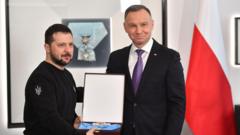
The mainstream media loves a clean, predictable narrative about international relations. When a headline broke claiming Volodymyr Zelensky returned Poland’s highest award, the Order of the White Eagle, after it was stripped, the press fell into its usual trap. Outlets ran standard commentary about "fraying alliances," "growing diplomatic rifts," and "the high cost of wartime friction."
They missed the entire point.
The obsession with medals, state dinners, and symbolic gestures is a distraction from the brutal reality of geopolitical leverage. Diplomatic honors are cheap currency. They are handed out when real, material commitments are too politically expensive to deliver. The narrative that this award exchange represents a fundamental collapse of regional security isn't just lazy—it misunderstands how wartime alliances actually function.
The Myth of the Sacred Award
Mainstream analysis treats state honors as if they possess inherent geopolitical weight. They don't. The Order of the White Eagle, like any top-tier state decoration, functions as a public relations tool.
When a country bestows its highest honor on a foreign leader during a crisis, it is rarely a reflection of permanent alignment. It is an act of political theater designed to signal solidarity to domestic voters and international observers without immediately signing away billions in military hardware or making permanent trade concessions.
To view the stripping or returning of a medal as a catastrophic breakdown in relations is to mistake the thermometer for the disease. Nations do not base their security strategies on hurt feelings over a piece of ribbon. They base them on geography, defense capabilities, and economic survival. Poland and Ukraine are bound by a shared, hardheaded reality: a mutual interest in keeping a buffer zone against aggressive expansion. That reality remains completely unchanged whether Zelensky wears a Polish medal on his chest or throws it back across the border.
The Real Leverage Behind the Friction
The friction between Warsaw and Kyiv has never been about prestige. It is about grain, logistics, and long-term integration into the European market.
- Agricultural Warfare: Polish farmers blocked border crossings because Ukrainian grain influxes threatened their livelihoods. This is a structural economic conflict, not a emotional one.
- Logistical Dependence: Rzeszów-Jasionka Airport in southeastern Poland remains the primary hub for Western military aid flowing into Ukraine. Kyiv cannot afford to alienate Warsaw entirely, and Warsaw cannot afford a collapsed state on its eastern flank.
- Domestic Politics: Polish politicians must answer to a domestic electorate. Showing toughness on bilateral disputes is a requirement for winning elections in central Europe, not a sign that a military coalition is dissolving.
Imagine a scenario where two corporate entities are locked in a high-stakes merger during a market crash. The CEOs might argue publicly over branding or office space to appease their respective board members, but the merger continues because neither company can survive alone. That is the current state of Poland-Ukraine relations. The public posturing is for the galleries; the hard military coordination continues behind closed doors because there is no other choice.
Stop Asking if the Alliance Is Fraying
The most common question filling the news cycle right now is fundamentally flawed. People keep asking, "Is Poland turning its back on Ukraine?"
The honest, brutal answer is that Poland is acting exactly how a sovereign nation-state is supposed to act: in its own self-interest.
An alliance built on pure altruism is a fairy tale. Real diplomacy is transactional, messy, and deeply uncomfortable. The expectation that Ukraine’s neighbors should unconditionally sacrifice their own economic stability out of pure solidarity is unrealistic. Conversely, expecting Ukraine to quietly accept trade restrictions while fighting an existential war is equally absurd.
Conflict within an alliance is not a sign of failure; it is a sign of maturity. It shows that both parties are moving past the initial, emotional honeymoon phase of the crisis and are now negotiating the complex, long-term terms of their coexistence.
The High Cost of Performance Diplomacy
There is a dark side to the contrarian view that we must acknowledge. When leaders rely too heavily on symbolic gestures, they create a fragile public perception. When the symbols inevitably clash with harsh economic realities, the public feels betrayed.
I have watched organizations and political bodies waste months crafting perfect public statements and organizing award ceremonies, only to see the entire strategy collapse the moment a real budget dispute or logistical bottleneck occurs. The energy spent managing the optics of this award could have been spent resolving the actual trade disputes at the border.
The lesson here is simple: stop tracking the medals. Track the ammunition shipments. Track the rail freight volumes. Track the radar system deployments. Those are the metrics that define the future of European security. Everything else is just noise designed to keep commentators talking and readers clicking.
The next time a headline screams about a diplomatic snub or a returned honor, ignore the outrage. Look at the logistics map instead. The trucks are still moving, the weapons are still crossing the border, and the shared threat hasn't changed. The medal didn't matter when it was given, and it matters even less now that it's gone.