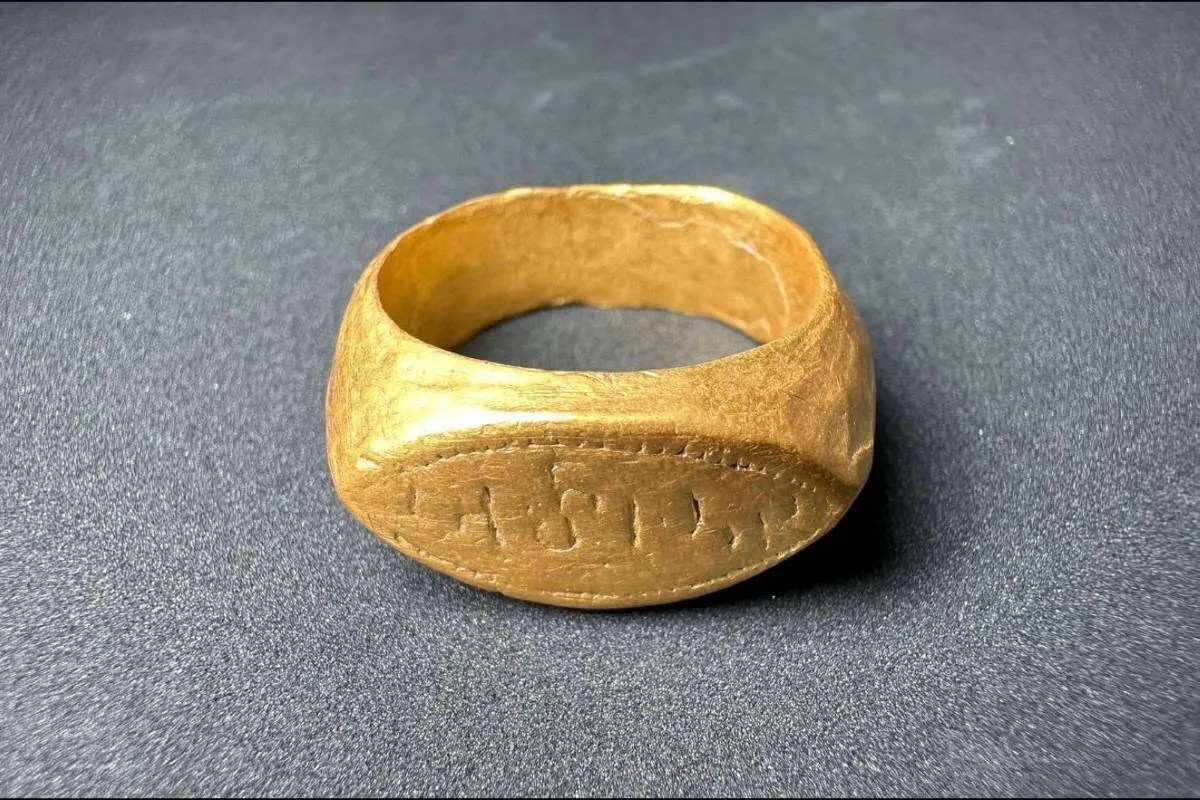
The discovery of two 2,000-year-old gold rings at the Don Yai Thong archaeological site in Phetchaburi province, Thailand, introduces definitive material evidence of institutionalized trans-oceanic commerce during the late prehistoric Iron Age. Rather than indicating isolated cultural contact, these artifacts demonstrate the operational maturity of the maritime trade corridor linking the Indian subcontinent with mainland Southeast Asia. By evaluating the epigraphic, metallurgical, and funerary data of this site, it is possible to reconstruct the economic systems, risk-mitigation frameworks, and structural logistics that governed early Indian Ocean trade networks between 500 BCE and 500 CE.
The Epigraphic Framework: Epistemic Analysis of the Inscription
The primary analytical breakthrough of the Don Yai Thong excavation centers on the epigraphic profile of the inscribed gold ring. The artifact features a deeply incised text composed in the ancient Brahmi script, an early logo-syllabic writing system originating in India. Initial linguistic assessment by epigraphists, including data verified by the Faculty of Archaeology at Silpakorn University, reads the text phonetically as pusarakhitasa.
Translating directly to "the one protected by Pushya," the text serves a functional dual purpose, operating simultaneously as a legal identity marker and a metaphysical risk-management device. In ancient Indian astronomy and Vedic astrological matrices, Pushya represents a highly auspicious lunar mansion associated with wealth accumulation, commercial expansion, and physical protection. The execution of this script on a high-value portable asset yields specific insights into the societal organization of the actor:
- Identity and Ownership Verification: The genitive case suffix -sa (equivalent to "of") establishes the ring as a personal seal or signet used to authenticate trade manifests, secure cargo containers, or ratify credit arrangements.
- Socio-Economic Stratification: The association of the inscription with the Vaishya community—the mercantile and agricultural order of the classical Indian social structure—indicates that the individual possessed the capital reserves required to commission bespoke metallurgical work.
- Astrological Risk Mitigation: In an era where maritime transit faced high rates of hull loss, piracy, and monsoon unpredictability, the explicit reliance on the protection of the Pushya constellation highlights the psychological and cultural frameworks used by merchants to rationalize systemic risk.
Funerary Context and Wealth Indicators at Don Yai Thong
The spatial and systemic placement of the artifacts within the Don Yai Thong site provides a structural blueprint of late Iron Age elite behavior. Located roughly 130 kilometers southwest of modern Bangkok, the site was initially flagged after agricultural activity exposed fragments of high-status bronze drums. Subsequent systematic excavations led by Thailand's Fine Arts Department have uncovered eight human skeletons, extensive pottery suites, and a complex assemblage of bronze and gold ornaments.
The specific burial containing the two gold rings—one intricately inscribed and the other a refined, unadorned band—exhibits signs of a high-density wealth repository. The physical juxtaposition of a plain utilitarian gold band alongside an inscribed signet ring matches known merchant practices across the broader Indo-Pacific network, where multiple rings served as discrete, highly liquid capital reserves.
The presence of bronze drums within the same site layout points to clear trade linkages. These drums, typical of the Dong Son cultural matrix or localized high-status adaptations, operated as major prestige goods across Southeast Asia. The concentration of these elite markers alongside imported Indian epigraphic material confirms that Don Yai Thong served as a significant administrative or commercial node, rather than a transient seasonal camp. The community burying its dead at this site maintained the purchasing power necessary to acquire goods from both the western maritime routes (India) and the northern or eastern metalworking hubs.
The Logistics Corridor: Mapping the Trans-Peninsular Transit
The positioning of Phetchaburi within the geography of the Thai-Malay Peninsula clarifies the logistics models utilized by ancient maritime operators. Navigating the full length of the Malacca Straits during the first millennium BCE and early first millennium CE presented severe operational bottlenecks, including piracy risks and shifting seasonal monsoon winds. To optimize transit times and minimize exposure to hazardous choke points, merchants frequently relied on trans-peninsular portage routes.
Phetchaburi sits at a critical geographic junction that allowed travelers to cross the narrow peninsula, linking the Andaman Sea to the Gulf of Thailand via overland river networks. The presence of an elite burial site containing explicit Indian mercantile markers at this location validates a three-stage logistics sequence:
- Stage 1: The Western Maritime Leg: Vessels departed ports along the eastern coast of India (such as Arikamedu or Tamralipti) during the western monsoon, crossing the Bay of Bengal to land at western peninsular hubs like Khuan Lukpat (Krabi) or Khao Sam Kaeo (Chumphon).
- Stage 2: Overland Trans-Peninsular Portage: Cargo and high-value merchants moved inland along river valleys, crossing the mountain ridges to re-embark on the eastern coast of the peninsula.
- Stage 3: Gulf of Thailand Integration: Goods entered nodes along the western coast of the Gulf of Thailand, including Phetchaburi, allowing distribution into central Thailand, the Mekong Delta, and onward towards Southern China.
This structural model positions Don Yai Thong as a specialized distribution and secure storage hub within a sophisticated multimodal transport network.
Environmental Risks and Conservation Bottlenecks
The ongoing field operations at the Don Yai Thong site face immediate environmental challenges that complicate data collection. Because the archaeological layers are located within active agricultural land, the matrix is highly vulnerable to seasonal monsoonal shifts and fluctuating groundwater levels.
High water tables introduce distinct preservation risks. While gold maintains structural integrity under saturated conditions, the associated human skeletal remains, organic textiles, and copper-alloy bronze artifacts experience accelerated degradation when exposed to alternating wet and dry cycles. Acidic agricultural runoff introduces chemical agents that corrode bronze surfaces and weaken bone collagen.
In response to these conditions, the Fine Arts Department has altered its recovery methodology, shifting from standard in-situ analysis to a block-excavation approach. This technique involves extracting entire sections of the earth matrix containing sensitive remains in single blocks, ensuring the physical relationship between the bones, the bronze vessels, and the gold rings remains undisturbed until it can be micro-excavated in a controlled laboratory environment at the Phra Nakhon Khiri Museum in Ratchaburi.
Strategic Historical Forecast: Redefining Early Globalized Commerce
The material evidence recovered from Don Yai Thong requires a revision of existing models regarding the timeline and density of early Indian Ocean trade. Rather than treating early globalized commerce as an uncoordinated exchange of luxury goods between isolated elites, historians must evaluate this system as a highly organized network backed by shared literacy, specialized legal tools, and complex logistics networks.
The presence of a personalized Brahmi signet ring deep within mainland Southeast Asia 2,000 years ago confirms that Indian mercantile actors were not merely shipping commodities; they were physically present within local ports, establishing long-term residential nodes, and interacting closely with indigenous elites. This early integration laid the structural foundations for the extensive cultural, linguistic, and political transformations that occurred across Southeast Asia during the subsequent classical period. Future research must prioritize systematic metallurgical sourcing of the gold and rigorous isotopic analysis of the associated skeletal remains to determine the geographic origin of the individuals buried at the site, definitively mapping the human mobility patterns that underpinned this ancient global economy.