The Ash Falls Before the Heat Arrives
You taste it before you see it.
A sharp, metallic tang coats the back of your throat while the mid-afternoon sky turns an unnatural shade of bruised violet. In the villages cradled within the Sierra de Guadarrama, north of Madrid, the elderly men who usually sit on pine benches outside the local bakeries know what that taste means. It isn’t the dry dust of an August drought. It is pine resin, burnt at eight hundred degrees Celsius, carried on a erratic wind that shifts every three minutes.
Over 29,000 hectares. Gone.
To digest a number like that, you have to strip away the clinical dryness of press briefings. Imagine 40,000 football pitches laid end to end. Now imagine every single one of them stripped of life, reduced to a stark landscape of charcoal, where the earth hums with heat long after the flames move on. Firefighters who have spent thirty years in the Mediterranean brush aren't speaking with their usual stoic calm. They call this blaze one of the most complex, terrifyingly unpredictable events in the modern history of the Iberian Peninsula.
It doesn't just burn wood. It swallows memories, alters microclimates, and rewrites the future of every small community trapped in its path.
The Anatomy of an Uncontrollable Wall
To understand why this specific inferno confounded some of the best wildland firefighting teams in Europe, consider a simple physical reality: a fire creates its own weather.
When a blaze burns through resin-heavy pine and sun-cured scrubland at this scale, the massive thermal plume rushes upward, sucking in surrounding air at high speeds. The atmosphere becomes volatile. Pyrocumulonimbus clouds—monstrous, soot-choked storm clouds generated by heat—form directly above the canopy. They offer no rain, only violent updrafts and sudden downbursts that hurl burning embers miles ahead of the main fire front.
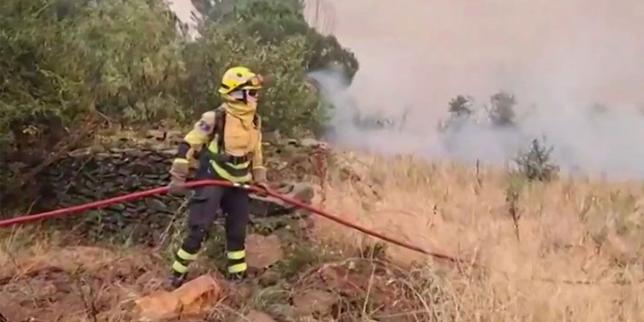
Picture a firefighter standing on a narrow gravel road outside a village like El Boalo or Rascafría.
Hypothetical Scenario: Call him Mateo. He holds a hose connected to a truck carrying three thousand liters of water. In front of him is a five-meter gap of cleared dirt designed to stop a fire. Under normal conditions, that trench works. But when the wind shifts upward, a gust catches a cone from a blazing Scots pine, lifts it high over his head, and drops it fifty yards behind him into a dry ravine. Instantly, he isn't fighting a wall in front of him. He is surrounded.
That is what the emergency services mean when they use the word complex. It describes a chaotic fluid system that refuses to follow traditional containment logic.
| Fire Metric | Standard Seasonal Incident | The Northern Madrid Incident |
|---|---|---|
| Area Impacted | 500 – 2,000 Hectares | Exceeding 29,000 Hectares |
| Behavior | Predictable line expansion | Self-generating atmospheric winds |
| Terrain Challenge | Low-grade valleys | Steep, inaccessible granitic peaks |
| Containment Strategy | Direct water drop & trenches | Indirect evacuation & structural defense |
What We Get Wrong About the Wilderness
We like to think of nature as an untouched paradise, a pristine wilderness that simply needs to be left alone. That belief is dangerous.
For centuries, the mountains north of Madrid were maintained by a slow, quiet rhythm of human presence. Goats and sheep grazed along the forest floor, clearing out the dense underbrush that acts as kindling. Local villagers collected fallen branches for fuel. Small-scale forestry kept the canopy open, allowing moisture to settle into the soil.
Then came the demographic shift. Rural Spain emptied out over the last four decades as younger generations moved into Madrid's sprawling metropolitan center. The pastures grew wild. The brush accumulated, unharvested and unchecked, year after dry year. When you combine decades of accumulated organic fuel with record-breaking heat waves and plummeting humidity levels, you aren't looking at a natural forest anymore. You are looking at a giant, unexploded powder keg waiting for a single spark—whether from a lightning strike, a piece of glass, or a discarded cigarette.
The heat isn't the only culprit. The silence left behind by an emptying countryside plays just as large a role.
The Human Toll Beneath the Plumes
The news reports give us numbers. They tell us about hectares, deployment figures, the number of amphibious aircraft dipping their bellies into nearby reservoirs, and the sheer volume of retardant dropped over the ridges.
They don't tell you about the silence in the evacuation centers.
Inside sports halls converted into makeshift shelters, the air smells of instant coffee, rubber shoes, and fear. Farmers sit on folding cots, staring at their phones, waiting for news about livestock left behind in stone barns. Store owners wonder if their roofs held, or if the life work of three generations was erased in twenty minutes.
There is a specific sound a forest makes when it burns at full force. It isn't a gentle crackle. It is a roar, deep and mechanical, sounding like a freight train barreling through a narrow tunnel. When that sound stops, the quiet that follows is heavy, thick with the scent of wet ash and pine oil.
Fire crews don't celebrate when a fire of this magnitude is finally contained. They collapse on the side of tarmac roads, face-blackened, eyes bloodshot, knowing that containment is merely a truce. The soil itself continues to burn underground, traveling along root systems, waiting to surface days later if the wind picks up again.
A New Reality on the Horizon
Spain has fought fires for centuries. But the rules of engagement have changed permanently.
The mega-fires sweeping through southern Europe are faster, hotter, and vastly more resistant to traditional suppression techniques. When an inferno wipes out 29,000 hectares in a matter of days, it signals that the boundary between urban spaces and wild terrain has blurred into something far more dangerous.
As the sun sets behind the mountains, casting a dull red glow through the lingering smoke, the people returning to the safe zones know that clean-up isn't just about rebuilding burnt roofs or re-paving melted asphalt. It requires rethinking how we live alongside the land, how we care for the spaces just beyond our city borders, and how we respect an element that takes minutes to destroy what took centuries to grow.
A single blackened pine needle falls onto the hood of a dusty off-road vehicle miles away from the fireline, still warm to the touch.