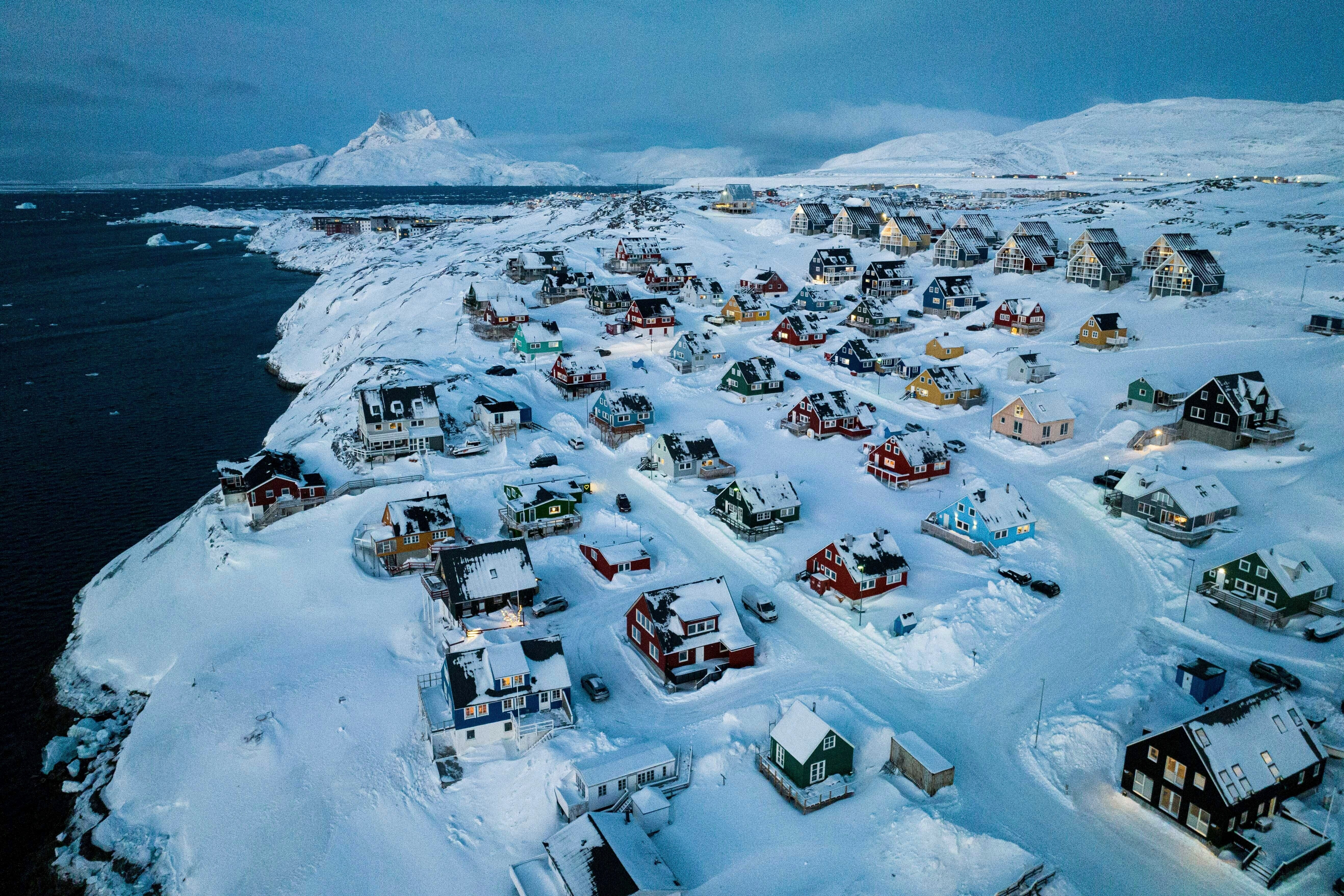
The air in Qaanaaq does not simply feel cold; it bites with a clean, terrifying authority. For ten months of the year, the sea ice locks the world into a monochrome stillness so profound that sound seems to travel miles across the frozen fjords before dying against the towering cliffs. Here, on the northwestern coast of Greenland, the horizon is a bruised lavender meeting a blinding sheet of white.
Malik knows this ice. He has watched it thin over forty winters, transitioning from a thick, unyielding floor capable of supporting heavy dog sleds to a treacherous patchwork of slush and fractured pans. He reads the cracks the way an old scholar reads marginalia in a rare manuscript. But lately, Malik reads something else in the sky.
A low, vibrating growl rolls across the silence. It is not the wind. It is a gray cargo aircraft, a mechanical behemoth painting a dark streak across the polar blue, descending toward the runways of Pituffik Space Base.
Thousands of miles to the south, in the paneled rooms of Washington and Copenhagen, diplomats have shaken hands on a quiet, monumental realignment. An agreement has been struck, expanding the American military footprint in the world's largest island. To the casual observer scanning a morning news feed, it looks like a routine bureaucratic update to an old Cold War pact. To those who live beneath the flight path, it is the sound of the world’s quietest corner turning into its most contentious frontier.
To understand why this matters, you must forget everything you think you know about geography. Look down at a flat Mercator map, and Greenland looks like an appendix hanging off the top of the earth, an irrelevant white frosting on the edge of the world. Now, spin a globe. Look straight down from the top.
Greenland is not an edge. It is the center.
It is the geographic ceiling of the northern hemisphere, a natural watchtower overlooking the shortest possible air and missile routes between North America and Eurasia. During the middle of the twentieth century, Washington recognized this spatial reality with frantic urgency. They carved out secret bases under the ice, built radar installations designed to spot Soviet bombers before they crossed the pole, and turned Thule Air Base into a vital strategic outpost. When the Soviet Union collapsed, the world exhaled. The radar stations hummed quietly, the bombers stayed parked, and the ice seemed to reclaim its sovereignty.
That truce has expired.
The Arctic is warming nearly four times faster than the rest of the planet. As the summer ice retreats, it reveals treasures and perils long locked away beneath frozen vaults. Beneath the melting surface lie staggering reserves of rare earth elements, nickel, copper, and oil—minerals essential for everything from electric vehicle batteries to advanced military guidance systems. More ominously, the receding ice opens up the Transpolar Sea Route, slashing shipping times between Asia and Europe by weeks.
Suddenly, the high north is no longer a frozen wasteland guarded by blizzards. It is a highway. And everyone wants to control the tollbooths.
Russia has spent the last decade aggressively reopening and modernizing its own ring of Soviet-era bases along its northern coast, bristling with air defense systems and icebreakers. Meanwhile, Beijing has cast an assertive eye northward, styling itself as a near-Arctic state and pouring billions into scientific outposts, shipping investments, and mineral extraction rights across Greenlandic soil.
Washington looked north and felt a familiar, cold panic. The new agreement between the United States and Denmark—acting in close consultation with the self-governing Greenlandic government—is the direct response to that anxiety. It is an operational tightening of the screws. It grants the United States broader access, upgraded infrastructure rights, and streamlined permissions to preposition assets at strategic points on the island.
Yet treaties signed in capital cities rarely capture the human friction on the ground.
In Nuuk, the political capital perched on a rocky peninsula further south, the debate wears a different face. The members of the Inatsisartut—Greenland’s parliament—walk a tightrope suspended over an abyss. On one side lies the economic necessity of escaping heavy financial block grants from Copenhagen, a dependency that has historically limited complete sovereignty. On the other side lies the reality of superpower realpolitik. When you host the eyes and ears of the Western alliance, you inevitably become a primary target in any future global friction.
Greenland has long been caught in a gravitational pull between distant powers. In the 1950s, local communities were forcibly relocated to make room for the original Thule Air Base. In 1968, a B-52 bomber carrying four thermonuclear weapons crashed near the base, contaminating the surrounding ice with radioactive debris that took years to acknowledge and clean up.
Memory in the Arctic is long. The ice preserves things, and so do the people.
When modern military planners talk about deterrence and force projection, they speak in the clean, bloodless language of strategic depth and early-warning architecture. They talk about tracking hypersonic missiles. They talk about anti-submarine warfare bottlenecks in the GIUK gap—Greenland, Iceland, and the United Kingdom.
Translate that language into human experience, and it looks like a hunter standing on a shrinking ice floe, watching a jet contrail slice the sky above his ancestors' hunting grounds. It looks like a small island community wondering if their future sovereignty will be traded away in a boardroom three thousand miles away for the sake of an American radar dish or a Danish political compromise.
The diplomatic text of the new agreement emphasizes cooperation, mutual security, and respect for local autonomy. Copenhagen insists that Greenland's voice is louder now than ever before, pointing to the formal mechanisms designed to ensure the local government retains a veto over military expansions that directly impact its people. Washington emphasizes the defensive nature of the buildup, framing it as a shield against the rising tide of authoritarian ambition in the polar north.
Both things can be true. And both things can leave people uneasy.
Security is a jealous master. Once you invite it into your house, it demands more room. A radar station needs maintenance crews. Maintenance crews need housing. Housing needs supply lines. Supply lines need deep-water ports. Before long, the quiet fjord is no longer quiet. The whales alter their migration routes to avoid the thump of diesel engines. The traditional sled routes become hazard zones near military sectors.
Consider the sheer logistical audacity of what is happening. The military footprint in Greenland is not just about concrete runways and satellite dishes. It is about electrons and algorithms. Pituffik Space Base is a vital node in the United States Space Force network, tracking space debris and monitoring intercontinental ballistic missile trajectories. In a conflict, seconds matter. The distance saved by having sensors planted on Greenlandic bedrock instead of mainland North America can mean the difference between interception and catastrophe.
That invisible shield overhead is purchased with the quiet erosion of isolation.
The Greenlanders are a resilient folk, accustomed to adapting to a climate that tries to kill them nine months out of the year. They have survived colonization, the shift from a sealing economy to a modern fishing export market, and the slow, grinding machinery of modern geopolitics. They are navigating their transition toward full national independence with remarkable political sophistication. They want the economic benefits of international partnerships, but they do not want to become an unsinkable aircraft carrier for a foreign power.
As the ink dries on the new pact, the wind howls across the desolate expanse of the inland ice sheet, the Sermersuaq. It is a river of frozen water thousands of feet thick, moving imperceptibly toward the sea, grinding rock into flour beneath its weight.
Human empires rise and fall with the frantic speed of mayflies. We draw lines on maps, ink treaties, upgrade our radars, and stare across frozen oceans with suspicious eyes, convinced that our steel and our electronics can master the earth.
The ice does not care about our treaties. It only listens to the temperature.
And out on the dark fjords of the north, Malik loads his rifle into his wooden boat, checking the fuel tank one last time. Above him, the high-altitude contrails of a military transport fade into the twilight, leaving behind a thin, white scar that lingers long after the engine noise has died away into the eternal silence of the pole.



