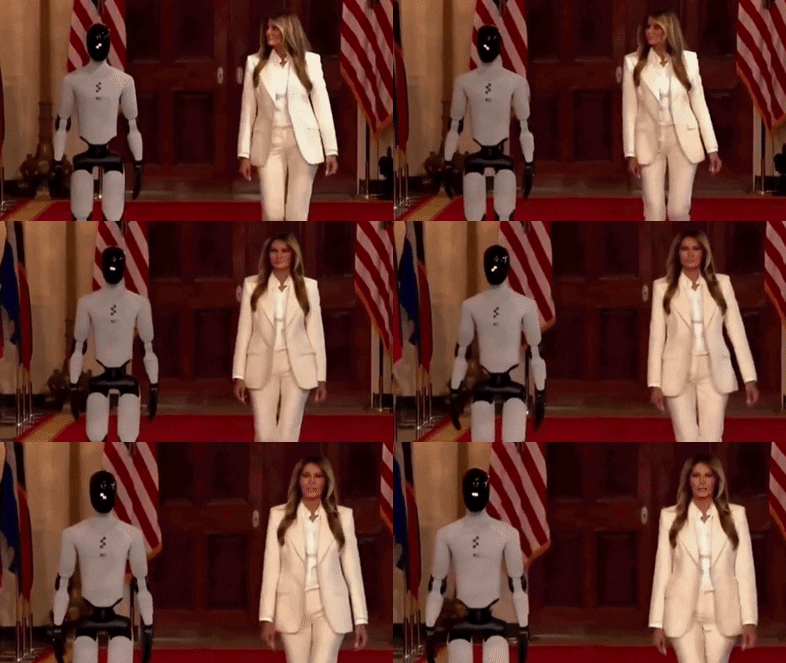
The optics were perfect for a slow news cycle. A sleek, white humanoid robot standing next to Melania Trump, supposedly signaling a "brave new world" of technological integration at the White House. The mainstream press ate it up, focusing on the novelty, the aesthetics, and the surface-level "cool factor."
They missed the point. Entirely.
What we witnessed wasn't a breakthrough. It was a high-budget puppet show. While the public dotes on these mechanical mascots, they ignore the reality that "humanoid" robots are currently the least efficient way to solve any actual problem. We are obsessed with making machines look like us when we should be obsessed with making them work for us.
The Humanoid Tax
Most people see a robot with two arms and a head and think, "The future is here." I’ve spent fifteen years in hardware labs and on factory floors where real automation happens. I can tell you exactly what that robot was: an expensive paperweight designed for PR.
When you force a robot into a human silhouette, you pay a "complexity tax" that yields zero ROI. Humans are built for biological versatility, not mechanical efficiency. To make a robot walk on two legs, you need dozens of actuators, sophisticated gyroscopes, and a massive amount of compute power just to keep it from falling over.
- Wheels beat legs in 95% of indoor environments.
- Static arms beat torso-mounted limbs for precision.
- Specialized sensors beat "eyes" for spatial awareness.
By cheering for a robot at a White House social event, we are rewarding theater instead of utility. It’s the equivalent of celebrating a car because it has four legs instead of wheels. It’s a regression disguised as progress.
The Misconception of Interaction
The "People Also Ask" sections of the internet are currently flooded with variations of: Can robots replace human caregivers? or Will robots soon be our social peers?
The answer is a brutal "No," but not for the reasons the Luddites think. It’s not because robots lack a "soul." It’s because the current trajectory of social robotics is built on a lie of mimicry.
When a robot "interacts" with a First Lady or a group of students, it is executing a pre-programmed script or responding to basic voice cues that a $30 smart speaker could handle better. The humanoid form factor is a psychological trick—a "husk" designed to trigger human empathy.
I’ve seen tech firms blow $50 million on "social" robots that end up in a warehouse because they can’t even open a door or pick up a dropped pen. We are anthropomorphizing tools to feel better about our own obsolescence, rather than building tools that actually expand our capabilities.
The Real Automation Debt
We are currently facing a massive "Automation Debt." This happens when organizations prioritize the visibility of tech over the infrastructure of tech.
The White House event is the pinnacle of this debt. It suggests that AI and robotics are about "presence"—about being in the room. In reality, the most impactful robotics are the ones you never see. They are the hive-mind bots in grocery fulfillment centers and the sub-surface drones maintaining underwater cables.
The Cost of the Gimmick
| Feature | PR Value | Actual Utility |
|---|---|---|
| Humanoid Face | High | Zero |
| Bipedal Movement | High | Negative (High Power Draw) |
| Voice Mimicry | Medium | Low (Prone to Hallucination) |
| Tactile Sensing | Low | High (The real challenge) |
If we want to actually move the needle, we need to stop putting robots in suits and start putting them in the dirt. We need robots that can handle the "Three Ds": Dull, Dirty, and Dangerous. Standing in a climate-controlled room for a photo op is none of those. It’s a waste of a motherboard.
Why the Status Quo is Dangerous
The media’s obsession with the "Robot at the White House" narrative creates a false sense of security. It makes the public believe that we are further along in general-purpose robotics than we actually are.
This leads to:
- Misallocated Funding: Capital flows to "shiny" startups with cool renders instead of boring companies solving battery density or torque-to-weight ratios.
- Regulatory Blindness: Policymakers focus on "Robot Rights" or "AI sentience" because they saw a humanoid talk on TV, while ignoring the actual risks of algorithmic bias in credit scoring or automated warfare.
- Educational Mismatch: We tell kids to learn how to "talk" to robots when we should be teaching them how to maintain the hydraulics that keep the world's supply chains moving.
I’ve sat in boardrooms where executives demanded a "human-facing" interface for a system that worked perfectly fine as a background script. They wanted the "cool factor" to show off to investors. It added six months to the timeline and doubled the budget. That is the "White House Effect" in action.
Stop Asking if Robots are "Ready"
The question isn't whether robots are ready to join us at social events. They are. A puppet is "ready" to join a play.
The real question is: Why are we still satisfied with puppets?
The industry is currently split between the "Showmen" and the "Engineers." The Showmen are winning the PR war because they give the public what they want—a mirror of themselves. The Engineers are losing because the truth is boring: real progress is a robotic arm that can sort 10,000 pieces of trash an hour without breaking, not a humanoid that can wave at a dignitary.
We don't need robots to be our friends. We don't need them to stand in the East Room. We need them to be invisible, efficient, and fundamentally non-human.
The next time you see a robot being paraded around by a politician or a celebrity, don't marvel at the tech. Ask to see the power cable. Ask how many engineers are standing off-camera with remote controls. Ask why we are spending millions to teach a machine to mimic a handshake when half the world’s infrastructure is crumbling for lack of automated maintenance.
Stop falling for the chrome. Demand the utility.
Build a better wrench, not a fake person.