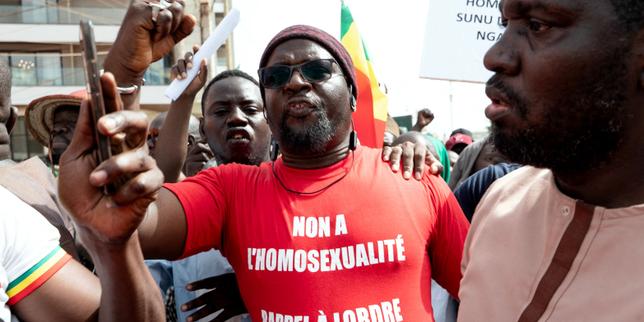
Western media loves a morality play. They want a narrative where "enlightened" global values clash with "primitive" local laws. But the standard reporting on homosexuality in Senegal—specifically the screams of "odious repression"—is lazy. It’s a shallow reading of a complex social ecosystem. If you think this is just about a penal code, you’ve already lost the plot.
The real story isn't about state-sponsored hate. It's about the catastrophic failure of Western diplomacy and the unintended consequences of "human rights" signaling that actually puts the people it claims to protect in more danger.
The Mirage of State Repression
Articles usually point to Article 319 of the Senegalese Penal Code. They frame it as a medieval tool of the state. But here is the nuance the pundits miss: for decades, Senegal operated under a social contract of "Masla" (discreet consensus).
In the Senegalese context, private life was largely shielded by a cultural refusal to pry. People knew what was happening behind closed doors, and they chose to look away. This wasn't perfect, but it was a functional peace. The "repression" didn't start because the state suddenly became more conservative. It started because the West tried to force a public, political identity onto a private, social reality.
When foreign NGOs and heads of state arrive in Dakar and demand legislative changes, they aren't helping. They are lighting a fuse. They turn a private matter into a nationalist battleground. To the average person in the Medina or Touba, defending Article 319 isn't about homophobia; it’s about anti-colonialism. It’s a middle finger to perceived ideological imperialism.
The Sovereignty Trap
We need to talk about the "Human Rights Industrial Complex." Groups like Amnesty International or Human Rights Watch use Senegal as a fundraising peg. They write reports that satisfy London and New York donors but ignore the ground reality in Dakar.
By framing LGBTQ+ rights as a Western export, these organizations have handed local populist politicians a golden ticket. In any democracy, if you want to distract from a failing economy or a corruption scandal, you find an "outsider" threat. The West, through its ham-fisted advocacy, provided that threat on a silver platter.
The "odious repression" is a feedback loop.
- Western embassy makes a public statement on pride or rights.
- Local religious leaders feel their authority is challenged by "foreign decadence."
- Politicians, sensing the mood, tighten the rhetoric to prove their "moral purity."
- Arrests increase as a performance of sovereignty.
The very people the West claims to be saving are the ones who pay the price for this performative diplomacy.
The Religious Factor: It’s Not What You Think
Westerners see "Islamic Republic" or "Muslim majority" and assume a monolithic wall of intolerance. They are wrong. Senegal’s Sufi brotherhoods—the Mourides and the Tidjanes—have historically been pragmatic actors. They value social stability above almost everything else.
The tension today isn't driven by ancient scripture. It’s driven by a modern fear of cultural erasure. When you tell a society that their thousand-year-old social fabric is "wrong" or "backward," they don't change; they entrench. The rise of groups like And Samm Djikko Yi (To Together Protect Values) is a direct reaction to what is perceived as a cultural invasion.
If you want to understand the "repression," stop looking at the Quran and start looking at the history of the CFA franc and French military bases. The resentment is systemic. Sexual politics is just the theater where the fight for dignity is happening.
The Data of Discomfort
Let’s look at the numbers—not the ones in the pamphlets, but the ones on the street. Since the mid-2010s, when international pressure on African nations regarding LGBTQ+ issues peaked, the number of mob-led "community policing" incidents in Senegal has spiked.
This isn't an increase in state efficiency; it’s a breakdown of the social peace. The law (Article 319) was rarely enforced for fifty years. It was a "dormant" law. By making its repeal a litmus test for "civilized" status, the West woke the dragon.
Now, the state has to enforce it to maintain its domestic legitimacy. This is the irony of modern activism: the more you scream from across the ocean, the harder the boot presses down on the ground.
The Strategy of Silence
If the goal is actually the safety and dignity of individuals, the current strategy is a failure. It’s worse than a failure; it’s a provocation.
The "contrarian" truth is that progress in conservative societies doesn't happen through loud, confrontational identity politics. It happens through the "Masla" I mentioned earlier. It happens through the quiet, gradual expansion of the private sphere.
By demanding that Senegal "evolve" on a Western timeline, activists are ensuring that evolution never happens. They are demanding a revolution, and revolutions in conservative societies usually end in a crackdown.
Stop Trying to "Save" Senegal
The arrogance of the competitor's article—and the general Western consensus—is the belief that Senegal is a broken version of France or America. It’s not. It’s a sovereign nation with a different hierarchy of values. In Senegal, the "communal" often outweighs the "individual." That might be uncomfortable for a liberal in San Francisco, but it’s the operating system of the country.
The path forward isn't more sanctions or more "odious repression" headlines. It’s a total withdrawal of Western ideological lecturing.
If you want to help, fund the lawyers who work quietly in the shadows. Fund the clinics that provide healthcare without asking questions. But for the love of God, take down the flags and stop the press releases. Your "solidarity" is a death sentence.
History doesn’t move in a straight line toward Western liberalism. Sometimes, the more you pull, the tighter the knot becomes. The West needs to stop ghostwriting the cultural wars of nations it barely understands.
Let Senegal handle its own social evolution. Even if it doesn't look like yours. Especially because it doesn't look like yours.
The loudest voices in this room are the ones doing the most damage. Shut up and get out of the way.