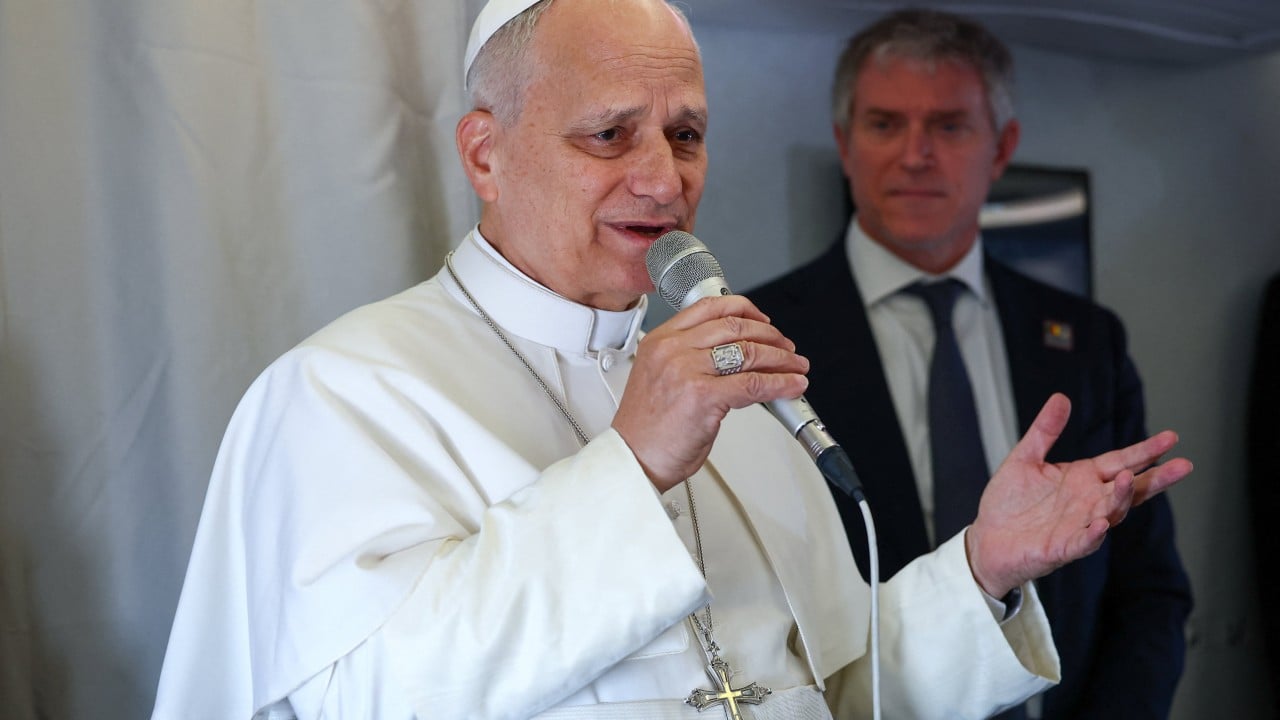
The morning light in the Apostolic Palace doesn’t care about the news cycle. It filters through the high windows of the Vatican with a clinical, indifferent grace, illuminating the dust motes that dance above floors polished by centuries of prayer and politics. For Pope Leo, these moments of silence are increasingly rare. Outside the stone walls, the world is screaming. Specifically, a very loud, very familiar voice from across the Atlantic has once again turned its sights on the papacy, transforming a message of spiritual unity into a battlefield for a campaign trail.
Leo sits at a desk that has seen the rise and fall of empires. He isn't looking at a teleprompter or a Twitter feed. He is looking at a pile of reports from refugee camps in South Sudan and struggling parishes in the rust belts of Europe. To him, these aren't data points. They are people. When a political figure like Donald Trump launches a fresh volley of criticism—labeling the Pope’s calls for open borders as "weak" or "out of touch with reality"—the temptation for the Vatican press office is to sharpen its quills. The world expects a counter-punch. The world wants a drama.
But Leo is playing a different game.
Imagine a man standing in the center of a hurricane. The debris of political discourse—insults, soundbites, "America First" rhetoric—whirls around him at a hundred miles an hour. If he reaches out to grab one piece of that debris, he becomes part of the storm. If he stays still, he remains the center. This isn't passivity. It is a grueling, muscular form of restraint that requires more strength than any retaliatory strike ever could.
The recent attack from the Trump camp wasn't just a disagreement over policy. It was a tonal assault. It framed the Pope’s recent encyclical on global brotherhood not as a religious document, but as a partisan manifesto. For a politician, everything is a zero-sum game. If I win, you lose. If you suggest we share resources, you are taking something from my supporters. It’s a binary world of walls and winners.
Leo’s reality is more complex. It is a world of circles.
Consider a hypothetical parish priest in a border town. Let’s call him Father Tomas. Every Sunday, Tomas looks out at a congregation split right down the middle. On the left side of the aisle are families who have lived in the town for four generations, who feel the economic squeeze of a changing world and fear that their culture is being erased. On the right side are new arrivals, exhausted and wide-eyed, seeking nothing more than a day’s work and a night without the sound of gunfire.
When the news breaks that the former President has called the Pope "the most political man in the world," the tension in Father Tomas’s pews becomes a physical weight. The "attack" isn't just a headline in Washington; it’s a crack in the foundation of a community three thousand miles away.
This is the invisible stake. This is what the cameras miss.
The Pope knows that if he engages in a mud-slinging contest, he loses his ability to speak to both sides of Father Tomas’s aisle. Once you become a combatant, you can no longer be a bridge. You just become another obstacle.
Leo’s response to the latest vitriol was a masterclass in redirection. He didn't mention the name Trump. He didn't address the specific insults. Instead, he stepped into the pulpit and spoke about the "fragility of peace." He used the metaphor of a glass vase: beautiful, ancient, and incredibly easy to shatter, but nearly impossible to put back together once the shards have fallen.
He spoke about the "globalization of indifference." It’s a phrase that sounds academic until you apply it to the way we consume news. We scroll past a war, then scroll past an advertisement for sneakers, then scroll past a political attack. We have become experts at not feeling. By refusing to be baited into a personal feud, Leo is forcing the public to look at the vase, rather than the person trying to throw a rock at it.
The statistics of global displacement are staggering—over 110 million people are currently forced from their homes—but those numbers are too big for the human heart to hold. Leo’s strategy is to shrink the world back down to the size of a single human face. He talks about the "uniqueness of the person," an idea that stands in direct opposition to the "masses" or "hordes" often cited in political rallies.
There is a profound loneliness in this position. To be a peacemaker in an era that rewards the loudest provocateur is to be perpetually misunderstood. To the hard-liners, Leo is a naive idealist. To the political activists, he isn't radical enough. He occupies a middle ground that is increasingly seen as a no-man's-land.
Yet, there is a quiet power in the refusal to hate.
Peace is not the absence of conflict. It is the presence of a different kind of energy. During his last address, Leo's voice didn't rise in anger. It dropped in gravity. He spoke about the "insanity of war" and the "poison of division." He didn't need to point a finger at a specific candidate because the principles he was outlining acted as a mirror. If you looked into that mirror and saw a person fueled by division, that was your discovery, not his accusation.
The Vatican's diplomatic corps often works in shadows, but Leo’s public stance is a lighthouse. Lighthouses don't move. They don't chase the ships. They just burn.
The strategy of the Trump campaign has always been to bring opponents down into the arena, where the rules of decorum are suspended and the loudest voice wins by default. By staying on the high ground, Leo isn't just protecting his own dignity; he is protecting the very idea that there is a high ground left to occupy.
He is betting everything on the idea that, eventually, the world will get tired of the shouting. He is betting that the human heart, battered by years of "us versus them," will eventually crave a "we."
It’s a massive gamble.
In the hallways of the Vatican, the staff might whisper about the unfairness of the attacks. They might point to the irony of a man who claims to defend Western values attacking the oldest institution in the West. But when Leo walks into the room, the oxygen changes. He carries the weight of the white cassock with a deceptive lightness.
He understands that his words have a shelf life of centuries, while a campaign attack has a shelf life of hours.
There is a story often told in Rome about a previous Pope who was asked how many people worked in the Vatican. "About half of them," he joked. But for Leo, the work is never-ending because the work is the preservation of hope. In a world where hope is often dismissed as a luxury or a lie, he treats it as a necessity, like bread or water.
The "peace and unity" he preaches isn't a soft, fuzzy concept. It is a grueling daily practice. it is the choice to look at an enemy and see a brother who is simply lost. It is the decision to meet a closed fist with an open hand, even if that hand gets bruised.
As the sun sets over the dome of St. Peter’s, the news cycle will pivot. Another headline will emerge. Another controversy will ignite. The "Trump vs. The Pope" narrative will be filed away in the archives of a frantic century.
Leo will still be there.
He will be in his small chapel, surrounded by the ghosts of two thousand years of history, praying for the people who curse him and the people who have forgotten how to pray for themselves. He knows that the walls people build are never as strong as the fear that built them. He knows that, eventually, every wall crumbles, but the need for a home remains.
The light fades from the marble floors. The palace grows dark. Somewhere in the distance, a bell tolls—a steady, rhythmic reminder that time is long, and the truth doesn't need to shout to be heard.
The vase is still standing. For today, that is enough.