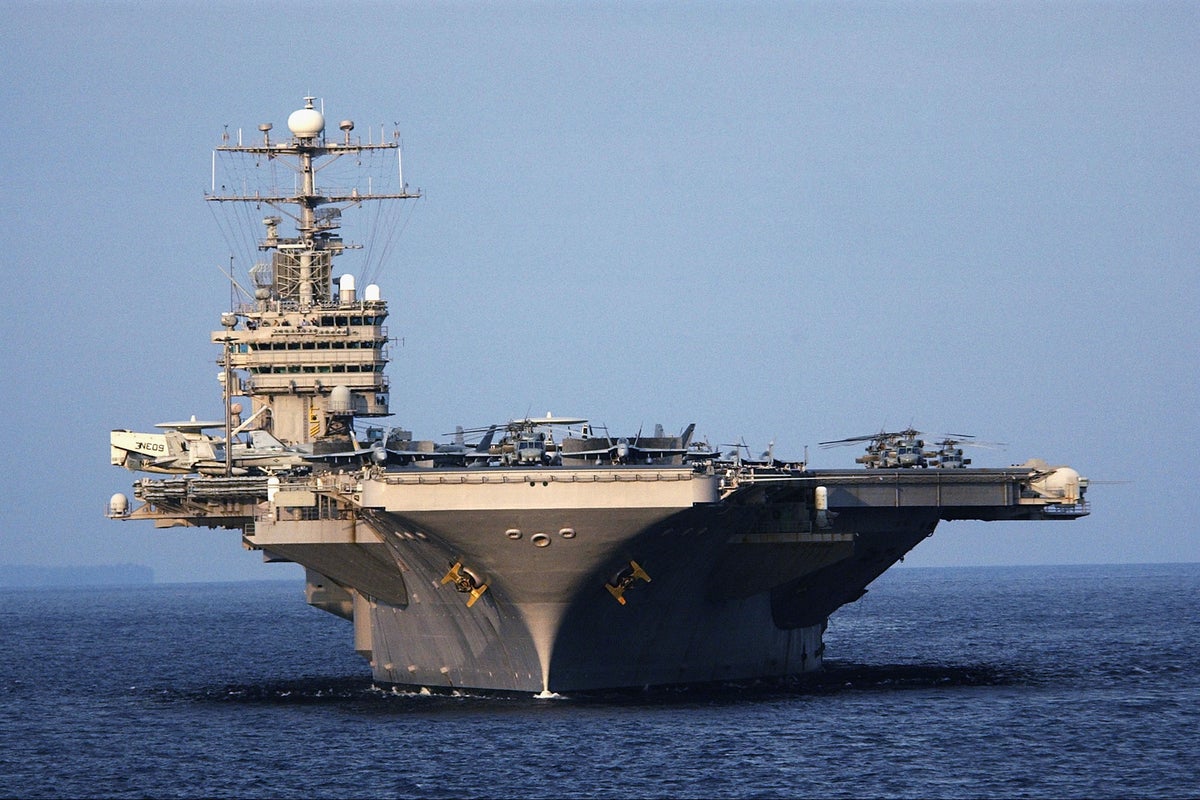
Midnight in the Philippine Sea smells like hot copper, stale coffee, and the faint, ever-present tang of aviation fuel. Down in the skin of the flight deck crew locker, Petty Officer Second Class Miller pulls a heavy rubber strap over his ear, securing his sound-powered phone. He is twenty-four years old. He has not seen his daughter walk across a living room rug in eight months. Right now, on the flight deck of the USS Abraham Lincoln, forty tons of titanium and jet fuel are resting on a hydraulic catapult, waiting for a green light that seems to stutter through the greasy night air.
We talk about military readiness in spreadsheets. We talk about it in congressional budget hearings, dry columns of numbers, and multi-billion-dollar allocations that roll off the tongue like alphabet soup. But readiness is not an abstraction. It is Miller’s aching lower back after his fourth consecutive twelve-hour shift. It is a cracked seal on a hydraulic line that has been patched twice with duct tape and hope because the replacement part is sitting in a warehouse in Norfolk, thousands of miles away, snarled in bureaucratic red tape.
When a supercarrier leaves port, it carries a small city’s worth of humanity, but it also carries the fragile ego of global stability. We rely on these floating islands of steel to keep the world's shipping lanes open, to deter aggression simply by existing, to cast a long, gray shadow across contested horizons. Yet, beneath the polished gray paint and the formidable reputation of the Nimitz-class, a quiet fatigue is setting in. The machines are tired. The people running them are running on fumes.
Consider what happens when a carrier deployment stretches from six months to nine, and then brushes against ten. To illustrate the cascading effect, imagine a rubber band stretched to its absolute limit, then held there for a year. It loses its snap. It frays at the edges.
The maintenance backlogs are the invisible antagonist of this story. Ships that are meant to spend months in dry dock, scraping away the barnacles of hard operations and overhauling reactor cores, are instead pushed back out into the brine. Why? Because there are simply too many flashpoints and too few hulls to cover them. The Navy is robbing Peter to pay Paul, shifting carrier strike groups across the globe like chess pieces to plug holes in a leaking dike.
When a critical pump fails aboard the Lincoln, it is not just a mechanical inconvenience. It is a domino. Without that pump, cooling systems falter. Without functional cooling systems, radar scopes blink out at the exact moment a shadow appears on the horizon. The crew improvises. They are masters of improvisation, sailors who can fix a diesel generator with a piece of wire and an act of sheer will. But improvisation is not a strategy. It is a symptom of decline.
I remember standing on a pier in San Diego years ago, watching a carrier return after an agonizing deployment. The families were screaming, waving homemade banners, tears carving tracks through soot and sunscreen. But the sailors coming down the brow did not look victorious. They looked hollowed out. Their eyes had that distinct, glassy stare of people who have lived too long in a gray box of gray water and gray routine. They had kept the ship afloat. They had launched the jets. They had completed the mission. But at what cost?
The public rarely sees the cost until the bill comes due in headlines about collisions, overworked crews, or deferred maintenance catching up with violent speed. We treat military readiness like an infinite well. We assume that because the flag is flying, the gears are turning smoothly. We forget that iron rusts, rubber rots, and human beings break.
Back on the flight deck of the Lincoln, the catapult fires with a deafening crack that rattles teeth and presses air straight out of lungs. An F-35C rockets into the black, disappearing into the void before the sound even catches up to its tail. Miller watches it go, rubs his tired eyes, and turns back toward the hatch, knowing his watch is only half over. The jet is airborne. The mission goes on. But the ground beneath us is shifting, and the silence left in the wake of our complacency is louder than any engine.


