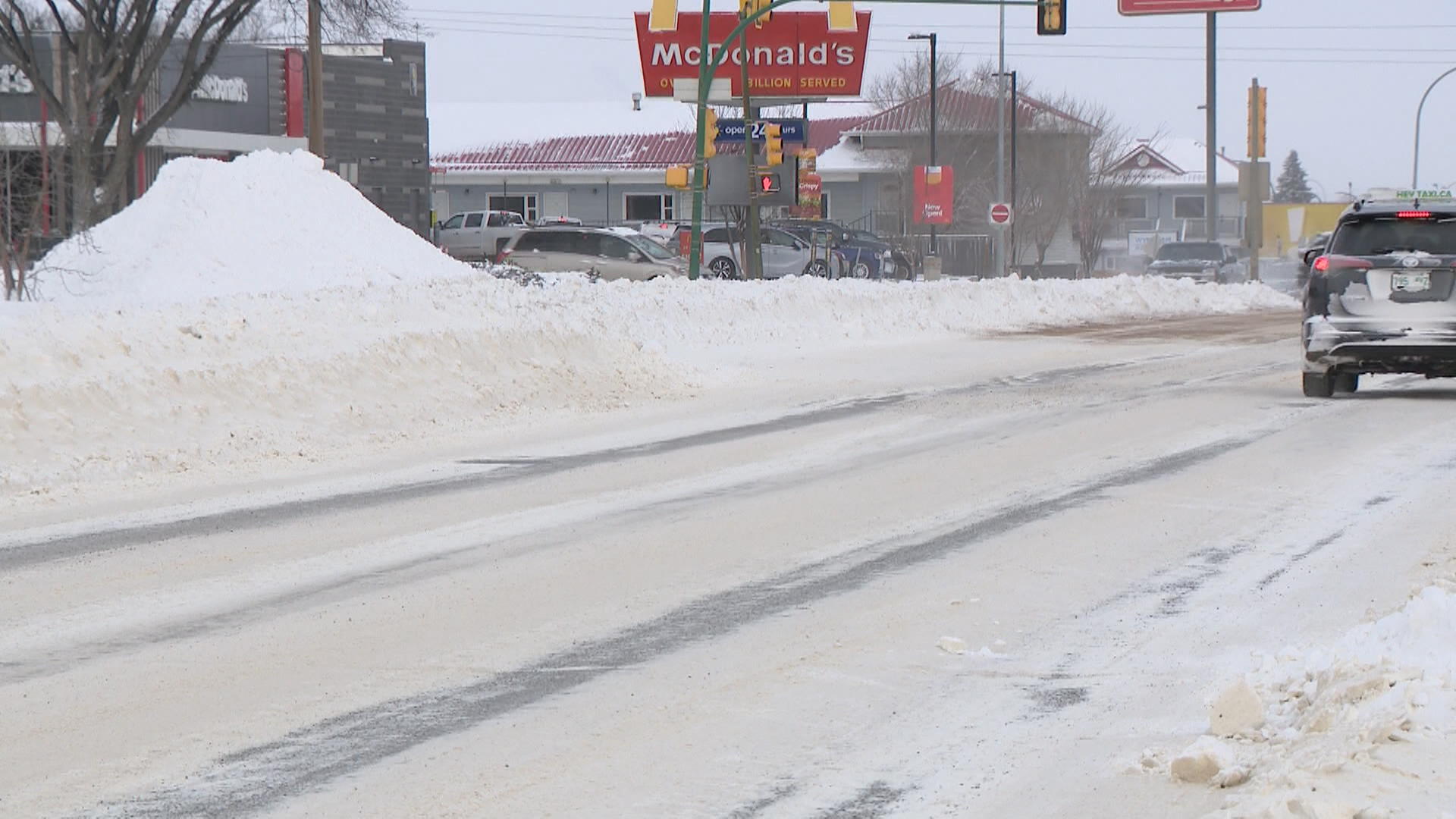
The first sign isn't the sight of white. It is the sound—or rather, the absence of it.
In the prairies, the wind is a permanent resident. It whistles through the siding of grain elevators and hums against power lines with a frequency every resident of Saskatchewan and Manitoba knows in their marrow. But when the sky turns the color of a bruised plum and the air pressure drops so fast it makes your inner ear pop, the wind takes a deep, ragged breath. It stops. The silence that follows is heavy. It is the silence of fifty centimeters of snow waiting to rewrite the map.
We call it "weather" when it's on the news. We call it "the forecast" when we check our phones. But when the barometer bottomed out this week, signaling a massive low-pressure system moving across the Canadian Shield, it stopped being a statistic. It became a physical weight.
The Calculus of the Drift
Imagine a woman named Sarah in a small town outside of Saskatoon. Sarah isn't thinking about the "up to 50 cm" predicted by the meteorological models. She is thinking about the three-mile stretch of gravel between her porch and the paved highway.
To a city dweller, fifty centimeters is an inconvenience—a morning spent with a shovel and a late start to the office. To Sarah, it is an island.
The physics of a prairie blizzard are different than a coastal storm. There are no trees to break the momentum. When those fifty centimeters fall, they don't sit neatly on the ground like a decorative quilt. They hunt. The wind picks up the crystals—sharp, dry, and jagged—and hurls them into every crevice, every lee side of a barn, every road cut. A half-meter of snowfall can easily become a three-meter drift.
That drift is a wall of concrete.
Sarah checks her pantry. Flour, coffee, the canned tomatoes she put up in August. She looks at the fuel gauge on the propane tank outside. These are the quiet rituals of survival that the "standard" news reports miss. They talk about "travel advisories." Sarah hears "you are on your own."
The Invisible Stakes of a Whiteout
Across the border in Manitoba, the Trans-Canada Highway begins to feel like a trap.
Think about the truckers. They are the circulatory system of the continent, hauling everything from fresh produce to industrial machinery. When a storm of this magnitude hits, the decision to pull over or push through isn't just a matter of logistics. It is a gamble with physics.
Visibility doesn't just "decrease." It vanishes.
One moment, you can see the taillights of the rig ahead of you. The next, the world is a milk-white void. This is "spatial disorientation," the same phenomenon that brings down pilots. Without a horizon line, the brain loses its ability to determine up from down, left from right. Drivers have been found frozen just twenty feet from their vehicles because they lost their sense of direction in the whiteout and walked the wrong way.
The "50 cm" mentioned in the headlines carries a secondary, darker number: the weight. Snow of this depth, especially if it turns wet as the temperature fluctuates near the freezing mark, puts thousands of pounds of pressure on rooftops. Old barns, those iconic wooden sentinels of the plains, often give up the ghost during these weeks. They groan under the burden until the timber snaps, a sound like a gunshot in the frozen night.
The Fragility of the Grid
We like to think we have mastered the elements. We have fiber-optic cables and climate-controlled living rooms. But our sophistication is tied to a series of aluminum wires strung across a frozen landscape.
When the ice builds up on those lines—a process called "galloping" where the wind catches the ice-coated wire and tosses it like a skipping rope—the poles begin to fail. One goes. Then the next. A domino effect that can plunge entire rural municipalities into a pre-industrial reality in seconds.
For a family in rural Manitoba, the loss of power isn't about the Wi-Fi going down. It is about the well pump. No power means no water. It means the wood stove becomes the only thing standing between a comfortable evening and a life-threatening drop in core body temperature.
The news will report on the "utility crews working around the clock." But let’s look at who those people are. They are men and women climbing poles in forty-kilometer-per-hour winds, their eyelashes frozen together, trying to splice wires with fingers that have lost all feeling despite the heavy gloves. They are fighting a war against a sky that doesn't care if they win.
The Heart of the Storm
There is a strange, terrifying beauty in this level of elemental power.
If you stand on a porch in the middle of a Saskatchewan blizzard, you feel small. Properly small. The kind of small that reminds you that our paved roads and property lines are just suggestions. The snow ignores them. It fills the ditches until the road and the field are one. It buries the fences that we used to claim ownership over the dirt.
By the second day of the storm, the world shrinks. Your universe becomes the four walls of your house and the glow of the emergency radio.
The "facts" tell us that this is a result of a moisture-heavy system colliding with an arctic air mass. But the truth is that it’s a forced pause. In a world that demands constant movement, fifty centimeters of snow is the only thing left that can actually make us stop.
The schools close. The shops lock their doors. The frantic pace of modern life is smothered under a heavy, white blanket. There is a primal fear in it, yes, but there is also a profound communal experience. You know that your neighbor, two miles away, is looking out their window at the same wall of white. You are separated by drifts, yet joined by the shared knowledge of what it takes to endure this place.
The Thaw and the Memory
Eventually, the pressure will rise. The clouds will break, revealing a blue so piercing it hurts to look at. The sun will bounce off the fresh drifts with a blinding, crystalline intensity.
But the 50 centimeters don't just go away.
They stay in the way we talk to each other at the general store once the plows finally break through. "How'd you fare?" becomes the standard greeting. We compare the heights of our drifts like battle scars.
The news cycles will move on to the next headline, the next political scandal, or the next sporting event. The "Up to 50 cm" forecast will be archived in a database. But for the people in the path of the storm, the memory remains in the sore muscles of the lower back, the extra cords of wood burned, and the quiet realization of how quickly the world can turn white and silent.
We live on the edge of a great, wild interior. Every few years, the sky reminds us of that fact. It reminds us that we are guests here, permitted to stay only as long as we remember how to prepare, how to hunker down, and how to wait for the wind to catch its breath again.
The snow is still falling. Somewhere in the middle of a vast, white field, a single fence post is about to disappear entirely.