Fabric has always been our second skin, our quietest language. Long before we learn to shape diplomacy with our tongues or protest with our votes, we dress ourselves in intent. We wear black for mourning, white for celebration, and occasionally, slogans that scream what our mouths are forbidden to voice.
Cloth is light. It bends with the wind, folds into corners of drawers, and offers no resistance to the touch. Yet, in certain coordinates of the map, a few ounces of cotton can carry the crushing gravity of treason.
Consider a single afternoon outside a courthouse in Hong Kong.
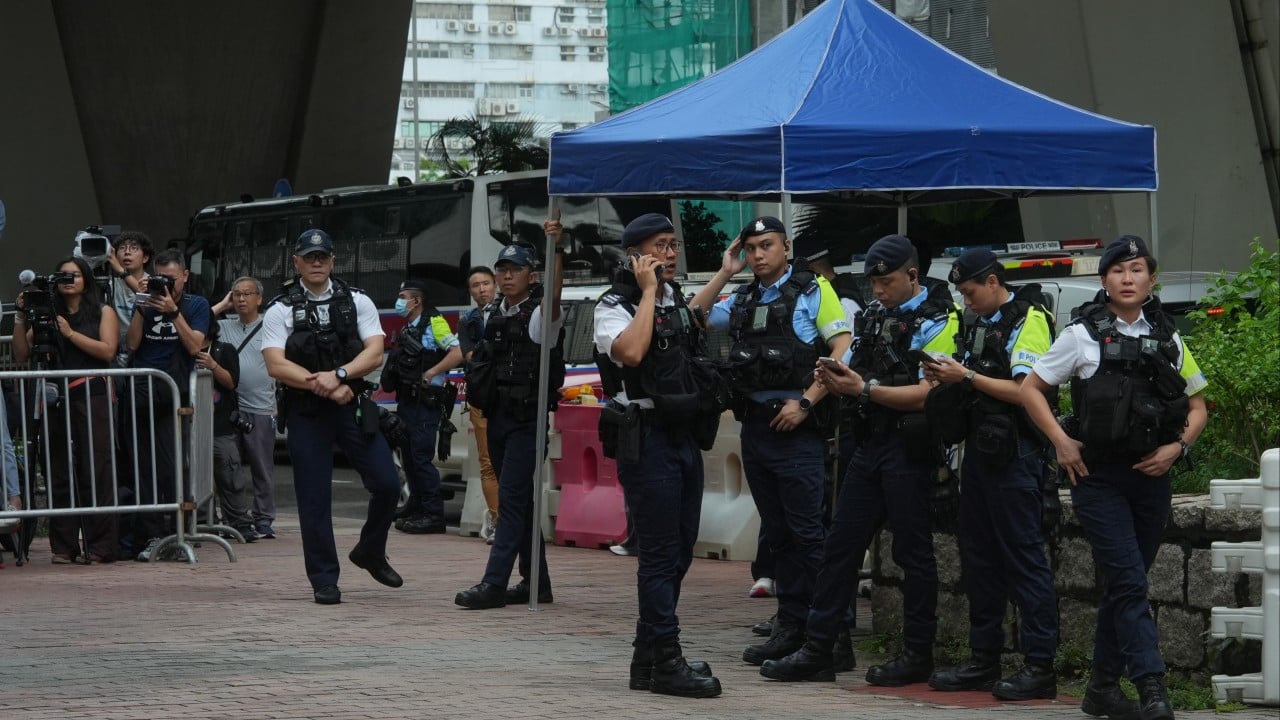
The air smells of exhaust fumes, damp concrete, and the distinct, rising tension of a city holding its breath. Journalists crowd the pavement, their camera lenses blinking like mechanical eyes. Police officers stand in disciplined clusters, their uniforms crisp, their expressions unreadable. Into this charged space walks a woman.
She is not shouting. She is not holding a megaphone, nor is she unfurling a massive banner that might catch the gale. She wears a simple T-shirt. Printed across the fabric are words that have suddenly transformed from ordinary ink into dangerous contraband.
Stop.
That is the entire mechanism of modern restriction. It does not require iron bars immediately; it begins with the criminalization of ordinary grammar.
According to the dry administrative record of the event, a 27-year-old woman was detained by national security police under the Safeguarding National Security Ordinance. Her crime? Wearing a top bearing a slogan associated with past protests, paired with a yellow mask. Yellow, once the cheerful color of lemons and sun, has evolved over the past few years into a visual shorthand for defiance. A color can be arrested now. A font can be suspect.
To understand the profound chill of this moment, one must remember what it feels like to live in a place where the boundaries of safety shift overnight.
I remember walking through neighborhoods where storefronts changed their names every month, shedding past identities like snakes losing old scales. People lowered their voices in cafes, not because anyone was directly listening, but because the architecture of suspicion gets inside your ribs. You start policing your own thoughts before they even reach your teeth. When a state begins to legislate what you can wear on your back, it is sending a very specific memo to your nervous system: Your body does not belong to you. It belongs to the narrative we permit.
The police statement later that day used heavy, formal terminology. Investigations revealed. Seditious intention. Incitement.
Words that sound impressive on parchment, yet when applied to a T-shirt, they reveal a profound insecurity. If an empire can be unraveled by a graphic tee, then the empire was never truly strong to begin with. It was fragile, built on glass foundations, terrified of the independent human imagination.
Think about the mental calculus required just to get dressed in the morning under such conditions.
You wake up. You open your wardrobe. In a free society, this is a mundane ritual of personal expression or sheer laziness—grabbing whatever clean laundry happens to be on top of the pile. But in an environment governed by sweeping security laws, your closet becomes a minefield. Is this phrase too ambiguous? Does this shade of yellow cross an invisible line? Will an overzealous officer on a street corner decide that your laundry is an act of war?
Paranoia is a slow poison. It turns neighbors into informants and strangers into potential threats. It makes public spaces feel like open-air interrogation rooms.
The woman outside the court knew the risks. Everyone knows the risks now. The city's legal landscape has transformed so radically that past precedents offer no comfort. Under the ordinance enacted earlier that year, penalties for sedition offenses were significantly hiked, turning minor expressions of dissent into felonies carrying years of imprisonment. The state raised the stakes so high that even a passive garment became a high-stakes gamble.
Why take the chance?
That is the question the detached observer asks from a safe distance across an ocean. Why not just wear a plain grey shirt? Why provoke the machine when the machine holds all the cards?
Because submission is a slow death.
There comes a point in the erosion of liberty where compliance stops feeling safe and starts feeling like complicity. When every public gesture is monitored, choosing what to wear becomes the last frontier of personal sovereignty. It is a desperate, quiet way of saying: I am still here. I have not entirely forgotten who I was before the silence was mandated.
The arrest happened swiftly. Officers moved in, isolating her from the crowd, turning her private act of protest into a public spectacle of state power. The cameras flashed. Notebooks scribbled details. Within hours, the incident was processed, digitized, and broadcasted to millions of screens around the world. Another headline. Another data point in the steady accumulation of control.
Yet, the irony of censorship is that it amplifies the very thing it tries to erase.
Before that afternoon, a T-shirt with a contested slogan was just a piece of fabric sitting in a drawer or worn by an obscure individual. By arresting it, by making it illegal, the authorities did something remarkable. They immortalized it. They gave a fading phrase infinite life, broadcasting its existence to millions who might never have noticed it otherwise.
Power often mistakes visibility for victory. It believes that by dragging the offender away, sweeping the pavement, and issuing stern warnings, it has restored order.
Order has indeed been restored. But it is the order of a graveyard.
As the sun sets over Victoria Harbour, casting long, bruised shadows across the skyscrapers, the neon lights flicker on. The city moves with its usual, frantic energy. Commuters rush toward the MTR stations, eyes glued to their smartphones, shoulders hunched against the evening chill. Everything looks normal on the surface. Commerce continues. Money changes hands. Laws are enforced.
Yet, beneath that polished veneer, everyone knows the truth. They know that a person can be taken away for the words on their chest. They know that the perimeter of acceptable thought has shrunk just a little bit more today.
And somewhere in a dark room, a piece of evidence sits in a plastic bag—a simple, folded T-shirt, silent and radioactive with meaning.