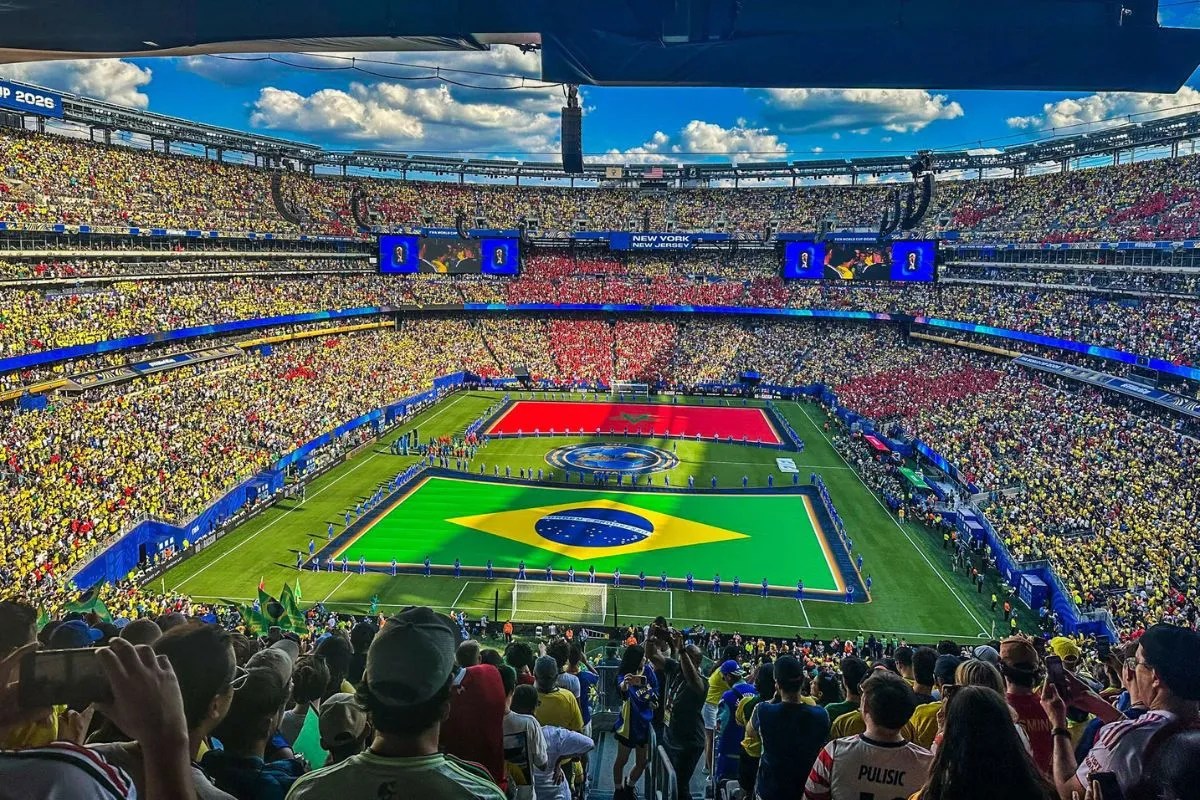
The stadium hums with a specific kind of anxiety that only international football can brew. It is not just noise; it is a physical weight, a collective holding of breath by thousands of people who have poured their identities into eleven shirts running across a patch of grass. To the casual observer watching a flickering screen in a bar halfway across the world, it is just a game. A scoreboard. A ticking clock. But on the pitch, every blade of grass feels like a battleground, and every second is an interrogation of a man’s character.
When the ball leaves the midfield, traveling along a trajectory that seems written in the stars, the stadium falls into a microscopic silence. For a striker, this is the moment where the universe shrinks. There is no crowd. There is no manager shouting from the technical area. There is only the flight of the leather sphere, the positioning of the defender’s hips, and the precise fraction of a second required to turn human muscle into pure kinetic energy.
Ayase Ueda spent his entire youth preparing for these exact micro-moments. When he struck the ball that night, extending Japan's lead and sending a shockwave through the opposition, it looked effortless. The commentators called it a missile. They talked about technique, power, and tactical positioning. They analyzed the angle of his ankle and the velocity of the shot.
They missed the entire point.
A goal like that is never just about physics. It is the culmination of an invisible, exhausting psychological war that every modern forward must wage against doubt, expectation, and the ghost of their own failures.
The Lonely Geography of the Penalty Box
To understand the strike that broke the game open, you have to understand the sheer loneliness of being a number nine for the Samurai Blue. Japan’s footballing history is rich with brilliant midfielders—magicians who could pass through the eye of a needle, creators who dictated the tempo of matches with artistic grace. But for decades, the national conversation always returned to the same agonizing question: Where is the killer instinct? Where is the man who does not want to pass the ball into the net, but wants to destroy it?
Ueda carries that historical hunger on his shoulders every time he ties his boots.
Consider what happens when a striker goes through a dry spell. The press becomes a choir of critics. Every missed opportunity is replayed in slow motion, dissected by pundits who have never felt the pressure of a center-back’s elbow crushing their ribs. The pressure builds like steam in a sealed pipe. If you let it get into your head, your feet become heavy. Your decision-making slows by a millisecond. In international football, a millisecond is the difference between a heroic finish and an embarrassing block.
On this night, the match was finely balanced. Japan held a fragile advantage, the kind of lead that feels like walking a tightrope in a high wind. One mistake, one momentary lapse in concentration from the backline, and the hard work of seventy minutes would evaporate. The opposition was pushing forward, throwing bodies into the attack, leaving spaces behind them but suffocating the Japanese midfield.
The game needed an exclamation point. It needed someone to step out of the tactical system and demand the spotlight.
The Anatomy of a Strike
It happened in a flash of instinct. The ball broke loose near the edge of the penalty area, bouncing awkwardly, spinning with a wicked malice that would make lesser players hesitate. A defender rushed in, desperate to close down the space, throwing his entire body into a block.
Time slowed down.
Ueda did not look at the goal. He did not need to. A true striker possesses an internal map of the pitch, an innate sense of where the posts stand in relation to their own body. He adjusted his stride, a microscopic stutter-step that allowed his plant foot to anchor firmly into the turf. His body leaned forward, keeping his center of gravity low—a textbook posture designed to keep the ball from soaring into the stands.
Then came the impact.
It was not a casual side-foot finish. It was a violent, uncompromising strike using the laces of his boot, catching the ball precisely at its equator. The sound of leather meeting leather echoed through the lower tiers of the stadium—a sharp, metallic crack that signaled danger before the ball even reached its peak velocity.
The ball did not curl. It did not dip. It traveled on a perfectly straight line, rising slightly as it cut through the air like a projectile. The opposing goalkeeper made a desperate, acrobatic leap, his fingers stretching until his muscles strained, but he was chasing a ghost. The ball exploded into the roof of the net with such force that the nylon rigging visibly shuddered.
Two-zero. The cushion. The relief.
The stadium erupted into a wall of sound, a release of all that built-up anxiety. Ueda did not engage in an extravagant, choreographed celebration. He ran toward the corner flag, his face a mask of intense determination before breaking into a triumphant smile as his teammates swarmed him, burying him beneath a mountain of blue shirts. He had not just scored a goal; he had restored order.
The Human Cost of Excellence
We look at these athletes and see machines, superheroes immune to the anxieties that plague the rest of us. We read headlines that treat their exploits like military maneuvers—missiles fired, advantages extended, territories conquered.
But the reality is far more fragile. Behind the spectacular goal is a young man who left his home country to test himself against the brutal physical realities of European club football, fighting for minutes, adapting to new cultures, and constantly carrying the expectations of millions back home. Every time he plays for Japan, he is auditioning for his place in history.
Imagine the mental fortitude required to step up in a crucial match, knowing that a single miss could define your international career for the next six months. The public memory is notoriously short; you are only as good as your last ninety minutes.
That strike was the answer to every doubt ever whispered in a press conference. It was a declaration that Japan possesses the clinical edge necessary to compete at the absolute highest level of the global game. It was a moment of pure, unadulterated catharsis for everyone who has ever watched the national team dominate possession only to fall short at the final hurdle.
The tactical sheets will show a tactical shift, a specific substitution, and a statistical increase in win probability after the second goal. The spreadsheets will record the three points. But anyone who was in that stadium, or anyone who felt their heart race in front of a television screen, knows that they witnessed something far deeper than a mere change in the scoreline.
They saw a man seizing his destiny in the space of a single heartbeat, leaving the goalkeeper frozen, the net shaking, and an entire nation breathing a collective sigh of relief.