The Mediterranean does not look like a graveyard. On a clear afternoon, it is an impossible, blinding blue, the kind of blue that fills postcards and lures vacationers to the rocky coastlines of southern Europe. But water holds no monuments. It leaves no headstones. When a fragile rubber dinghy collapses ten miles off the coast of Lampedusa, the sea swallows the evidence of human panic in minutes, returning to its pristine, deceptive calm.
For years, the statistics have arrived on our screens with a rhythmic, numbing regularity. Thousands dead. Hundreds missing. Numbers typed out in press releases by maritime authorities, filed away in bureaucratic archives in Brussels, and skimmed over by citizens eating breakfast.
Then an old man in white vestments walked down to the water’s edge.
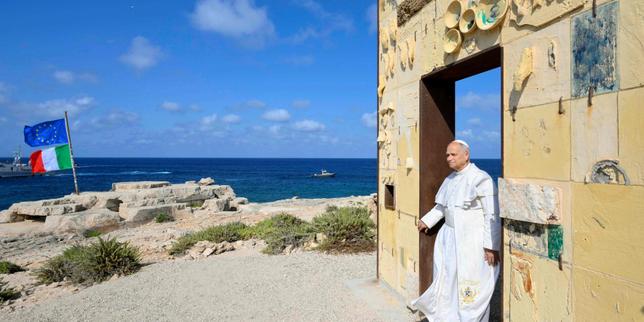
When Pope Leo XIV stood on the shoreline, looking out over the expanse that separates North Africa from the European Union, he was not there to review policy briefs or debate border quotas. He came to force a continent to look at its own reflection in the water. By tossing a wreath of bright flowers into the waves, he transformed a vast expanse of geopolitical tension into what it truly is: a site of profound, collective mourning.
Consider what happens long before a name becomes a digit in a missing-persons report.
Imagine a young man named Tareq. He is twenty-two, born in a city where the future was shelled into rubble years ago. He does not want to leave his mother, or the smell of jasmine that lingers in the courtyard after a rainstorm. But hope is a physical necessity, and when it dries up at home, a person will walk toward any horizon that promises a drop of it. Tareq sells his father’s watch, pays a man he does not trust, and boards a vessel that was never meant to leave the safety of a harbor.
The boat is overcrowded. The plastic sides groan under the weight of seventy human beings, each clinging to a backpack containing their entire life: a wet passport, a family photograph wrapped in plastic, a change of clothes.
When the engine dies in the middle of the night, the silence is louder than any explosion. There is no light except the stars, which look cold and indifferent. The water begins to lap over the gunwales. In those dark hours, the abstract debates held in the air-conditioned halls of the European Parliament disappear. There are no "flows of migrants" or "illegal crossings." There are only terrified voices crying out in Arabic, French, and Somali, all praying to the same sky for a rescue ship that might never come.
When these boats sink, they leave behind an invisible ghost fleet.
The standard news reports focus on the logistics. They detail the naval patrols, the political friction between Italy and France, the new funding mechanisms designed to fortify Frontex. They treat the crisis as a math problem, an equation of deterrence and security to be solved with higher fences and longer drone surveillance flights.
But the real problem lies elsewhere. It lies in the slow, quiet death of European empathy.
Leo XIV’s address to the European Union was a deliberate strike against this spiritual exhaustion. Standing before the cameras, his voice carrying over the sound of the surf, he did not use the sanitized language of international diplomacy. He spoke of a "shipwreck of civilization." He warned that when a society grows accustomed to the drowning of children, it has already lost its own soul.
The message to Brussels was unmistakable. The European Union was founded on the ashes of World War II as a grand experiment in human rights and shared dignity. It was meant to be a sanctuary of law and compassion. Yet, by turning the Mediterranean into a militarized moat, the project risks undoing its own foundational myth. When we build walls so high that we can no longer hear the screams of those on the other side, the wall changes what it means to be human on the inside.
This is not a simple problem with an easy solution. The anxieties of European towns and cities are real. Resources are finite, integration is complex, and fear is a potent political currency. It is easy to feel overwhelmed by the sheer scale of the movement, to believe that any gesture of openness will simply invite a tide that cannot be contained.
But look at the flowers floating on the water.
They do not solve a policy crisis. They do not rewrite asylum laws. What they do is break the spell of distance. They remind us that every single person who went under that water had a name, a mother who still waits for a phone call, and a dream that was no different from the dreams we have for our own children.
We have gotten the entire conversation backward. We treat solidarity as a luxury we can only afford when times are good, a secondary concern to be addressed after the borders are perfectly secure. The truth is much harsher. Solidarity is the baseline. Without it, the institutions we build to protect our own comfort become brittle, hollow shells.
The afternoon sun began to dip, casting long, golden shadows across the shore as the ceremony concluded. The politicians will return to their meetings. The patrol boats will resume their sweeps. The numbers will inevitably rise again next month.
But the image of that white robe against the gray stone of the coast remains. It stands as an uncomfortable, necessary question mark over the conscience of a continent. The sea will continue to wash against the shores of Europe, bringing with it the unspoken memories of those who dared to believe that the land across the water was a place of safety. We can choose to look away, to hide behind the thick walls of bureaucracy and security. But the water remembers. And sooner or later, we will have to answer for what we allowed it to take.