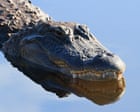
Florida waters conceal a prehistoric reality that defies our modern urge to sanitize nature. On a quiet afternoon, a routine paddleboard excursion on a placid Florida waterway transformed instantly into a violent survival struggle when a massive American alligator struck without warning, targeting a woman and turning the recreational calm into a bloody operational crisis. A nearby paddleboarder executed a split-second rescue, snatching the victim from the jaws of a predator that most weekend visitors treat as an urban myth or a harmless photo opportunity.
We write about these events as anomalies. They are not. They represent the predictable collision of aggressive regional development, expanding reptile populations, and human ignorance regarding apex predators in shared aquatic habitats.
Understanding how an alligator strike unfolds requires looking past the sensational headlines to examine the ecological mechanics of ambush predators, the failure of municipal warning infrastructure, and the raw biomechanics of water rescues.
The Mechanics of the Ambush
Alligators do not hunt like mammals. They do not chase, stalk across open ground for miles, or exhaust their prey through endurance. They wait.
The American alligator operates as a sensory-driven ambush machine. Rows of specialized integumentary sense organs dotting their jaws detect microscopic pressure changes and vibrations in the water column. When a paddleboard glides over the surface, it creates a subtle hydrodynamic signature. To a submerged reptile weighing several hundred pounds, that rhythmic disturbance mimics the movement of a wading bird, a raccoon, or a struggling mammal.
Water acts as an amplifier. The low-frequency ripples generated by a paddleboard travel straight to the alligator's lower jaw. By the time a human sees the disturbance, the animal has already calculated mass, trajectory, and strike velocity.
[Submerged Alligator] ---> (Detects Hydrodynamic Pressure) ---> [Paddleboard Movement]
                                     |
                                     v
                       [Immediate Explosive Ambush]
The strike itself defies human reaction times. An alligator can accelerate from a dead stop underwater to explosive surface velocity in fractions of a second. The initial bite is rarely meant to kill outright; it is designed to drag the target beneath the surface where hydrostatic pressure and drowning immobilize resistance. When the attack occurred on that Florida waterway, the victim had no window for evasion. The predator was already closing the distance before cognitive recognition registered the threat.
The Rescuer Calculus
Rescue operations in open water against an apex predator depend entirely on immediate physical intervention and the disruption of the animal's feeding sequence.
When the secondary paddleboarder heard the commotion, the margin for error measured in heartbeats. Hesitation equals fatality. In wildlife conflict scenarios, predators operate under a fixed set of behavioral rules. Once an alligator secures an initial grip, its immediate instinct is the death roll—a violent rotational maneuver designed to dismember prey. If a victim enters the death roll phase while attached to a board or a shoreline, rescue becomes exponentially harder due to structural entanglement and catastrophic tissue damage.
The intervening paddleboarder closed the gap, utilized their board as an unstable tactical platform, and physically pulled the victim away from the lunging reptile. This intervention broke the predator's sequence. Alligators calculate risk versus energy expenditure. Encountering unexpected resistance and a massive, unfamiliar object—the second paddleboard—often triggers a hesitation response. That hesitation provided the crucial window to haul the injured woman clear of the strike zone.
We celebrate these rescuers as accidental heroes. Yet their actions highlight a glaring systemic vacuum. We rely on random civilian bravery because our public safety frameworks treat wildlife attacks as acts of God rather than manageable environmental risks.
The Human Footprint and the Reptile Boom
Florida's human population surges by thousands of residents every week. Every new housing development, every concrete bulkhead pushed into a cypress swamp, and every stormwater retention pond carved out of a wetland compresses the boundary between human recreation and wildlife habitat.
Decades of successful conservation transformed the American alligator from an endangered species into an overwhelming local abundance. Protected by stringent laws for generations, alligator numbers rebounded past historical baselines. Today, millions of alligators inhabit every county in Florida. They live in drainage ditches behind gas stations, hazard zones on golf courses, and the canals winding through suburban subdivisions.
Yet public perception remains dangerously naive. Tourists and new residents arrive with a Disney-fied view of Florida wildlife. They treat retention ponds like community swimming pools. They walk dogs near the water's edge at dusk—the prime hunting window for ectothermic predators whose metabolism peaks in warm water.
Municipalities compound the problem. Warning signs are sparse, generic, and frequently ignored. Real estate marketing materials heavily promote waterfront living while burying the reality of coexisting with large carnivores in the fine print. When an attack happens, officials express shock, remove or euthanize the specific animal, and reset the clock until the next inevitable encounter.
The Reality of Water Safety in Predator Territory
Surviving shared waters demands moving past passive awareness into active operational discipline. Standard water safety advice—wear a life jacket, swim with a buddy—fails to address the specific threat profile of crocodilian ambush zones.
- Ditch the shoreline at twilight: Alligators are crepuscular hunters. Low light matches reduced human visibility with peak predator activity.
- Keep pets clear of the bank: Dogs represent the exact visual and acoustic profile of prime alligator prey. Walking a dog near fresh water is an invitation for a strike.
- Maintain spatial awareness on vessels: Paddleboards and kayaks place the user low to the water, highly vulnerable to lateral strikes and boarding attempts.
- Never assume a body of water is clear: If it is wet and in Florida, assume an alligator occupies it. Size is irrelevant; juveniles are aggressive, and large adults are invisible until they move.
The victim on that Florida waterway survived because a fellow paddler possessed situational awareness and raw nerve. But relying on civilian intervention in the middle of a wildlife crisis is a failing strategy. Until local governments enforce stricter zoning buffers, mandate robust physical barriers around high-risk retention ponds, and launch aggressive public education campaigns that strip away the novelty of these apex predators, the water will keep breaking quietly, and another strike is only a matter of time.


