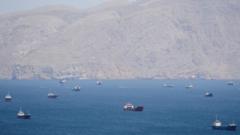
The United States government has issued a blunt ultimatum to the global maritime industry. Any shipping company caught paying transit tolls to Iranian authorities risks being severed from the American financial system. This move marks a significant escalation in the use of economic statecraft to choke off Tehran’s remaining revenue streams. For decades, the Strait of Hormuz has served as a volatile choke point where geopolitics and commerce collide. Now, the administrative act of paying a standard transit fee has been redefined as a sanctioned transaction with a terrorist-sponsoring entity.
Shipping firms now find themselves in an impossible position. They must choose between the physical risks of navigating one of the world's most dangerous waterways without paying for "protection" or the financial ruin that comes with U.S. Treasury blacklisting. This isn't just about a few million dollars in fees. It is about the fundamental mechanics of how oil and goods move through the Middle East.
The Invisible Financial Border
Under current Treasury Department guidelines, the Office of Foreign Assets Control (OFAC) views these payments not as maritime necessities but as direct funding for the Islamic Revolutionary Guard Corps (IRGC). The IRGC exerts control over Iranian ports and maritime security operations in the Gulf. When a Greek tanker or a Singaporean bulk carrier pays a toll to ensure safe passage or to utilize Iranian-monitored lanes, that money often ends up in accounts controlled by sanctioned individuals.
Washington’s logic is simple. If you feed the IRGC’s coffers, you are an accomplice to their regional activities. The penalty is the "death sentence" of secondary sanctions. This means the shipping line loses access to U.S. dollar clearing, its ships are banned from American ports, and its insurers—mostly based in London or New York—are forced to cancel coverage. Without insurance, a ship cannot enter any major port in the world. It becomes a pariah at sea.
The Mechanics of Maritime Extortion
Iran views the Strait of Hormuz as its backyard. While international law generally provides for "transit passage" through straits used for international navigation, Tehran has long maintained that this right is conditional. They argue that vessels must adhere to their specific environmental and security regulations, which conveniently involve fees paid to state-linked entities.
In practice, these tolls act as a form of sovereign protection money. If a company refuses to pay, their vessels become targets for "inspections" or outright seizure by IRGC Navy fast-attack boats. We have seen this play out repeatedly. A ship is diverted under the guise of a maritime technicality, only to be held as a bargaining chip in a larger diplomatic standoff. By threatening sanctions on those who pay, the U.S. is effectively removing the "easy way out" for shipping executives.
The Insurance Crisis Beneath the Surface
The real pressure point isn't the ship itself, but the paper that allows it to sail. The International Group of P&I Clubs provides marine liability cover for about 90% of the world's ocean-going tonnage. These clubs are deeply integrated into the Western financial grid.
If the U.S. Treasury identifies a specific payment to an Iranian entity, the insurer is legally obligated to drop the vessel. This creates a terrifying domino effect. A ship carrying $100 million in crude oil suddenly has no liability coverage for spills, collisions, or crew injury. No terminal will allow it to dock. The cargo becomes "homeless."
Maritime lawyers are currently working overtime to draft "sanction-proof" clauses, but the reality is that the U.S. maintains a long-arm jurisdiction that few can escape. If the transaction touches a U.S. server or involves a bank with a New York branch, the trap snaps shut.
Dark Fleets and the Shadow Economy
This aggressive stance has an unintended side effect. It pushes more of the world’s shipping into the "Dark Fleet." These are aging vessels with opaque ownership, often flying flags of convenience from nations that turn a blind eye to international regulations. These ships don’t care about U.S. sanctions because they already operate outside the legitimate financial system.
By making it impossible for legitimate, law-abiding firms to operate near Iranian waters without legal risk, the U.S. is inadvertently ceding the territory to rogue players. These shadow tankers often turn off their AIS (Automatic Identification System) transponders, making them invisible to standard tracking. They engage in dangerous ship-to-ship transfers in the middle of the ocean to mask the origin of their cargo. The environmental risk is catastrophic. A massive spill from an uninsured, unmaintained shadow tanker would leave no one to pay for the cleanup.
The Cost of Doing Business
For the legitimate global fleet, the result is longer routes and higher costs. If you cannot safely or legally pass through the Strait of Hormuz because you refuse to pay Iranian tolls—and rightfully fear U.S. retaliation—you may have to reconsider your entire route. While there is no easy way to bypass the Strait for Persian Gulf exports, the increased "compliance premium" is passed directly to the consumer. Every barrel of oil becomes more expensive not because of scarcity, but because of the legal friction required to move it.
The Strategic Gambit
Why now? The timing suggests a coordinated effort to dry up Iranian foreign exchange reserves ahead of potential regional shifts. The U.S. is betting that shipping giants like Maersk, MSC, and COSCO will prioritize their access to the American market over the convenience of Iranian routes. It is a high-stakes game of chicken where the global supply chain is the pavement.
The European response has been characteristically muted. While the EU often complains about the extraterritorial reach of American law, European banks and shippers are far too risk-averse to challenge OFAC. They remember the multi-billion dollar fines levied against banks like BNP Paribas for sanctions violations. No one wants to be the test case.
The Legal Gray Zone of Transit Passages
There is a brewing legal conflict regarding the United Nations Convention on the Law of the Sea (UNCLOS). The U.S. is not a party to UNCLOS but recognizes most of its provisions as customary international law. Under UNCLOS, ships have the right of transit passage through straits. Iran, which has signed but not ratified the treaty, argues that it can regulate this passage.
By intervening in the payment of tolls, the U.S. is asserting its own interpretation of maritime law through the lens of national security. It is a move that bypasses international courts and goes straight for the jugular of the global economy.
Risk Mitigation for the Modern Fleet
Ship owners are now being advised to conduct "deep-dive" due diligence on every entity involved in their transit. It is no longer enough to know your customer. You must know your customer’s port agent, the provider of your tugboats, and the ultimate beneficiary of the waterway's "administrative fees."
The burden of proof has shifted. In the eyes of the U.S. Treasury, you are often guilty until you can prove your payment didn't touch a sanctioned hand. For many, the only winning move is to stay away entirely, or to risk the wrath of a superpower that has proven it can erase a company's balance sheet with the stroke of a pen.
The era of "just business" in the Middle East is over. Every dollar paid at sea is now a political statement. Shipping companies that fail to recognize this shift are not just risking fines; they are risking their existence. The message from Washington is clear: there is no such thing as a neutral toll in a cold war.
If you are operating in these waters, the cost of passage has just become infinitely higher than any fee Iran could ever demand.