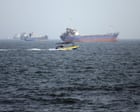
The headline reads like a clean Hollywood action sequence. An American warship takes incoming fire, the retaliation arrives with pinpoint cinematic vengeance, and enemy tankers burn on the horizon. Washington pops the champagne, stock prices for defense primes tick upward, and the cable news pundits nod sagely about the restoration of deterrence.
It is a comforting narrative. It is also a dangerous fantasy. For a deeper dive into this area, we recommend: this related article.
For years, I have watched defense analysts and beltway strategists obsess over hardware metrics while completely missing the economic and operational reality of modern maritime choke points. When the Pentagon announces the destruction of Iranian tankers following a missile exchange, the lazy consensus treats this as a tactical victory. It assumes that sinking steel and burning crude equals strategic success.
That assumption ignores how modern asymmetric conflicts actually function. For further details on this topic, in-depth analysis is available at The Guardian.
The Logistics Myth of Retaliation
Every time an exchange occurs in the Persian Gulf or the Red Sea, the immediate conversation focuses on exchange ratios. How many missiles did the destroyer fire? What did those interceptors cost? How many hulls did we put on the ocean floor?
This is the wrong scoreboard.
Think about the economics of attrition. A rudimentary anti-ship missile costs a fraction of the multi-million-dollar interceptor sent to stop it, or the billion-dollar hull it targets. But when we shift the focus to destroying tankers, we fall into a trap of our own making. Sinking low-value or aging hulls does nothing to degrade the adversary's capability to disrupt global shipping. In fact, it often achieves the exact strategic goal the adversary wanted in the first place: higher global oil prices, strained insurance markets, and diverted Western naval assets.
Let us be entirely clear about what a tanker represents in modern asymmetric warfare. These are not capital ships. They are often older, heavily insured, flag-of-convenience vessels operating in grey-zone logistics. Destroying them does not choke off a regime's financial lifeline; it merely validates their narrative of Western aggression while imposing massive friction on neutral commercial traffic.
When you celebrate the destruction of a tanker, you are celebrating an event that makes marine insurance rates spike from Singapore to Rotterdam. You are cheering for supply chain chaos disguised as military dominance.
The Choke Point Fallacy
The deeper strategic blindness lies in how we view geography. The Strait of Hormuz is treated in defense papers as a static tollbooth that can be secured with enough gray hulls parked offshore.
I have spoken with maritime logistics directors who quietly lose sleep over this exact delusion. They know that physical control of a body of water means very little when asymmetric actors can introduce chronic uncertainty into the market. You do not need to sink every tanker to shut down a trade route. You only need to make the risk premium high enough that commercial captains refuse to sail.
When Washington claims that destroying retaliatory targets restores freedom of navigation, they are confusing punishment with control. Punishment feels good in a press release. It provides a clean visual for a Tuesday morning briefing. But it does nothing to lower insurance premiums, clear maritime lanes, or guarantee the safe transit of liquefied natural gas.
The adversary understands this dynamic perfectly. They do not need to win a fleet action against the United States Navy. They only need to impose a slow, grinding tax on global commerce through the mere threat of disruption. Every time we respond with kinetic theater, we play directly into that attrition model.
The Cost of Operational Myopia
There is a severe cost to this institutional addiction to tactical retaliation. It crowds out long-term strategic resilience. While billions are spent replacing exquisite munitions used in short-term skirmishes, critical investments in autonomous mine countermeasures, distributed logistics networks, and commercial supply chain redundancy are chronically underfunded.
We are fighting twenty-first-century hybrid conflicts with twentieth-century vanity metrics.
Admit the uncomfortable downside of the current naval posture: every kinetic engagement in these narrow corridors normalizes a state of permanent instability. It signals to markets that the world's most vital energy artery is a permanent combat zone. That is not deterrence. That is exhaustion by a thousand cuts.
Stop looking at the smoke rising from the horizon as proof of victory. Look at the balance sheets of shipping conglomerates, the spiking cost of bunker fuel, and the diversion of naval assets away from genuine strategic flashpoints in the Indo-Pacific. That is the real ledger.
The next time a warship fires back and a tanker burns, do not ask how many enemies we punished. Ask how much closer we pushed the global economy toward a cliff while patting ourselves on the back for a good day at the office.