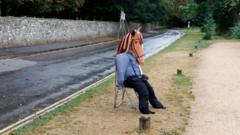
The final photographic commission of Martin Parr (1952–2025), executed in the Wiltshire village of Lacock during the spring and summer of 2025 and exhibited at the Fox Talbot Museum in 2026, represents more than a valedictory artistic statement. It serves as a bounded, empirical case study in visual anthropology. By returning to the identical geographical site he first documented in the 1980s, Parr established a 40-year longitudinal comparative framework. The significance of this work lies not in its superficial charm, but in its methodical deconstruction of contemporary British social structures through specific visual mechanisms.
To understand how these images operate, one must analyze them through a structural matrix rather than a purely aesthetic filter. Parr's methodology relies on a predictable friction between institutional preservation and localized lived experience. Lacock is not an organic settlement; it is a highly regulated environment owned almost entirely by the National Trust since 1944. This structural reality creates a distinct socio-spatial dynamic that dictates the behavior of both residents and observers.
The Three Pillars of the Parr Vernacular
The structural integrity of Parr’s final work depends on three distinct conceptual levers that convert mundane regional interactions into quantifiable cultural data.
1. The Myth-Reality Divergence Matrix
Every image in the Lacock series functions along an axis of tension between external cultural mythologies and internal behavioral realities. The external myth—monetized by heritage tourism and preserved via strict architectural conservation codes—demands a frictionless, frozen-in-time representation of rural England. Parr disrupts this by capturing the contemporary detritus and unvarnished behavior that slips through the conservation net: modern consumer goods, plastic event branding at a VE Day 80th anniversary party, or the unglamorous mechanics of the local Garden and Allotment Association Annual Flower Show.
2. Saturated Commercial Irony
Borrowing the high-saturation, high-contrast palette of post-war commercial postcards—originally influenced by John Hinde’s 1940s mass-observation photography—Parr uses aesthetic seduction to deliver sociological critiques. The chromatic profile is deliberately unnatural. By utilizing a medium-format camera paired with daylight fill-in flash, Parr flattens shadows and equalizes the foreground and background. This technique strips away atmospheric romanticism, forcing the eye to examine the material culture—such as prize-winning potatoes or cheap plastic festival decorations—with the clinical detachment of an inventory clerk.
3. Structural Conviviality
Rather than isolating subjects as alienated actors, the final portraits map out localized social infrastructure. The subjects—vicar, jeweler, schoolchild, shopkeeper—are systematically documented within the specific environments that anchor their social roles. Conviviality is treated as an operational mechanism. By embedding himself within community rituals like the Scarecrow Festival or summer fêtes, Parr records the exact micro-interactions and shared behaviors that form the social cohesion of the village.
The Cost Function of Preservation
The core conflict under inspection throughout the Lacock commission is the economic and social cost function of artificial heritage preservation. Because the National Trust maintains strict architectural control over the village’s physical infrastructure—preserving a central grid of four streets to look much as it did two centuries ago—a structural bottleneck is created. The physical space is fixed, yet the cultural and economic realities of the inhabitants are fluid.
This structural bottleneck manifests in several observed visual anomalies across the collection:
- The Spatial Compression of Material Culture: Modern utility vehicles, contemporary apparel, and digital infrastructure are forced into tight juxtaposition with timber-framed medieval and post-medieval cottages. This creates a high density of visual anachronisms within a single frame.
- The Performative Local Identity: Because the village operates under a tourism-driven economic model, the residents are hyper-aware of their status as observed subjects. Parr’s genius lay in his ability to subvert this performance. By utilizing a "cheeky," disarming, and rapid shooting methodology, he captured the exact micro-moments where the self-conscious performance breaks down into unvarnished, mundane reality.
- The Class Displacement Inversion: Early in his career, particularly during his work on The Last Resort (1983–1985), Parr faced criticism for a perceived middle-class voyeurism of working-class leisure spaces. In his 1989 project The Cost of Living, and culminating in his 2025 Lacock series, the dynamic inverts. He applies the identical analytical lens to the middle and upper-middle-class structures of the rural heritage economy, exposing the manufactured nature of their traditions with the same rigorous lack of sentimentality.
Methodological Limitations and Analytical Biases
A rigorous analysis of Parr's final work requires acknowledging the inherent boundaries of his methodology. Visual anthropology of this nature is never purely objective; it is constrained by specific operational parameters.
First, the selection of Lacock introduces a severe selection bias. As a model village heavily managed by a preservation institution, it cannot be read as a statistically representative sample of wider contemporary Britain. It is an outlier, an amplified clean room of Englishness. Consequently, the social patterns observed inside this boundary are distorted by the institutional forces acting upon them.
Second, the presence of the documentarian introduces an inevitable observer effect. To mitigate this, Parr and the museum curators executed a specific trust-building strategy prior to the bulk of the shooting schedule, including a free village-wide screening of the biographical documentary I Am Martin Parr inside St Cyriac's church. While this optimized access and lowered defensive social barriers, it structurally altered the field environment. The subjects were no longer interacting with an anonymous photographer; they were participating in the conscious co-production of a legacy project by an established cultural figure.
The Longitudinal Trajectory
To evaluate the evolutionary shifts in Parr's execution, one can trace his methodology across four distinct chronological markers:
1983–1985: The Last Resort
- Socio-Economic Focus: Working-class leisure under economic duress in New Brighton.
- Technical Execution: Medium-format color, harsh daylight flash, chaotic wide-angle compositions emphasizing litter and decay.
- Core Thesis: The disintegration of post-war social solidarity visible through the breakdown of public leisure spaces.
1989: The Cost of Living
- Socio-Economic Focus: Middle-class consumerism and social rituals in southern England, including initial preliminary visits to Lacock.
- Technical Execution: Increasingly saturated color palettes, tighter framing on consumer goods and material markers of class distinction.
- Core Thesis: The transition of regional identity into commodified lifestyle choices during the late Thatcher era.
1992: A Year in the Life of Chew Stoke Village
- Socio-Economic Focus: Traditional institutional infrastructure (pub, church, school, village hall) within a Somerset village.
- Technical Execution: Systematic, editorial documentation over a fixed 12-month timeline, building a dense archive of over 250 images.
- Core Thesis: The reliance of rural community cohesion on specific, physical civic nodes.
2025: Lacock by Martin Parr
- Socio-Economic Focus: The intersection of contemporary local life with an institutionalized, hyper-preserved heritage economy.
- Technical Execution: Refined synthesis of fill-in flash and intimate portraiture, executed under the physical constraints of declining health.
- Core Thesis: The ultimate closing of the creative circle, demonstrating that despite rigid architectural preservation, the internal human mechanics of the community remain fluid, eccentric, and stubbornly contemporary.
The strategic imperative for contemporary visual strategists and cultural analysts studying Parr’s final archive is to separate his distinct aesthetic style from his underlying structural framework. The saturation, the flash, and the humor are merely delivery mechanisms for a rigorous, data-driven recording of material culture and human geography. By mapping human behavior against the rigid constraints of a preserved environment, Parr left behind a precise diagnostic tool for understanding the tensions of modern British identity at the dawn of the twenty-first century.