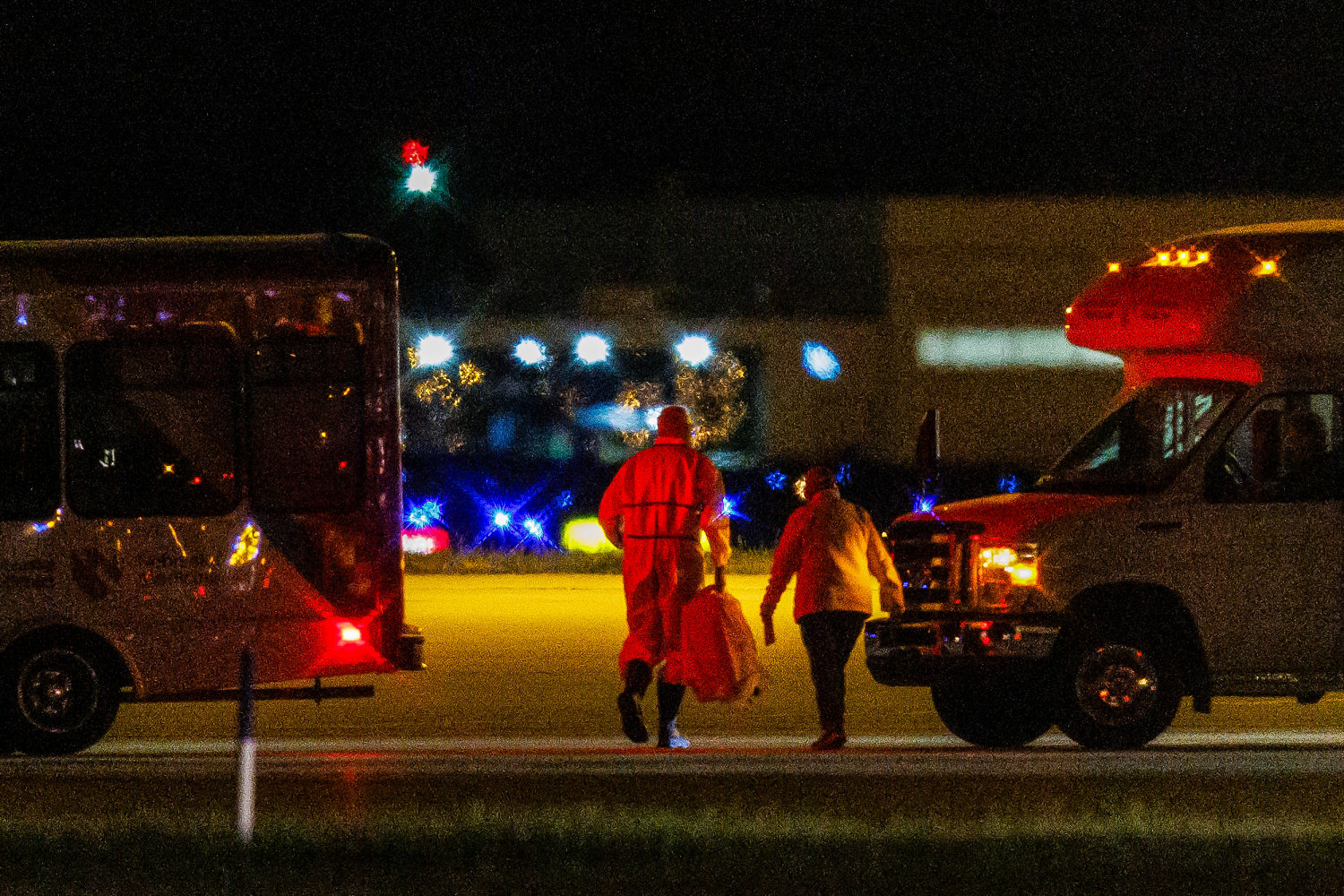
The Andes orthohantavirus (ANDV) represents a unique biological deviation within the Hantaviridae family because it bypasses the evolutionary bottleneck that restricts other hantaviruses to zoonotic-only transmission. While the Sin Nombre virus (SNV) and other North American strains remain locked in a rodent-to-human spillover cycle, ANDV has demonstrated the capacity for sustained human-to-human transmission. Understanding the threat requires moving beyond general public health warnings and into a structural analysis of viral shedding, protein interaction, and the socio-biological variables that dictate an outbreak's reproductive number.
The Mechanism of Interspecies Divergence
Hantaviruses are enveloped, single-stranded RNA viruses. Their genome consists of three segments: Small (S), Medium (M), and Large (L). The divergence of ANDV from its North American counterparts, like SNV, lies primarily in the M segment, which encodes the envelope glycoproteins Gn and Gc. These proteins facilitate viral entry into host cells by binding to $\beta_3$ integrins.
The transmission bottleneck in most hantaviruses occurs because the viral proteins are optimized for the reservoir host’s immune environment. In the United States, the primary vector is the deer mouse (Peromyscus maniculatus). Transmission to humans usually occurs via the inhalation of aerosolized excreta. However, ANDV, native to South America and carried by the long-tailed pygmy rice rat (Oligoryzomys longicaudatus), has evolved a specific affinity for human cellular machinery that allows the virus to maintain stability in human respiratory secretions.
The Three Pillars of ANDV Transmission Risk
The probability of an ANDV outbreak scaling into a regional crisis depends on three distinct variables:
- Viral Load Thresholds in the Upper Respiratory Tract: Unlike SNV, which primarily replicates in the lower lungs and leads to Hantavirus Pulmonary Syndrome (HPS), ANDV exhibits higher titers in the saliva and upper airway of infected individuals. This shift in the primary site of replication is the mechanical prerequisite for person-to-person spread.
- The Incubation-Shedding Window: ANDV has an unusually long incubation period, ranging from 11 to 30 days. Evidence suggests that viral shedding begins several days before the onset of prodromal symptoms (fever, myalgia). This creates a "silent transmission" window where the index case is infectious but asymptomatic.
- Protein-Level Stability: The Gn and Gc proteins of ANDV are more resistant to environmental degradation than other hantaviruses. This environmental persistence increases the likelihood of transmission through shared surfaces or close-quarters air exchange.
Quantifying the Reproductive Number
In epidemiological terms, the $R_0$ (basic reproductive number) for most hantaviruses is effectively zero. For ANDV, the $R_0$ has been observed to fluctuate between 0.5 and 1.2 in localized clusters. Any value above 1.0 indicates the potential for an epidemic. The transition from a dead-end spillover to a self-sustaining chain of infection is governed by the "Effective Contact Rate."
The transmission logic follows a specific decay function. As the distance from the index case increases, the viral dose decreases. However, in the 1996 and 2018 outbreaks in Argentina, the "attack rate" among household contacts was as high as 30%. This suggests that while ANDV is not as highly transmissible as measles or SARS-CoV-2, it is significantly more dangerous than previously modeled hantaviruses due to its high case fatality rate (CFR), which often exceeds 35%.
Pathogenesis and the Vascular Leak Syndrome
The primary cause of death in ANDV infection is a catastrophic failure of the vascular system. The virus does not cause direct cytopathic effects (it doesn't kill the cells it infects). Instead, the damage is immunopathological.
- Endothelial Activation: The virus targets the endothelial cells lining the blood vessels.
- Cytokine Storm: The immune system responds with an overproduction of pro-inflammatory cytokines (IL-6, TNF-alpha).
- Permeability Increase: This immune response triggers the dissociation of VE-cadherin, a protein that holds endothelial cells together.
- Pulmonary Edema: Fluid leaks from the capillaries into the alveolar spaces of the lungs, effectively drowning the patient from the inside.
Structural Bottlenecks in Diagnostics and Intervention
Current diagnostic frameworks in the U.S. are optimized for SNV detection. This creates a dangerous lag in identifying a potential ANDV importation. The primary bottleneck is the "Diagnostic Window Gap." Most enzyme-linked immunosorbent assays (ELISA) look for IgM antibodies, which may not appear until the patient is already in critical condition.
RT-PCR (Reverse Transcription Polymerase Chain Reaction) is the gold standard for early detection, but its efficacy is limited by the transient nature of viremia. If the blood sample is taken too late, the virus may have already migrated into the lung tissue, leading to a false negative despite the patient exhibiting clear respiratory distress.
Therapeutic Limitations and the Neutralizing Antibody Function
There are currently no FDA-approved vaccines or antivirals specifically for ANDV. Ribavirin, an antiviral used for other hemorrhagic fevers, has shown little to no efficacy in clinical trials for HPS. The most promising intervention involves the use of "Convalescent Plasma." This strategy relies on transferring neutralizing antibodies from recovered survivors to acute patients.
The success of this strategy is a function of:
- Antibody Titer: The concentration of specific antibodies in the donor plasma.
- Timing of Administration: Neutralization must occur before the "cytokine storm" phase begins. Once the vascular leak starts, neutralizing the virus has diminishing returns on patient survival.
Geographic Displacement and the Climate Variable
The risk of ANDV appearing in the United States is traditionally viewed through the lens of travel medicine—specifically, infected travelers arriving from the Patagonia region. However, a more complex risk factor is "Ecological Displacement."
Climate change alters the distribution of hantavirus reservoirs. As temperatures shift, the long-tailed pygmy rice rat or its ecological equivalents may expand their range. Furthermore, the "Dilution Effect" hypothesis suggests that a decrease in biodiversity leads to an increase in hantavirus prevalence. In a degraded ecosystem, the generalist species that carry hantaviruses thrive because their natural competitors and predators have been removed. This increases the density of infected rodents and, by extension, the frequency of human-rodent interactions.
Tactical Defense and Containment Strategy
To mitigate the risk of an ANDV outbreak, health systems must move from a reactive posture to a predictive one. This requires a three-tier containment logic:
Tier 1: Environmental Decoupling
Eliminating the rodent-to-human interface is the first line of defense. This involves high-efficiency particulate air (HEPA) filtration in high-risk areas and the use of 10% bleach solutions to neutralize the virus in contaminated environments. The virus is highly susceptible to lipid solvents and chlorine-based disinfectants.
Tier 2: Precision Triage
Emergency departments must implement travel-history screening that specifically triggers hantavirus protocols for patients presenting with "unexplained acute respiratory distress syndrome (ARDS)" and a history of South American travel. The presence of thrombocytopenia (low platelet count) alongside pulmonary edema should be treated as a definitive red flag for ANDV.
Tier 3: Contact Tracing and Sequestering
Because ANDV is the only hantavirus known to spread between humans, the contact tracing protocol must be as rigorous as that for Ebola. Close contacts must be monitored for the full 30-day incubation period. The use of prophylactic convalescent plasma for high-risk exposures remains a theoretical but logically sound intervention that requires further clinical validation.
The evolution of ANDV into a human-transmissible pathogen is not a statistical anomaly but a biological warning. The virus has already solved the hardest problem in virology: crossing the species barrier and achieving host-to-host stability. The remaining barrier is simply the frequency of encounter. Every spillover event is an "evolutionary experiment." In a high-density, globally connected environment, the window for containing these experiments is closing.
Immediate investment in pan-hantavirus vaccines—targeting the conserved regions of the S and M segments—is the only viable long-term strategy to prevent a South American endemic from becoming a global respiratory crisis. Priority should be placed on DNA-based vaccine platforms that can be rapidly scaled and modified as the viral genome continues its inevitable drift.


