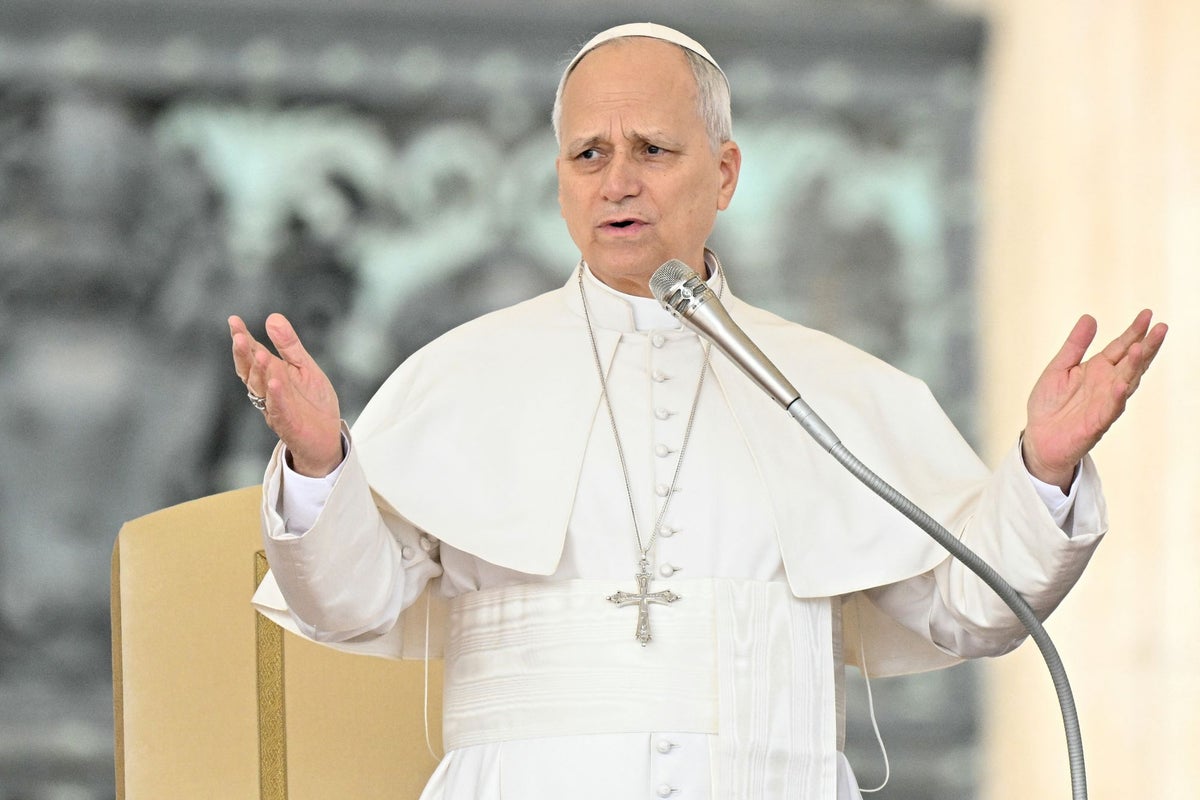
The headlines are predictable. A religious leader wags a finger at a populist politician. Pope Leo tells Donald Trump to "go to confession" over escalating tensions with Iran. The media laps it up because it fits a tired narrative of moral clarity versus reckless ego.
It’s lazy. It’s performative. It’s fundamentally missing the tectonic shifts in global power that have nothing to do with a confessional booth. Learn more on a connected issue: this related article.
While the press focuses on the "swipe" taken at a former and potentially future president, they ignore the reality that the Vatican is no longer a neutral arbiter of peace. It has become a legacy brand struggling for relevance in a multipolar world where religious edicts carry less weight than a regional trade agreement. To suggest that a complex, forty-year geopolitical cold war between Washington and Tehran can be solved by an act of contrition isn't just naive; it’s a strategic distraction.
The Myth of the Moral High Ground
The "lazy consensus" here is that the Church provides a necessary moral check on state power. But look at the data. Historically, the Vatican’s interventions in Middle Eastern diplomacy have yielded high-profile photo ops and zero structural change. From John Paul II’s opposition to the Iraq War to the current administration’s pleas for Iranian restraint, the track record is a series of ignored memos. Additional reporting by Reuters delves into similar perspectives on the subject.
When Leo tells Trump to seek penance, he is practicing "vibes-based" diplomacy. It feels good to the base, but it ignores the brutalist logic of the IRGC (Islamic Revolutionary Guard Corps) and the Pentagon. These entities don't operate on guilt; they operate on deterrence, energy corridors, and proxy maintenance.
I’ve sat in rooms with policy analysts who have spent decades mapping out the Shia Crescent. Not once has the concept of "sacramental confession" entered the chat. The idea that a single leader’s spiritual state dictates the movement of carrier strike groups is a medieval delusion we’ve dressed up as modern commentary.
Why Trump Is the Wrong Target for This Critique
The critique of Trump’s Iran policy usually centers on the 2018 withdrawal from the JCPOA (the "Iran Deal"). Critics claim this move "unleashed" chaos. In reality, the JCPOA was a temporary band-aid on a gushing wound. It front-loaded economic benefits for Tehran while back-loading the actual nuclear restrictions.
By attacking Trump’s "war-mongering," the Vatican ignores that the current status quo—a shadow war fought via Houthi rebels and Hezbollah—was cemented long before a gold-plated plane landed in D.C. Trump’s approach, for all its bluster, was based on "Maximum Pressure." It was an attempt to bankrupted the regime’s ability to fund those proxies.
Is it risky? Absolutely. But the alternative—the Vatican’s preferred path of endless dialogue—has resulted in an Iran that is closer to a breakout nuclear capability than at any point in history. The Church is effectively advocating for a slow-motion catastrophe while claiming the moral high ground.
The Confessional as Geopolitics
Let’s talk about the "Go to confession" remark. It’s a brilliant soundbite, but a terrible policy prescription. Confession requires a firm purpose of amendment. In the world of realpolitik, "amendment" often means unilateral disarmament or the abandonment of strategic interests.
If Trump "confessed" his desire for a hardline stance on Iran, what would the penance be? Lifting sanctions? Allowing the Strait of Hormuz to be choked by IRGC speedboats?
The Vatican is using a 1st-century spiritual tool to try and fix a 21st-century drone war. It’s like trying to debug a server farm with a prayer rope.
The Nuance the Media Missed: The Holy See’s Own Interests
Nobody wants to admit that the Vatican is a state with its own agenda. Pope Leo isn't just worried about "peace"; he’s worried about the survival of Christian minorities in the Middle East. This is a valid concern, but it’s one that often leads the Church to favor "stability" over "justice."
Stability, in the Middle East, usually means keeping dictators in power because they protect the steeples. When the Vatican swipes at Western leaders for taking a hard line against Tehran, they are often sub-textually protecting their own diplomatic channels with the Iranian regime—channels they hope will keep their local parishes safe.
It’s a survival strategy, not a moral crusade.
Dismantling the "People Also Ask" Delusions
Most people asking "Will there be a war with Iran?" are looking at the wrong metrics. They look at tweets and papal statements. They should be looking at the price of insurance for tankers in the Gulf.
- "Is Iran actually a threat?" Brutal honesty: Yes, but not in the way you think. They aren't going to invade anyone. They specialize in asymmetrical disruption. They make it too expensive for the West to exist in the region.
- "Can the Pope stop a war?" No. He hasn't stopped one in 500 years. He can provide a face-saving exit for a leader who already wants to back down, but he cannot change the trajectory of a state that views its regional hegemony as a divine mandate.
- "Was the Iran Deal working?" It was working for the Iranian treasury. It was not working for regional stability.
The High Cost of Pacifism
I have seen diplomatic missions fail because they were built on the "good intentions" the Vatican prizes. In the 2010s, the "reset" mentality led to a vacuum in Syria that was filled by Russian jets and Iranian militias. Pacifism in the face of expansionist theocracy isn't "peace-making"; it’s "space-making" for the next conflict.
The downside to my contrarian view? It’s ugly. It acknowledges that sometimes, the only way to prevent a massive war is to engage in a series of small, violent deterrents. It admits that "confession" is for the soul, but "containment" is for the state.
Stop Asking for a Moral President
The biggest mistake the public makes—and the one the Pope is capitalising on—is the desire for a "moral" foreign policy. Foreign policy is not about being a good person. It’s about the management of power to ensure the least-bad outcome for your citizens.
When Leo tells Trump to go to confession, he’s trying to drag the conversation back to the individual. But the Iran problem is systemic. It’s a collision between a revolutionary state and a global hegemon. No amount of "Hail Marys" changes the range of a ballistic missile.
The Vatican needs to decide if it wants to be a serious diplomatic player or a lifestyle coach for world leaders. Currently, it’s playing the latter, and it’s doing so at the expense of a clear-eyed understanding of what is actually happening on the ground in the Persian Gulf.
Stop looking at the miter and start looking at the centrifuges.
The world doesn't need a Pope who moralizes about the "sins" of deterrence. It needs leaders who understand that in a room full of wolves, the person suggesting everyone just "be better" is usually the first one eaten.
The "confession" we actually need is an admission from the international community that the era of empty dialogue is over. We are in a period of hard power. If you can't handle the heat of a tactical reality, get out of the situation room and stay in the cathedral.