The sky turned a bruised shade of purple before the sirens even started. That’s the reality for millions of Americans lately as a massive weather system stretches from the Rockies to the Atlantic. We aren't just seeing a "bit of rain" or some "snowy days." We’re seeing a total atmospheric breakdown. One side of the country is digging out from three feet of snow while the other side is sprinting for storm cellars. It’s chaotic. It’s relentless. And honestly, it’s becoming the new normal.
If you’ve looked at a radar map recently, you know the deal. A massive low-pressure system is acting like a giant vacuum, pulling cold Arctic air down into the plains while dragging moisture-heavy warmth up from the Gulf of Mexico. When those two worlds collide, things get ugly fast. You get the "clash of the titans" effect. This isn't just a weather report; it’s a survival reality for anyone living in the crosshairs of the latest system.
The Science Behind the Chaos
Most people think of tornadoes and blizzards as separate events. They aren't. They’re two sides of the same coin. In a standard mid-latitude cyclone, the cold sector produces the heavy, wet snow we see in places like the Dakotas or Colorado. Meanwhile, the warm sector—usually the southeastern quadrant—is where the atmosphere turns explosive.
This specific setup is fueled by something called the jet stream. Think of it as a high-altitude river of air. When that river gets "wavy," it allows cold air to dip further south and warm air to surge further north than usual. That’s why you’re seeing reports of "historic" snowfall in the mountains at the exact same time that Alabama or Georgia are bracing for EF-2 or EF-3 tornadoes. The energy being released is staggering.
According to data from the National Oceanic and Atmospheric Administration (NOAA), the frequency of these "multi-hazard" events is climbing. We’re seeing more days where the National Weather Service has to issue blizzard warnings and tornado watches simultaneously. It’s a massive strain on emergency resources. It also catches people off guard. You might be worried about freezing pipes while your neighbor three states away is worried about their roof being ripped off.
Why the Heartland is Taking a Beating
The central US is basically a bowling alley for storms. There are no mountain ranges running east-to-west to block the cold air coming from Canada or the warm air coming from the Gulf. They just slam into each other in the middle.
This year, the intensity feels different. We’re seeing "bombogenesis" happen over land more often. That’s a fancy way of saying the atmospheric pressure is dropping incredibly fast—at least 24 millibars in 24 hours. When the pressure drops that quickly, the wind speeds crank up. We’re talking 60 to 80 mph gusts that can flip a semi-truck or down power lines in seconds.
The Problem With Modern Infrastructure
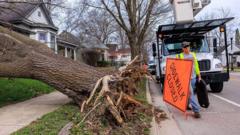
Our power grid wasn't built for this. Most of the electrical infrastructure in the US is decades old. It’s designed for "normal" storms. It’s not designed for 100 mph straight-line winds or ice storms that add two inches of weight to every wire.
In many cases, the "smart grid" isn't as smart as we think. We’ve seen entire counties lose power for a week because a single substation was swamped or frozen. The backup systems are often just as vulnerable. If the main lines are down, the backup lines are probably down too. This is where the real danger lies. It’s not just the wind or the snow; it’s the loss of heat and communication in sub-zero temperatures.
Tornadoes Are Spreading East
For decades, we’ve talked about "Tornado Alley"—Oklahoma, Kansas, Texas. But that’s shifting. We’re seeing a significant migration toward "Dixie Alley," which includes Mississippi, Alabama, and Tennessee. These storms are arguably more dangerous because of the geography.
- Visibility: In the Great Plains, you can see a tornado coming from miles away. In the South, you have hills and trees that block your view until it’s on top of you.
- Nighttime Storms: A huge percentage of Southern tornadoes happen after dark. If you’re asleep and your phone is on "Do Not Disturb," you’re in trouble.
- Population Density: The Southeast is more densely populated than the Plains. There are more houses, more businesses, and more people in the path of any given storm.
Dr. Victor Gensini from Northern Illinois University has done extensive research on this shift. His data shows that while the frequency of tornadoes in the traditional "Alley" is staying steady or even dropping, the frequency in the East is climbing. We have to adapt. Building codes in these newer "hot zones" often haven't caught up to the reality of the threat.
How to Prepare Without Going Overboard
You don’t need a bunker or a $10,000 generator to stay safe. Most of it is common sense. But it’s common sense people forget when the sky starts turning green.
Your Digital Safety Net
Get a NOAA Weather Radio. Seriously. Your phone is great, but cell towers fail. A battery-powered weather radio with a hand crank is your best friend when the world goes dark. It’s a $30 investment that can save your life.
Make sure your "Wireless Emergency Alerts" are turned on in your phone's settings. These are those loud, buzzing notifications that tell you there’s a tornado warning. Don't disable them just because they're annoying. They’re annoying for a reason.
The Winter Storm Checklist
If a blizzard is coming, you need to think ahead about more than just bread and milk.
- Water: One gallon per person per day. Don't forget your pets.
- Heat: If the power goes out, do you have a safe way to stay warm? No, do not use your gas oven. Propane heaters like a "Mr. Heater Big Buddy" are rated for indoor use and have oxygen-depletion sensors, but you still need a carbon monoxide detector.
- Gas: Keep your car's gas tank at least half full. If you have a generator, have fresh fuel on hand with stabilizer in it.
- Charge: Get a high-capacity power bank for your devices.
The Economic Toll No One Talks About
Beyond the immediate danger, these severe weather outbreaks are hammering the US economy. Every time a major storm hits, we see a spike in insurance premiums. In states like Florida and Louisiana, the insurance market is already in a tailspin. Now, homeowners in the Midwest and South are seeing 20-30% increases in their annual premiums.
Repairing the damage isn't cheap. A single "billion-dollar disaster" used to be a rare event. Now, the US sees dozens of them every year. In 2023 alone, we had a record-breaking number of weather and climate disasters that each cost at least a billion dollars.
That money has to come from somewhere. It comes from your taxes, your insurance premiums, and the price of goods at the grocery store. When a blizzard shuts down major interstates like I-80 or I-70, it delays the delivery of food and medicine. The "hidden cost" of severe weather is everywhere.
Rethink Your Home's Weak Points
If you live in a high-risk area, stop waiting for the next storm to act. Check your roof. Are there loose shingles that a 60 mph gust can grab? Trim those tree branches hanging over your house. They’re just giant hammers waiting for the wind to swing them.
If you don't have a basement, identify your "safe room" now. It should be on the lowest floor, in the center of the building, with as many walls as possible between you and the outside. A bathroom or a closet is usually your best bet. Keep a pair of sturdy shoes and a helmet in that room. It sounds ridiculous, but many tornado-related injuries are caused by head trauma or walking on broken glass after the storm passes.
Stay weather-aware, keep your gear ready, and don't trust the blue sky. It can change faster than you think.