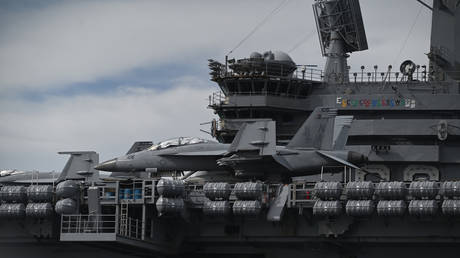
You can't enforce a naval blockade with polite requests. The United States military proved that again when an American aircraft fired a Hellfire missile directly into the engine room of a commercial cargo vessel in the Gulf of Oman.
The target was the M/V Lian Star, a Gambia-flagged merchant ship. According to U.S. Central Command, the ship was transiting international waters toward an Iranian port. It ignored more than 20 warnings broadcasted by American forces overnight. When the crew refused to turn around, Washington stopped talking and pulled the trigger.
The missile strike completely disabled the vessel, leaving it adrift. It marks a sharp escalation in a high-stakes maritime standoff that most people think is paused due to a ceasefire. It isn't. The reality on the water is chaotic, dangerous, and threatening to upend global energy markets.
The Midnight Intercept of the Lian Star
This wasn't a sudden, knee-jerk military action. CENTCOM records show that American forces tracked the Lian Star for hours. The cargo ship had previously departed Karachi, Pakistan, and was listed as bound for Iraq, but its actual trajectory headed straight for the Iranian coast.
Radio operators issued consecutive warnings, informing the captain they were violating the active U.S. maritime blockade on Iranian ports. The ship kept moving. Once the crew crossed the invisible line drawn by the military, an American fighter jet swept in.
A single Hellfire missile slammed into the engine compartment. It was a calculated, precision kinetic strike designed to immobilize the vessel without sinking it or blowing up the cargo. CENTCOM confirmed the outcome with a blunt statement on social media, noting that the ship is no longer transiting to Iran. A U.S. official later confirmed that American forces haven't boarded the ship. It remains dead in the water, bobbing in the swells of the Gulf of Oman, while the status of the crew remains unknown.
Running the Numbers on Washington's Naval Blockade
Many analysts are treating this as an isolated incident, but they're missing the bigger picture. This is part of a systemic, aggressive campaign to choke off Tehran's economic lifelines.
Look at the data provided by the Pentagon since this blockade began in April. The military isn't just watching; they're actively reshaping maritime traffic.
- 5 commercial vessels have been directly fired upon and disabled by U.S. forces for defying orders.
- 116 vessels have been intercepted and forcibly redirected away from Iranian waters.
- 1 vessel was cleared to proceed after a comprehensive inspection.
This operation started after Iran blocked access through the critical Strait of Hormuz following the outbreak of major hostilities on February 28, which kicked off with joint U.S. and Israeli airstrikes. The U.S. responded with this counter-blockade. The goals are straightforward. Washington wants to dry up Iran's foreign currency reserves, halt its import of industrial components, and force Tehran back to the negotiating table on American terms.
The Selective Weapons of Maritime Enforcement
How the U.S. Navy and Air Force enforce these rules depends entirely on the ship they encounter. They aren't just dropping bombs blindly. They are using specific tactical options to match the target.
Earlier in May, a U.S. Navy F/A-18 Super Hornet flying from the USS Abraham Lincoln intercepted an Iranian-flagged tanker named the M/T Hasna. Instead of blowing up the ship, the fighter pilot used a 20mm cannon to riddle the vessel's rudder with gunfire, destroying its ability to steer.
Days later, another Super Hornet launched from the USS George H.W. Bush used precision-guided munitions to strike the smokestacks of two separate Iranian oil tankers, the M/T Sea Star III and the M/T Sevda.
The strike on the Lian Star with a Hellfire missile represents a middle ground. It punches through the hull to wreck the machinery inside, insuring the boat goes nowhere, but avoids hitting the main cargo holds where hazardous materials or oil could trigger an environmental disaster.
The Illusion of the April Ceasefire
Don't let the diplomatic talk fool you. While politicians discuss a 60-day extension to the fragile ceasefire brokered in April, the situation on the ground is a shooting war by another name. The United States and Iran are locked in dual, competing blockades.
While the U.S. stops ships from entering Iranian docks, Iran is enforcing its own draconian rules on the Strait of Hormuz. Tehran claims that any merchant vessel passing through the narrow waterway needs explicit Iranian approval. They've even started demanding transit fees that human rights groups and shipping firms say run as high as $2 million per trip.
This economic warfare is spilling over into kinetic attacks elsewhere in the region. Just hours after the Lian Star was disabled, an Iranian missile attack targeted the Ali Al Salem Air Base in Kuwait, where major U.S. forces are stationed. Kuwaiti air defenses intercepted the incoming missile, but falling debris wounded five people, including active-duty American troops. Earlier in the week, U.S. forces launched heavy retaliatory strikes against military targets around the Iranian port city of Bandar Abbas.
Defense Secretary Pete Hegseth made the American position clear, warning that military forces are fully prepared to resume massive, wide-scale strikes if the current diplomatic talks over Iran's nuclear program fall apart.
Realities for Global Shipping Operations
If you run a maritime logistics firm or insure cargo vessels, the Middle East is currently a logistical nightmare. The Strait of Hormuz is the world's most critical energy chokepoint. With shipping volumes down to a fraction of pre-war levels, the ripple effects are slamming global markets. Petroleum, liquefied natural gas, and global fertilizer shipments are experiencing massive delays or total cancellations.
Ship captains can no longer rely on traditional maritime law or flag-state protections. The Lian Star flew a Gambian flag, a common flag of convenience used by commercial shipping lines to avoid heavy regulations. The Pentagon didn't care. If a ship heads toward an Iranian port, it becomes a military target, regardless of the flag flying from its stern.
If you have assets moving through the Western Asia region, you need to alter your operational protocols immediately to avoid catastrophic financial or physical loss.
Order Immediate Route Re-Audits
Instruct your logistics teams to review every active voyage heading toward the Gulf of Oman or the Persian Gulf. If a vessel has an automated destination pinging anywhere near an Iranian port, or if your bill of lading involves secondary Iranian state entities, halt the transit. Re-route the cargo through alternative overland or red-sea corridors if possible, even if it adds weeks to your timeline.
Enforce Absolute Compliance with Military Hailings
Make sure your crews understand that ignoring radio communications from coalition warships is a direct path to getting fired upon. If a U.S. Navy asset or CENTCOM controller issues a redirection order, compliance must be immediate. Do not attempt to negotiate or test the blockade line. The U.S. military has shown it will use kinetic force against unarmed commercial hulls without hesitation.


