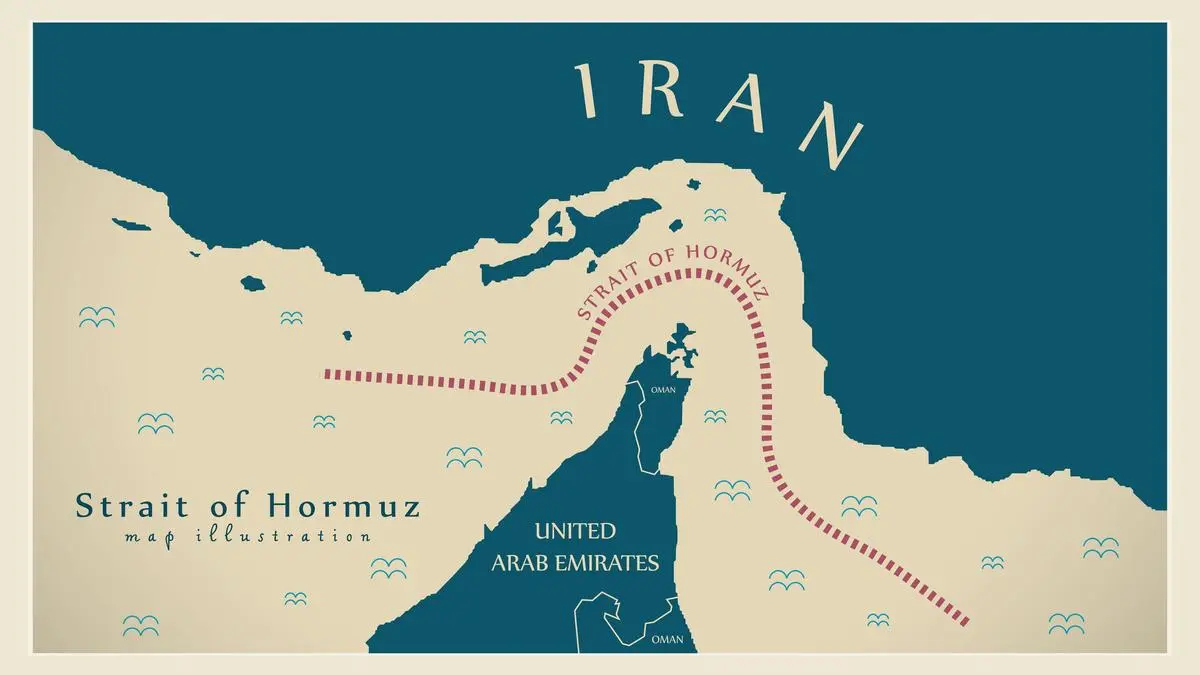
The maritime strategy "experts" are currently recycling the same tired playbook they’ve used since 1979. They look at a map of the Strait of Hormuz, see a narrow chokepoint, and assume a U.S. Navy carrier strike group can simply turn off the world’s oil faucet like a garden hose.
They are wrong. They are dangerously, fundamentally wrong.
Most analysts focus on the "disruption of flows"—a sterile phrase that masks a complete misunderstanding of 21st-century energy logistics and asymmetric warfare. They argue about whether Brent crude will hit $150 or $200 a barrel. They debate the "reliability" of the Fifth Fleet. They miss the reality that a formal blockade would not starve the Iranian regime; it would validate their entire defensive doctrine while bankrupting the West’s political capital.
The Geography Myth
The armchair admirals love to talk about the "bottleneck." They point to the 21-mile width of the Strait of Hormuz and claim that whoever controls the surface controls the trade.
This ignores the physics of modern denial. You don't need a superior navy to break a blockade in 2026; you just need to make the cost of maintaining that blockade higher than the value of the oil being protected. Iran has spent three decades perfecting "Anti-Access/Area Denial" (A2/AD). While the U.S. builds $13 billion Ford-class carriers, Tehran builds $20,000 suicide drones and $100,000 anti-ship missiles.
A blockade requires U.S. ships to sit in predictable patterns. In naval warfare, predictability is a death sentence. To maintain a "tight" blockade, assets must remain within the "weapons engagement zone" of Iran’s coastal missile batteries. We aren't talking about a few Silkworm missiles anymore. We are talking about saturated swarms of Noor and Khalij Fars ballistic missiles.
If you think insurance underwriters will let tankers sail into a zone where the U.S. Navy is actively playing dodgeball with hypersonic projectiles, you haven't spent enough time on the floor of Lloyd’s of London. The blockade doesn't stop the oil; the risk stops the ships, and that risk applies to everyone—including the "good guys."
China Won't Just Watch
The "lazy consensus" assumes that China, as a massive oil importer, would eventually side with a U.S.-led blockade to "restore stability."
This is a fantasy.
Beijing has spent the last decade building a "ghost fleet" and a sophisticated web of sanctions-evasion tactics. A U.S. blockade of Iran isn't just an attack on Tehran; it is a direct assault on Chinese energy security. For China, this is a golden opportunity to finalize the shift away from the petrodollar.
If the U.S. tries to seize Iranian tankers or block their passage to the East, China won't just send a sternly worded letter. They will provide the intelligence, surveillance, and reconnaissance (ISR) data Iran needs to target U.S. ships with surgical precision. They will provide the financial rails—likely via the Digital Yuan or CIPS—to ensure Iran gets paid regardless of what happens in the Strait.
The Price Spike Paradox
Everyone assumes a blockade means oil prices go up, and therefore Iran loses because they can't sell their volume.
Let's look at the math. If Iran's exports drop by 50% due to a blockade, but the global price of oil triples due to the panic, the regime’s revenue actually increases. This isn't a theory; we saw a version of this in the early stages of the Russia-Ukraine conflict.
The global oil market is a complex adaptive system. It doesn't react to "blocked" oil by simply doing without. It reroutes. It hides. It rebrands. "Malaysian" or "Omani" blends suddenly appear in massive quantities at Chinese refineries. The only thing a blockade achieves is adding a "middleman tax" that goes to the very smugglers and shadow networks the U.S. is trying to dismantle.
The Death of the Tanker Economy
A blockade would permanently alter the risk profile of the Persian Gulf. We are talking about the end of the "Just-in-Time" energy model.
Currently, the world relies on a steady stream of Very Large Crude Carriers (VLCCs) moving through the Gulf. These vessels are massive, slow, and defenseless. In a blockade scenario, even a single successful "lucky shot" from an Iranian midget submarine or a remote-controlled explosive boat turns the Gulf into a no-go zone.
The cost of shipping isn't just fuel and crew; it’s P&I (Protection and Indemnity) insurance. If a blockade starts, insurance premiums won't just rise—they will vanish. No insurance, no shipping. The "blockade" effectively shuts down the entire Gulf, including exports from Kuwait, Iraq, and the UAE.
Congratulations: in an attempt to squeeze Iran, you’ve just committed economic seppuku for the entire global West.
Why "Sanctions Plus" is a Lie
Politicians love the idea of a "peaceful" naval blockade. They call it a "quarantine" or "enhanced maritime interdiction." They want the results of a war without the casualty counts.
It is time to be brutally honest: there is no such thing as a "limited" blockade against a sovereign state with a capable military. The moment a U.S. destroyer fires a shot across the bow of a tanker, the clock starts on a general regional war.
Iran’s response won't be limited to the sea. They will use their proxy networks to hit infrastructure in the Eastern Province of Saudi Arabia. They will target desalination plants in the UAE. They will turn the "oil flow" problem into a "regional survival" problem.
The U.S. Navy is built for "blue water" dominance—fighting other big navies in the middle of the ocean. It is poorly equipped for the "littoral" nightmare of the Persian Gulf, where every fishing dhow could be a mine-layer and every coastal cave could hide a drone launcher.
The Actionable Reality
If you are an investor or a policy-maker, stop asking "how much will oil go up?" and start asking "how long can the U.S. sustain a $100 million-a-day naval presence in a shooting gallery?"
The contrarian truth is that the threat of a blockade is far more powerful than the blockade itself. Once you actually deploy the ships and start the interdictions, you have played your last card. If it fails—if a single U.S. destroyer is crippled or if the oil keeps flowing through "shadow" channels—the illusion of U.S. hegemony in the Middle East evaporates instantly.
The U.S. isn't refraining from a blockade because they lack the "will." They are refraining because they know they cannot win a war of attrition against a country that views the Strait as its own backyard.
Stop looking at the Strait of Hormuz as a chokepoint for Iran. It is a trap for the United States. The regime in Tehran knows this. It’s time the "experts" in D.C. and London figured it out, too.
The moment the first anchor is dropped for a formal blockade, the West has already lost. You don't "control" flows in the 21st century; you merely negotiate with the chaos. If you want to stop Iran, you do it through the treasury, not the turret. Anything else is just expensive theater that will end in a massive, oily disaster for the global economy.