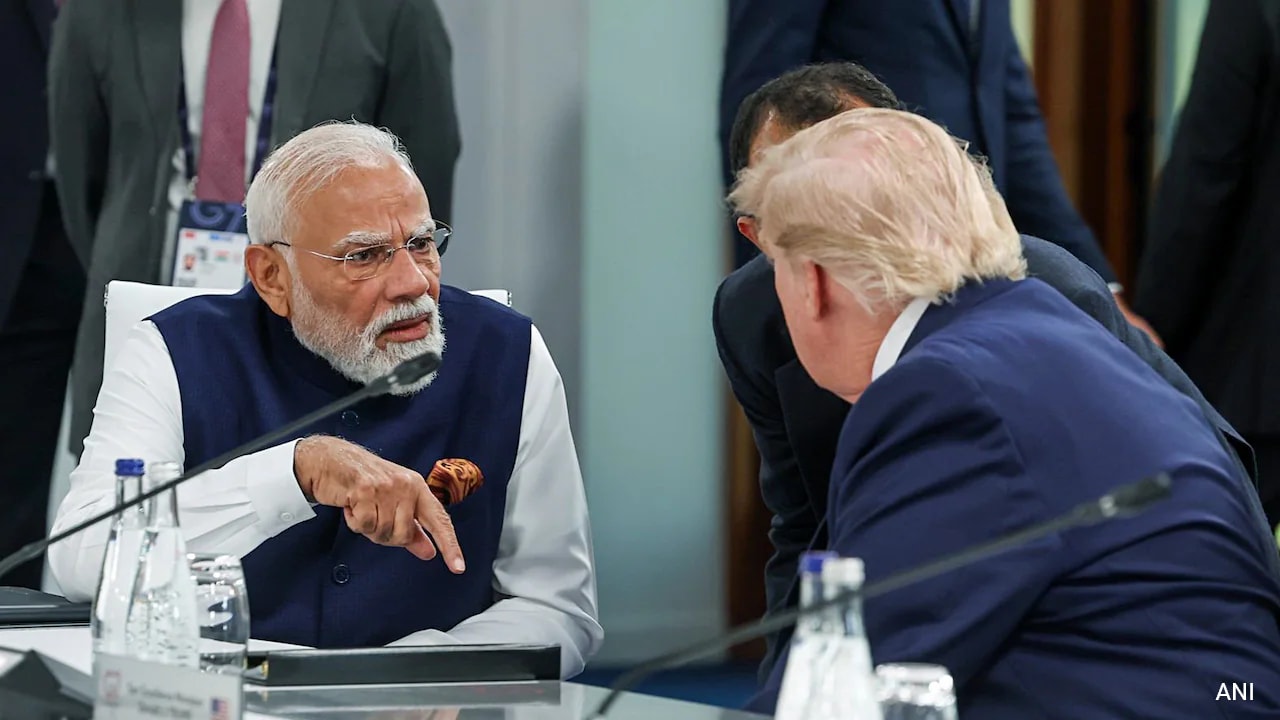
The air inside a G7 summit room does not breathe like normal air. It is heavy, scrubbed clean by industrial filters, and thick with the invisible weight of global GDP. When the world’s most powerful leaders sit down, the geometry of the room matters more than the agenda. Every tilt of a head, every micro-expression, and every casual aside is parsed by a small army of diplomats watching on closed-circuit feeds in adjoining holding rooms. They are looking for cracks. They are looking for alignment.
At the recent gathering, amid the standard diplomatic theater of group photos and rehearsed communiqués, a moment occurred that bypassed the usual bureaucratic filter. It wasn't a signed treaty or a joint economic declaration. It was a character assessment, delivered by a man who views the world entirely through the lens of performance and leverage.
Donald Trump leaned forward, locked eyes with Indian Prime Minister Narendra Modi, and described him to the room as calm, cool, and a total killer.
The room went quiet for a fraction of a second. In the polite, highly sanitized vocabulary of international relations, "killer" is a word reserved for backrooms, if used at all. But spoken aloud at a summit table, it stripped away the polite fiction of global governance. It revealed the raw, transactional nature of modern geopolitics. To understand why this description matters, you have to look past the sensational headline and understand the psychological dance happening between Washington and New Delhi.
The Chemistry of the Strongman Dialogue
International politics is often taught as a series of spreadsheets, treaties, and demographic shifts. This is an illusion. Decisions that affect billions of lives are frequently decided by the interpersonal chemistry between a handful of individuals.
Consider the contrast in the room. On one side, you have Trump, a leader whose political identity is rooted in unpredictability, public theater, and a loud, disruptive bravado. On the other side sits Modi, a leader who has built his political empire on an aura of monastic discipline, deep calculation, and an unshakeable, quiet confidence.
When Trump uses the phrase "a total killer," he isn't offering an insult. In his vocabulary, it is the highest form of praise. It signifies someone who cannot be bullied, someone who understands power, and someone who operates with a singular, ruthless focus on their nation's self-interest.
Watch the body language in the archival footage of their past meetings. Trump often uses aggressive handshakes and physical dominance to establish hierarchy with European leaders. With Modi, the dynamic changes. There is a mutual recognition of a shared political reality. Both leaders operate with massive domestic mandates, both have systematically challenged their respective country's traditional establishments, and both view the international arena not as a community, but as a competitive marketplace.
The Invisible Stakes of the Indian Pivot
Why does the American political establishment, regardless of who occupies the White House, feel the need to publicly flatter the Indian leadership? The answer lies in the shifting tectonic plates of global power.
For decades, Western foreign policy treated South Asia as a secondary theater, a regional problem to be managed rather than a global engine to be courted. Those days are gone. Today, India is the fulcrum upon which the balance of the twenty-first century rests.
Imagine a massive see-saw. On one end is the United States and its traditional Western allies. On the other end is a rising, increasingly assertive China. India sits precisely in the middle. Whichever way New Delhi leans, the global order tilts.
This reality gives Modi immense leverage, and he knows it. Western capitals want India to act as a democratic counterweight to Beijing. They want Indian factories to replace Chinese supply chains. They want Indian consumers to buy Western goods. But India refuses to be a junior partner in someone else's alliance.
This is the "killer" instinct Trump recognized. India’s foreign policy under Modi has abandoned the old, idealistic rhetoric of non-alignment and replaced it with a cold, clear-eyed realism. India will buy oil from Russia despite Western sanctions if it keeps inflation low for its domestic consumers. It will purchase American weapons while simultaneously maintaining deep strategic autonomy. It acts entirely in its own self-interest, offering no apologies and asking for no permission.
Behind the Velvet Curtain of Diplomacy
To understand how this plays out in real time, consider the mechanics of a bilateral negotiation away from the cameras.
A standard diplomatic delegation arrives with binders of talking points, pre-approved by various ministries. The conversation is usually a slow, painful grind through syntax and punctuation. But when leaders who operate on pure power dynamics meet, the binders stay closed.
The negotiation becomes visceral.
"What do you need?" one asks.
"What are you willing to give up to get it?" the other responds.
It is a high-stakes game of poker where the chips are trade tariffs, military intelligence sharing, and semiconductor supply routes. In these rooms, a leader who is perceived as weak or overly reliant on international approval gets eaten alive. They are forced into concessions that damage their domestic economy.
The praise offered at the G7 was a public signal that the United States recognizes India is no longer a country that can be managed or dictated to. It was an acknowledgment that New Delhi is playing the game at the highest level, with a strategy that is patient, calculated, and entirely devoid of sentimentality.
The Friction of Two Nationalisms
Yet, this public display of mutual admiration masks a deeper, structural tension that defines the US-India relationship. It is a partnership built on shared anxieties rather than shared values.
Both leaders represent a fierce, inward-looking nationalism. Trump’s political theology is rooted in bringing manufacturing back to the American heartland, questioning foreign aid, and challenging global institutions. Modi’s philosophy is centered on self-reliance, national pride, and restoring India to what his supporters see as its rightful place as a global superpower.
When two deeply nationalistic powers collide, friction is inevitable.
Consider the issue of trade. The United States wants access to India’s massive agricultural and dairy markets. India, protecting hundreds of millions of its own subsistence farmers, routinely says no. The United States wants stricter intellectual property laws; India prioritizes affordable, generic pharmaceuticals for its population.
This is where the "coolness" matters. A lesser leader might react emotionally to public pressure or threats of tariffs. The strategy deployed by New Delhi has been to absorb the pressure, smile for the cameras, and quietly maintain their positions. They calculate that the West needs India more than India needs the West’s approval. Every month that passes without a breakdown in relations proves that calculation correct.
The Quiet Room and the Long Game
The cameras eventually turn off. The journalists pack up their tripods, and the motorcades speed away through the blocked-off streets of the host city. The public is left with a handful of memorable quotes and a few seconds of video footage to dissect on evening news panels.
But the real consequence of these summits unfolds over years, not news cycles.
The significance of the interaction at the G7 isn't that one leader used colorful language to describe another. The significance is that the vocabulary of global leadership has shifted. The era of polite, institutional consensus is giving way to an age of raw, personality-driven realism.
Power recognizes power.
As the global order becomes more fractured and unpredictable, the leaders who survive are not those who rely on old treaties or abstract notions of international law. They are the ones who can sit at a table surrounded by rivals, maintain an absolute, unshakeable calm, and execute a strategy with surgical precision.
The evaluation delivered in that scrubbed-air room wasn't just a comment on one man's style. It was a description of the new baseline for global survival. The table has been set, the stakes are absolute, and the players who cannot handle the cold reality of the game are quickly being left behind.