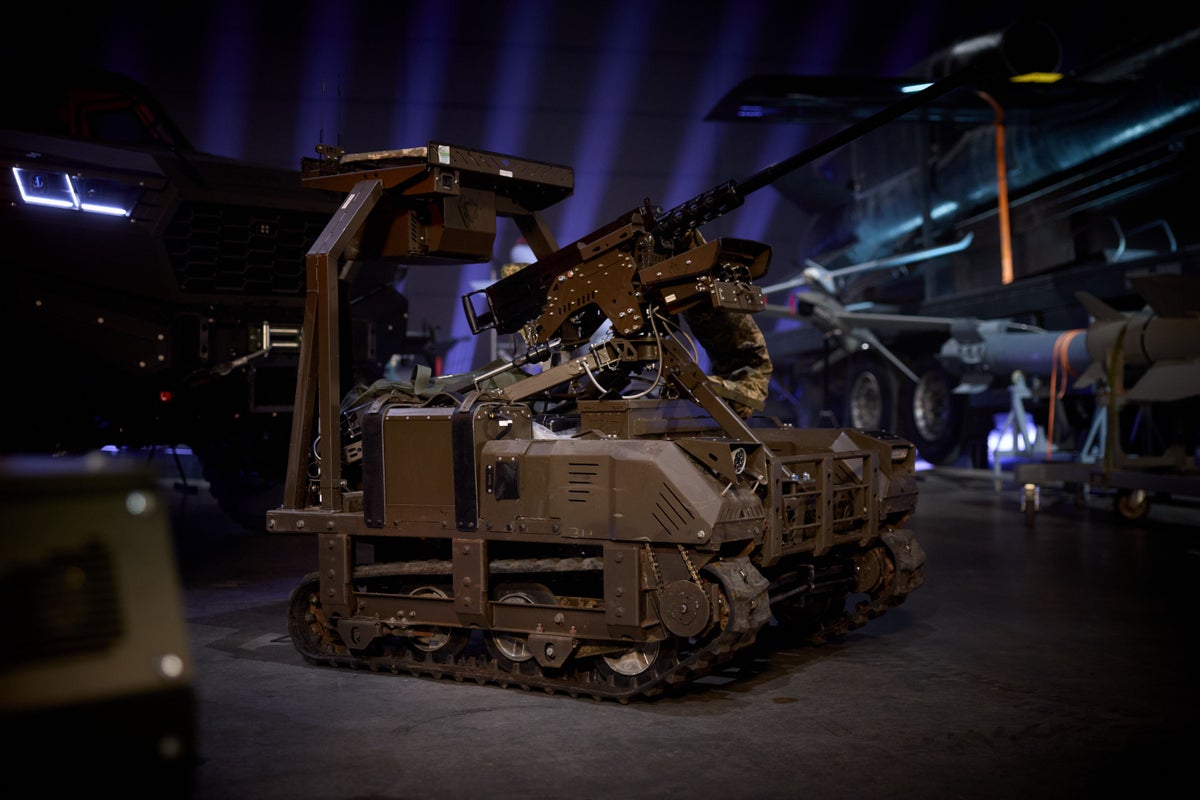
The battlefield just changed forever. President Volodymyr Zelensky recently confirmed a surreal moment in the ongoing conflict where Russian soldiers surrendered not to a human platoon, but to a group of unmanned robots. This wasn't a scene from a sci-fi flick. It happened in the mud and trenches of Ukraine.
We've seen drones drop grenades for years now. We've seen them scout positions. But an entire unit giving up their weapons to a machine they couldn't even talk back to? That's new. It marks a shift from robots being tools of observation to robots being the primary force of psychological and physical dominance on the front lines. If you think this is just a one-off gimmick, you're missing the bigger picture of how ground-based drones are starting to replace the "boots" in "boots on the ground."
The Moment the Machines Took Over the Assault
Zelensky shared details about a specific Ukrainian assault where the human element stayed back. Usually, an infantry charge involves a terrifying rush of soldiers, yelling, and direct fire. This time, the Ukrainians sent in ground-based drones equipped with heavy firepower. These aren't the little DJI Mavics you see at the park. These are rugged, tread-based platforms built to soak up bullets and dish them out.
The Russian troops faced a terrifying reality. They could shoot at the robots, but they weren't killing anyone. Every bullet they fired was wasted on steel and sensors. Meanwhile, the robots kept coming. When the machines reached the trenches, the Russians realized that staying meant certain death by an adversary that doesn't feel fear or fatigue. They dropped their guns. They put their hands up. They waited for the robots to herd them toward Ukrainian lines.
It's a bizarre sight. Imagine being a soldier trained for "glorious" combat and finding yourself being taken captive by a glorified RC car with a machine gun. It's humiliating. It's effective. Most importantly, it keeps Ukrainian soldiers out of the line of fire.
Why Ground Drones are Succeeding Where Humans Struggle
The Ukrainian military isn't just using these for the "cool factor." They're doing it because human life is their most precious resource. Russia has more people to throw into the meat grinder. Ukraine doesn't. They have to be smarter.
Ground drones—often called UGVs (Unmanned Ground Vehicles)—solve the biggest problem of trench warfare: the "last hundred yards." That's the space where most soldiers die during an attack. By using robots to cross that gap, Ukraine removes the risk.
These machines are getting cheaper to build too. While a Western tank costs millions, a scrap-built UGV with a PKM machine gun might cost a few thousand dollars. They're basically expendable. If a Russian RPG hits a drone, the drone is gone, but the operator is back at a base sipping coffee, ready to link into the next unit. You can't put a price on that kind of tactical advantage.
The Psychological Toll of Fighting a Robot
War is 90% psychology. When you fight another person, you're looking for signs of weakness. You hope they'll get scared, run out of ammo, or hesitate. A robot doesn't hesitate.
Russian soldiers have reported a sense of total helplessness when facing these units. There is no one to negotiate with in the heat of the moment. There's no one to "scare off" with suppressive fire. The relentless, mechanical nature of the assault breaks the will to fight much faster than a standard infantry skirmish. Zelensky pointed out that this surrender proves the tech is working as a deterrent. If you know that an unstoppable robot is coming for your trench, you're a lot more likely to think about that "I Surrender" hotline before the machines arrive.
How Ukraine is Scaling the Robot Army
This isn't just about one or two lucky breaks. Ukraine has launched a massive initiative called United24 to fund the development of these ground robots. They're testing everything from mine-layers to kamikaze ground drones that drive under tanks and explode.
They've moved past the experimental phase. We're now seeing the mass production of specialized ground units. Some are designed for logistics, carrying ammo to the front so soldiers don't have to carry 80-pound packs under fire. Others are pure combat units. The goal is a "combined arms" approach where aerial drones spot the targets and ground drones clear the path.
The Real Tech Behind the Surrender
- Low-latency remote links: Operators see what the robot sees in real-time, allowing for precise targeting.
- Thermal optics: The robots find soldiers hiding in bushes or dark trenches instantly.
- Automated pathfinding: Some of these units can navigate around obstacles without constant human input.
- Hardened shells: Small arms fire usually just bounces off the armored casings of the combat models.
The Ethical Mess Nobody Wants to Talk About
While the Ukrainian side celebrates this as a win for safety, it opens a massive can of worms. International observers are already debating what happens when these robots become more autonomous. Right now, a human is still pulling the trigger via remote control. But the line is blurring.
What happens when the signal gets jammed? Does the robot have the "right" to decide to fire on its own? For now, the focus is on winning the war and saving lives, but the precedent being set in these Ukrainian trenches will be studied by every military in the world for the next fifty years. We're watching the birth of a new kind of warfare where the winner isn't the one with the most soldiers, but the one with the best software and the most batteries.
Russia's Failed Response to the Robot Threat
Russia hasn't been sitting still, but their attempts at ground drones have largely been a mess. They've showcased "robot dogs" with RPGs strapped to them at trade shows, only for people to realize the robots were bought off a Chinese retail site and couldn't handle actual dirt.
They're struggling with the electronic warfare side too. Ukraine has become world-class at protecting their drone signals while jamming the Russian ones. This "signal war" is why Ukrainian robots are reaching the trenches while Russian ones often just sit spinning their wheels in the mud.
The gap is widening. While Russia relies on mass mobilization and 1950s-era tanks, Ukraine is leaning into the "Army of Drones." This recent surrender is the clearest evidence yet that high-tech ingenuity can overcome raw numbers.
What This Means for the Rest of the War
If robots can force surrenders, the need for mass infantry charges might vanish in certain sectors. We're looking at a future where "taking a hill" means sending in a swarm of machines while the soldiers stay 2 kilometers back.
This changes the math for Russia. They can't just count on having more men if those men are surrendering to machines. It also changes things for the West. The NATO countries watching this are realizing their own expensive, manned vehicles might be obsolete before they even hit the field.
The next step for Ukraine is integrating these ground drones with AI-driven swarm technology. Imagine not just one robot, but twenty, all communicating with each other to flank a position. At that point, the "surrender or die" choice becomes an easy one for any rational soldier.
If you're following the conflict, watch the ground, not just the air. The aerial FPV drones get all the viral videos, but the ground robots are the ones that actually hold the territory and take the prisoners. This is the new face of the front line. It's cold, it's mechanical, and it's winning.
Stop thinking about drones as just "eyes in the sky." Start looking at them as the new infantry. The shift is happening right now in the Donbas, and there's no going back. If you're a soldier in a trench and a machine with a gun turret rolls up on you, your training manual from 2010 isn't going to help you. You're going to do exactly what those Russian soldiers did. You're going to put your hands up and hope the person on the other end of the screen is feeling merciful.