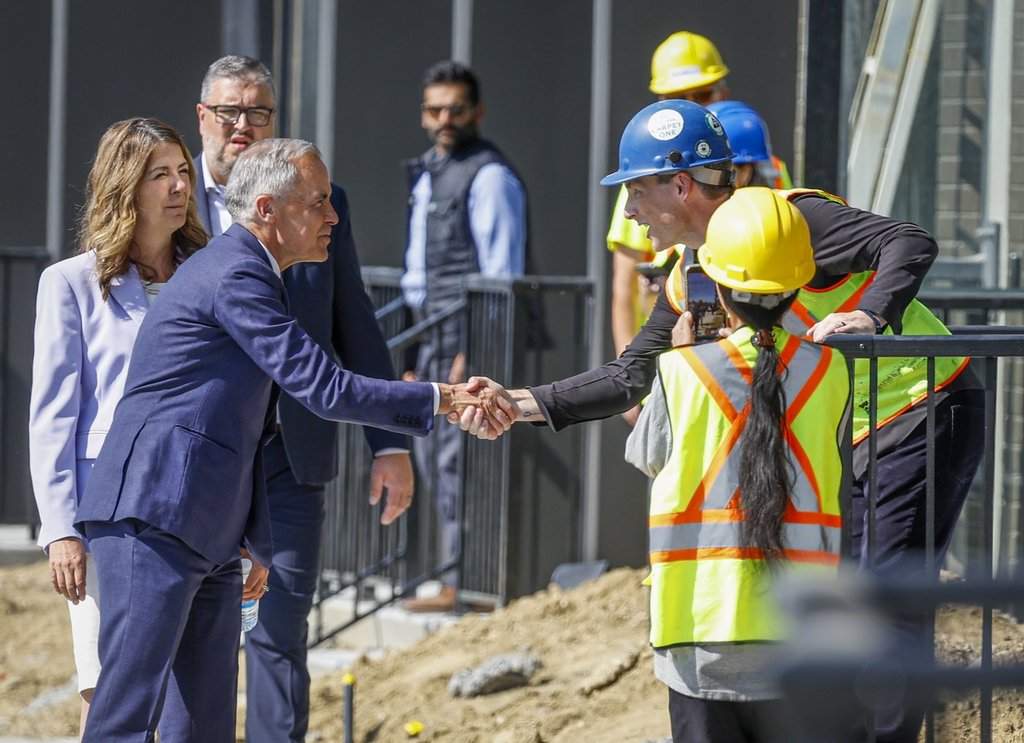
The ground beneath Alberta's booming cities hides a crisis that no amount of political ribbon-cutting can instantly solve. On Wednesday in Red Deer, Prime Minister Mark Carney and Alberta Premier Danielle Smith signed the Canada-Alberta Housing Infrastructure Fund Agreement, unlocking more than $510 million in federal funds over eight years alongside a provincial commitment of up to $428 million. The stated goal is simple on paper: finance the water, wastewater, stormwater, and solid waste networks required to get new homes built.
Yet, looking past the press releases reveals a much harder engineering and economic reality.
For the past five years, Alberta's population has surged by more than 600,000 residents. Municipalities have scrambled to expand boundaries, approve zonings, and clear bureaucratic backlogs, only to hit a hard physical wall. You cannot flush toilets or turn on kitchen taps in subdivisions that lack basic trunk lines and treatment plant capacity.
Premier Smith noted that builders can only construct homes when the infrastructure is already there. Underground pipes must precede drywall and shingles.
This federal-provincial pact attempts to address that lag by injecting a combined potential of nearly $938 million into municipal projects. At least $100 million of this envelope is earmarked specifically for rural and Indigenous communities, while initial project submissions carrying a minimum price tag of $25 million in federal contributions must cross the desk by November 30, 2026.
The mechanics sound promising, but execution is where previous infrastructure initiatives routinely stall.
The Math and the Municipal Burden
Let us examine the financial architecture of the agreement. Ottawa’s $510 million is spread across nearly a decade, translating to roughly $63.7 million annually for a province absorbing tens of thousands of new arrivals every single quarter. Alberta’s matching contribution requires municipalities to cover at least one-third of eligible costs.
For cash-strapped local governments already wrestling with inflated construction materials, high borrowing costs, and aging legacy systems, finding their matching share is no small feat. Municipalities do not possess bottomless vaults. When senior levels of government announce capital funding matched by local requirements, city councils often face agonizing choices. They must either reallocate budgets from existing maintenance programs or pass the burden down to local property taxpayers through steep municipal hikes.
Consider the scale of individual projects. Take the planned wastewater pipeline in Airdrie, cited by Prime Minister Carney as an essential catalyst designed to connect with Calgary's treatment system and unlock 45,000 homes. That single project carried a provincial cost estimate of $114 million back in 2025. When multiplied across dozens of growing towns and cities from Lethbridge to Grande Prairie, the combined $938 million pool will evaporate faster than municipal planners care to admit.
The Labor Bottleneck
Money sitting in a treasury account does not lay concrete.
The agreement claims it will support 750 skilled trades jobs every year, calling on engineers, pipefitters, electricians, and plumbers. That figure reveals a structural vulnerability. Western Canada is already experiencing a profound labor deficit across the construction and industrial mechanical sectors. Training programs take years to produce certified journeypersons, while projects compete directly with private commercial developments and heavy industrial expansions for the same pool of talent.
When every province across the country concurrently chases federal housing infrastructure money, a bidding war for labor begins. Contractors stretch thin. Timelines stretch out. Costs inflate beyond initial projections.
Municipalities are required to submit their remaining infrastructure project proposals by March 31, 2030. Given current engineering backlogs and supply chain friction for specialized valves, pumps, and large-diameter piping materials, keeping projects on schedule will require near-flawless bureaucratic coordination.
Who Wins and Who Waits
The strategic decision to hand Alberta the lead role in identifying and prioritizing projects introduces a different variable entirely. Regional needs vary wildly between the dense urban corridors of the Calgary-Edmonton mega-region and isolated northern municipalities.
While the $100 million rural and Indigenous carve-out attempts to spread the wealth, smaller communities frequently lack the internal engineering staff required to prepare complex grant applications that meet stringent federal and provincial auditing criteria. The risk remains that well-resourced cities will capture the lion's share of the early funding rounds simply because they have dedicated grant-writing departments ready to hit the ground running.
Meanwhile, housing starts depend entirely on whether these underground upgrades break ground before private capital pulls back from a cooling market. Real estate developers operate on tight debt schedules. If water treatment plant expansions or major trunk mains suffer two-year delays due to environmental assessments or supply chain holdups, master-planned communities sit frozen on drafting tables.
The ink on the Red Deer agreement is dry, but the heavy lifting has only just begun. Millions have been pledged, formulas have been drawn, and timelines have been set. Whether those numbers translate into actual water flowing to new front doors depends on navigating a labyrinth of municipal balance sheets, labor shortages, and hard engineering realities that checks from Ottawa cannot bypass.