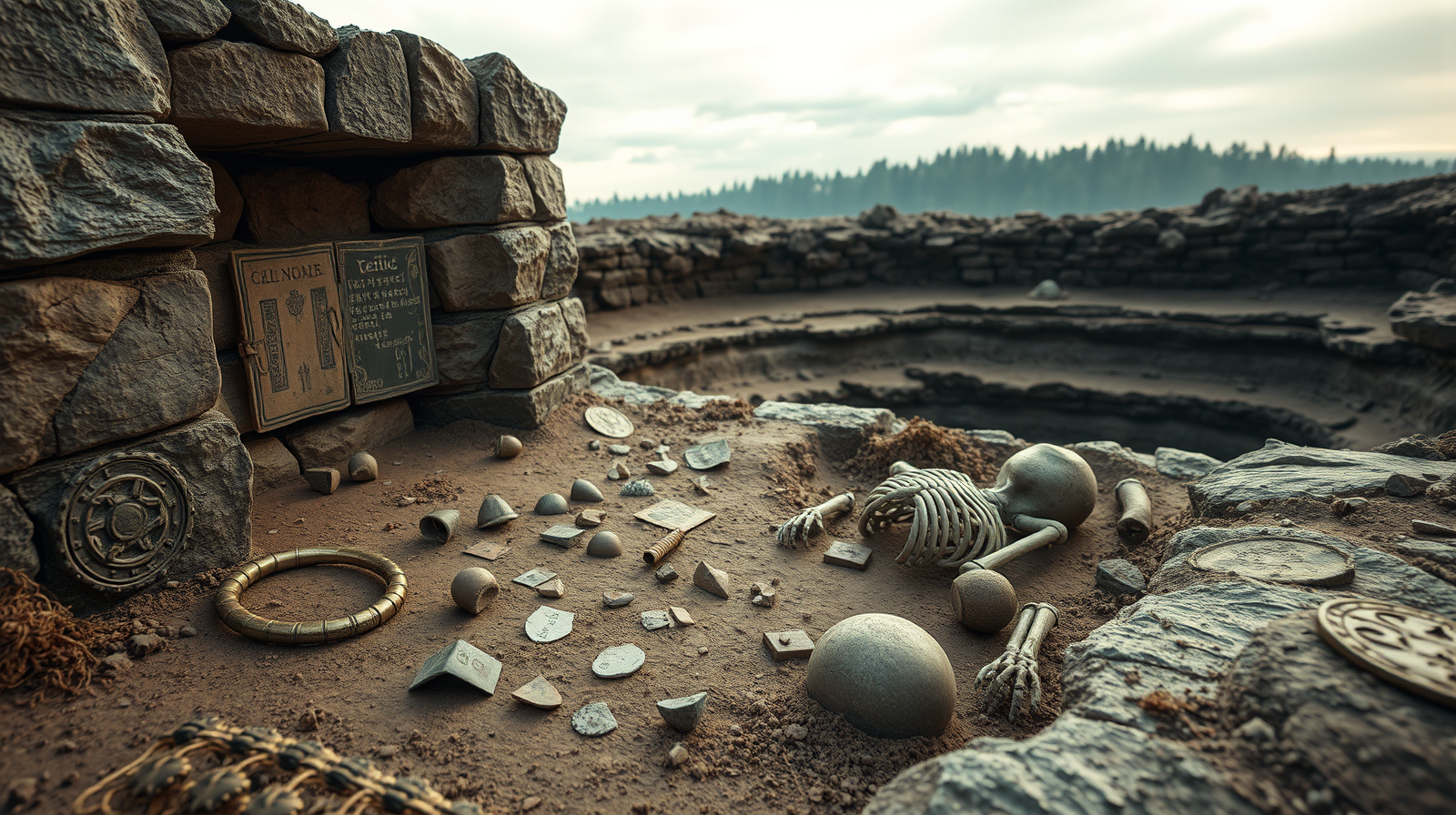
The earth in southwestern Germany does not give up its dead easily. For twenty-three centuries, the heavy, damp clay of the Danube region held onto a secret, pressing it flat under layers of agricultural silt and the relentless march of changing civilizations. Above this patch of ground, Rome rose and fell. Empires splintered. Wars tore through the landscape. Tractors dragged steel plows over the soil, missing the crown of a buried timber chamber by mere inches.
Then, a shovel struck wood.
When archaeologists brushed away the last damp clods of German soil recently, they found themselves staring into a pristine, undisturbed Celtic burial chamber dating back to roughly 300 BC. In the lexicon of modern archaeology, discovery usually comes with a caveat. Most tombs are found ransacked, emptied by grave robbers who broke through the ceilings centuries ago to strip the bones of anything that could be melted down. Not this one. This grave was an intact time capsule belonging to a man who possessed immense power in life—a Celtic prince whose final journey was prepared with an almost terrifying amount of luxury.
To stand at the edge of an open trench and look down at two-thousand-year-old gold is a jarring experience. It is not yellow like modern jewelry; it has a heavy, deep hue that seems to absorb the grey European light. The prince lay surrounded by it. There were intricate gold fibulae—heavy brooches used to fasten cloaks—and a massive gold neck torc, the ultimate symbol of elite status in the ancient Iron Age world.
But it wasn’t the gold that stopped the breath of the excavation team. It was the wagon.
Buried alongside the prince was a fully intact, four-wheeled wooden ceremonial chariot. Even the iron ironwork on the wheels remained resting in the exact position it had settled when the mourners walked out of the chamber and sealed the door. To understand the sheer scale of this wealth, consider a modern equivalent: this wasn't just burying a wealthy man with his wallet; it was burying him inside a bespoke, armored luxury vehicle, flanked by an arsenal of expertly forged weaponry.
Historically, we have a bad habit of looking at the Celts through a lens polished by their enemies. The Greeks and the Romans wrote the history books, and they painted the tribes of central Europe as bloodthirsty, chaotic barbarians who lived in squalor and fought naked in the woods. This discovery shatters that narrative completely. You do not build a timber-lined, subterranean vault capable of resisting the crushing weight of the earth for two millennia by accident. You do not forge iron-rimmed wheels that survive centuries without an advanced understanding of metallurgy and engineering.
What the German team uncovered was not the grave of a savage. It was the final resting place of a statesman, a warlord, and a member of a highly sophisticated, deeply connected European aristocracy.
Imagine the day this chamber was sealed. The air would have smelled of freshly felled oak, sweet resin, and the metallic tang of oiled iron weapons. The prince’s followers did not simply throw his possessions into a pit. They staged a precise, theatrical send-off. The four-wheeled wagon was rolled into place. The prince was laid out, dressed in his finest textiles, adorned with gold that gleamed in the torchlight. His swords and spears were arranged within arm’s reach, ensuring that whatever battles awaited him across the great threshold, he would not face them unarmed.
There is an incredible, almost painful intimacy in these details. Someone had to polish that gold neck ring one last time. Someone had to lift the heavy iron swords and place them just so. These were acts of profound grief and immense political theater, designed to project the enduring power of a dynasty even as its leader turned to dust.
The preservation of the organic material—the wood of the chamber and the chariot—is what makes this find a monumental victory for modern science. Wood rot usually claims these structures within a few generations. Here, a unique combination of waterlogged soil and dense clay created an airtight seal, starving the bacteria that cause decay. As a result, we are left with an unprecedented look at Iron Age carpentry. The joints of the chamber walls, the turning mechanisms of the chariot, the very grain of the trees cut down by Celtic axes twenty-three hundred years ago are all laid bare.
This discovery also changes our understanding of ancient trade routes. The gold, the craftsmanship of the weapons, and the style of the ceremonial wagon suggest a culture deeply plugged into a vast commercial network that stretched from the British Isles all the way to the Mediterranean. These people were not isolated forest dwellers. They were trading raw materials, furs, and amber for luxury goods, wine, and Mediterranean ideas. The prince was a globalist of his era.
The excavation continues under strict secrecy to protect the site from modern looters, a reminder that the greed that threatened this tomb in antiquity is still very much alive today. The artifacts are being systematically lifted, encased in protective blocks of earth, and transported to specialized laboratories where conservationists will spend years stabilizing the fragile wood and metal.
Eventually, these items will sit behind glass in a museum. Millions of people will walk past them, checking their phones, snapping photos of the gold, marveling abstractly at how old it all is. But the real power of the find lies in that muddy trench in southern Germany, where the distance between the past and the present briefly collapsed to zero. For a moment, the modern world vanished, leaving only the quiet, unbroken sleep of a king who was buried with everything he needed to conquer the dark.


