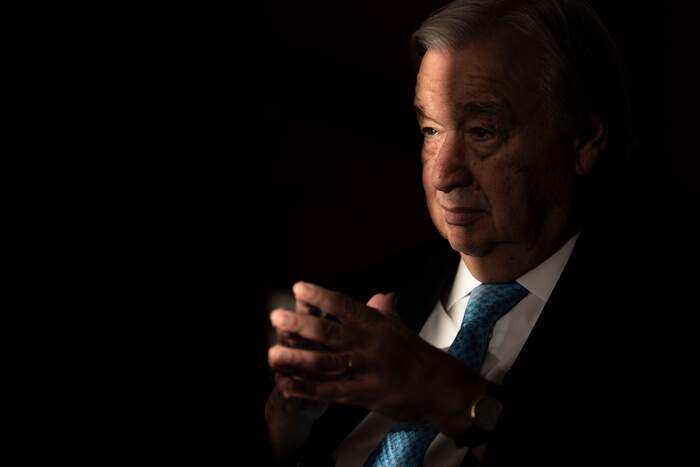
The departing United Nations Secretary-General is calling the current juncture a "moment of truth" in the global effort to curb warming, yet that familiar diplomatic alarm obscures a far starker reality. International climate diplomacy has not merely stalled; its foundational enforcement mechanism—voluntary national pledges paired with peer pressure—has collided with the hard physics of global energy demand and geopolitical fragmentation. While official communiqués frame the crisis as a test of political will, the actual bottleneck lies in broken capital allocation, unpriced carbon externalities, and a multilateral architecture designed for consensus rather than compliance.
Diplomats love a countdown. Every summit since the 1992 Rio Earth Summit has been billed as humanity’s last clear chance, a rhetorical habit that has steadily eroded public urgency while insulating leaders from measurable accountability. When a departing UN chief uses the phrase "moment of truth," it signals the end of a tenure rather than a shift in operational power. The Secretary-General holds the world’s loudest megaphone, yet commands zero legislative authority, zero taxation power, and zero ability to compel a sovereign state to leave coal, oil, or gas in the ground. For a closer look into this area, we recommend: this related article.
The Architecture of Voluntary Failure
To understand why emissions continue to climb despite decades of historic agreements, you have to look at the structural compromise baked into the 2015 Paris Agreement. Negotiators abandoned the top-down, legally binding emission caps of the 1997 Kyoto Protocol because major emitters refused to ratify treaties that constrained domestic growth. In their place, the world adopted Nationally Determined Contributions (NDCs)—a polite diplomatic term for self-assigned homework with no grading rubric and no penalty for failing.
The theory was elegant on paper. Countries would submit modest initial targets, build confidence, and ratchet up their ambition every five years under the glare of international scrutiny. In practice, the ratchet mechanism jammed. Domestic election cycles run on two-to-four-year clocks, while climate infrastructure requires twenty-to-thirty-year capital commitments. When energy prices spike or supply chains fracture, governments immediately prioritize short-term political survival over long-term atmospheric targets. For broader information on this development, in-depth coverage is available at Associated Press.
Consider how the accounting works. Under current UN frameworks, nations report territorial emissions—the carbon released within their physical borders. This creates an optical illusion of progress in wealthy post-industrial economies. A European or North American nation can shutter domestic heavy industry, import steel and cement from coal-powered factories overseas, and celebrate a steep drop in its national carbon inventory. The atmosphere, indifferent to customs borders, absorbs the exact same tonnage of greenhouse gases.
Follow the Capital, Not the Speeches
If you want to know where the global energy transition actually stands, ignore the plenary halls in New York or Geneva and look at global project finance. Renewable energy deployment has shattered records year after year, driven by steep declines in the levelized cost of solar photovoltaics and lithium-ion storage. In purely economic terms, clean electrons have won the argument in most power markets.
Yet fossil fuel demand has not collapsed; it has plateaued at historic highs. We are not experiencing an energy transition so much as an energy addition. Developing economies are expanding their power grids so rapidly that wind and solar installations, massive as they are, are merely absorbing new growth rather than displacing existing coal and gas fleets.
The financial plumbing of the global economy remains tilted toward incumbency. The world’s largest multilateral development banks, alongside private institutional investors, still treat clean energy projects in emerging markets as high-risk ventures. A solar farm in Sub-Saharan Africa or Southeast Asia faces borrowing costs two to three times higher than an identical project in Germany or Texas. Currency volatility, uncertain grid off-take agreements, and sovereign debt distress inflate the cost of capital to the point where clean infrastructure becomes unbankable without concessional public guarantees that wealthy nations routinely promise and rarely deliver in full.
The Geopolitics of Decarbonization
The era of cooperative globalization that birthed the Paris framework is dead. We now operate in a fractured multipolar system where clean technology is viewed less as a shared planetary public good and more as a strategic weapon in great-power competition.
Supply chains for critical minerals—lithium, cobalt, nickel, copper, and rare earth elements—have become the new chokepoints of global statecraft. Processing capacity is heavily concentrated, prompting Western capitals to erect tariffs, local-content rules, and industrial subsidies designed to reshore manufacturing. While these policies build domestic political support for green spending, they simultaneously raise the global price of decarbonization and slow deployment in nations that cannot afford billion-dollar industrial subsidies.
Security imperatives also override climate pledges the moment conflict erupts. When pipeline gas supplies were severed in Eastern Europe, governments that had spent years lecturing the world on fossil fuel phase-outs scrambled to build liquefied natural gas import terminals, restarted mothballed coal plants, and struck long-term supply deals with petrostates. National security always trumps atmospheric security when the lights threaten to go out.
Why Diplomatic Rhetoric Keeps Recycling the Same Script
Why, then, does the UN leadership continue to lean on apocalyptic framing if the underlying political machinery refuses to budge? Because moral suasion is the only tool left in the Secretariat's kit. The UN operates on the consensus rule, meaning nearly two hundred nations—from low-lying Pacific island states facing existential submersion to petrostates whose entire national budgets depend on hydrocarbon exports—must agree on the text of every final communiqué.
Consensus guarantees lowest-common-denominator outcomes. A single bloc can water down language calling for a "phase-out" of fossil fuels into an ambiguous "transition away" with loopholes for abatement technologies that do not yet exist at commercial scale. The resulting documents are masterpieces of constructive ambiguity, allowing every minister to fly home claiming victory while changing very little on the ground.
A departing Secretary-General naturally seeks to cement a legacy as a truth-teller unburdened by the need to win re-election. Calling the current moment a "moment of truth" is an accurate diagnosis of the geophysical reality—atmospheric concentrations of carbon dioxide are at levels unseen in millions of years, and thermal inertia guarantees decades of locked-in warming. However, framing this as a sudden moral crossroads misleads the public into thinking a single burst of diplomatic courage can fix a systemic engineering and economic problem.
The Hard Mechanics of What Actually Moves the Needle
Real progress happens when decarbonization shifts from an environmental charity project to an unavoidable industrial and trade standard. Three concrete mechanisms are already beginning to bypass the paralysis of UN summits, though each carries steep political friction.
First, carbon border adjustments are turning climate policy into trade policy. When major economic blocs place a tariff on carbon-intensive imports like steel, aluminum, cement, and fertilizers, exporting nations suddenly face a direct financial penalty for dirty manufacturing. A steelmaker in an exporting country will ignore a UN resolution, but it will rapidly overhaul its blast furnaces to avoid losing access to a major consumer market.
Second, grid modernization and permitting reform have become the decisive battlegrounds inside wealthy democracies. Thousands of gigawatts of wind, solar, and battery projects sit stuck in interconnection queues because high-voltage transmission lines take a decade or more to permit and build. Until governments treat electrical transmission with the same legal urgency as wartime infrastructure, clean generation capacity will remain stranded on paper.
Third, methane abatement offers the fastest near-term brake on warming. Unlike carbon dioxide, which lingers in the atmosphere for centuries, methane traps far more heat over a twenty-year window before breaking down. Plugging leaks across oil and gas pipelines, capping abandoned wells, and capturing landfill gas require off-the-shelf technology and minimal capital compared to overhauling entire power grids. Enforcing strict satellite-monitored methane standards yields immediate climatic returns without waiting for global consensus.
The Illusion of the Final Warning
History shows that major technological shifts rarely happen because leaders heed a moral warning. The world did not move from whale oil to kerosene because whales ran out or because activists shamed whalers; it shifted because petroleum was cheaper, brighter, and easier to scale.
The tragedy of the current climate stalemate is that clean energy technologies have largely reached that economic tipping point, yet institutional inertia, perverse subsidies, and fragmented trade policies keep the old system artificially afloat. Every year spent debating non-binding phrasing in conference halls widens the gap between physical reality and political theater. The planet does not negotiate with diplomatic communiqués, and physics does not grant extensions when a treaty misses its target.